Holiday reads, sayonara 2021

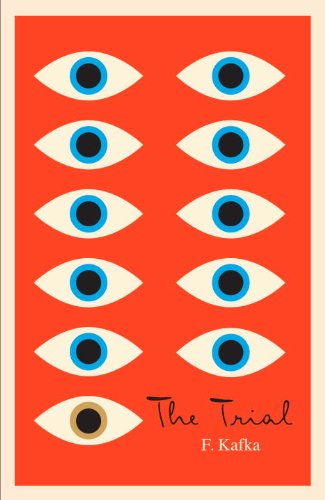
The Trial: A New Translation Based on the Restored Text (The Schocken Kafka  Library) - Kindle edition by Kafka, Franz, Breon Mitchell. Literature &  Fiction Kindle eBooks @ Amazon.com.

The last month of 2021 saw another review piece for FULL STOP, this time on the latest novel from the great Rikki Ducornet. I made some spicy remarks in this one (at least they might be), and they don’t have to do with Steely Dan trivia.
(source)

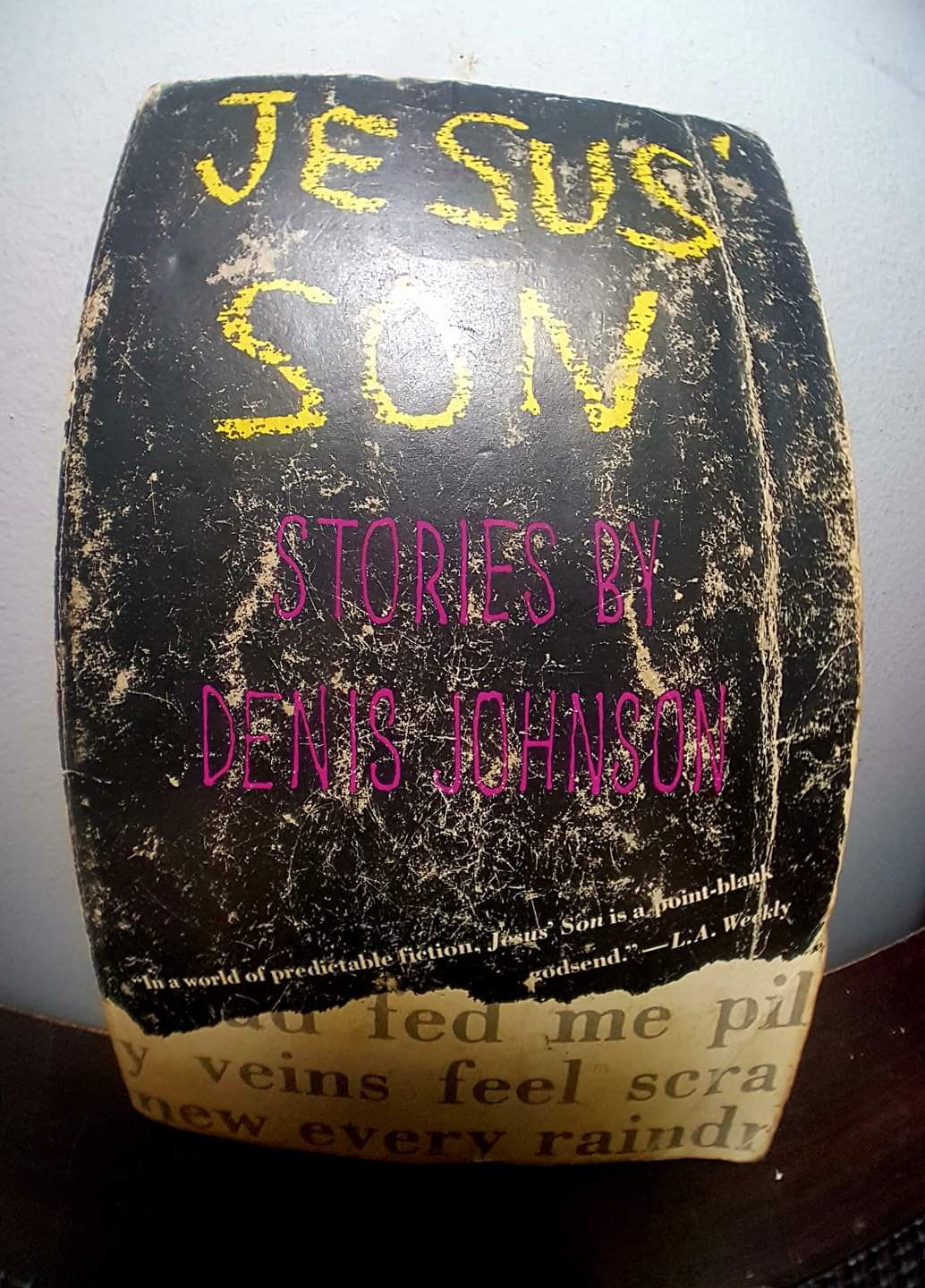
On my way back from one of the rallies for striking grad workers at Columbia, I picked up JESUS’ SON at a curbside book sale for four bucks. Denis Johnson was a great writer. TREE OF SMOKE was utterly engrossing (in a dark period), TRAIN DREAMS and SEAMAIDEN also excellent. But this collection from the 90s was an absolute knockout. The language is so clean and precise while still making all kinds of irregular choices in words and phrasing. When the speaker says he is a “whimpering dog inside” and nothing more, I felt it instantly. With Johnson there’s always this immediate connection so that you feel something for his cast of gentlemen losers. It brings to mind an image from Bruno Schulz of the writer and reader secretly holding hands under the table across which they face.

Every story in this cycle is a brief episode in the speaker’s drifting, dreg-filled life (the only name he goes by is Fuckhead). At the same time each story often breaks down into fragments that can read on their own like prose poems. Here’s one from “Emergency.”

Georgie and I had a terrific time driving around. For a while the day was clear and peaceful. It was one of the moments you stay in, to hell with all the troubles of before and after. The sky is blue and the dead are coming back. Later in the afternoon, with sad resignation, the county fair bares its breasts. A champion of the drug LSD, a very famous guru of the love generation, is being interviewed amid a TV crew off to the left of the poultry cages. His eyeballs look like he bought them in a joke shop. It doesn’t occur to me, as I pity this extraterrestrial, that in my life I’ve taken as much as he has.

#
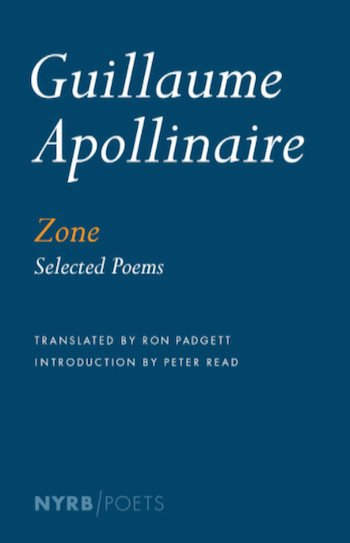
I couldn’t have asked for a better companion on a long plane ride than ZONE, a selection of Guillaume Apollinaire’s poetry translated by the great Ron Padgett. This book is the “fruit of [his] fifty-year engagement” with Apollinaire, and it’s hard to imagine a better fit between two poetic temperaments. Both are playful yet frank and unpretentious. Apollinaire’s lines are clear, even without punctuation, yet also have a capacity for avant-gardism that punches through every now and again, like in “Il pleut” and “The Little Car.” Padgett himself has a deadpan diction the majority of the time (BIG CABIN was a favorite read of last year) but he’s also written the most successful Oulipo text ever, in the form of a haiku that describes how a haiku works within the form of a haiku.

Many of Apollinaire’s poems are made of snatches of everyday conversation, and others are like stories or newspaper articles cut up into lines. And while they’re stuffed with references to mythology, religion, and ancient western literature, his poems are often funny. In “Annie,” the speaker sees a woman walking down a tree-lined road in Texas. This could be the easy occasion for some flaneur-like address to the eternal feminine, or to serendipitous encounters on the street; instead he finishes the poem like this:

Comme cette femme est mennoite
Ses rosiers et ses vêtements n’ont pas de bouttons
Il en manque deux à mon veston
La dame et moi suivons presque le même rite

(Since that woman is a mennonite
There are no buds or buttons on her clothes
Two of them are missing from my coat
The lady and I follow almost the same rite)

This project has become a new favorite book, and I speak as someone who thought he was over the romance of French bohemianism and all that early 20th century business. I was won over by how Apollinaire via Padgett can conjure that opium-addled atmosphere with such beautiful linguistic simplicity.

#
(source)

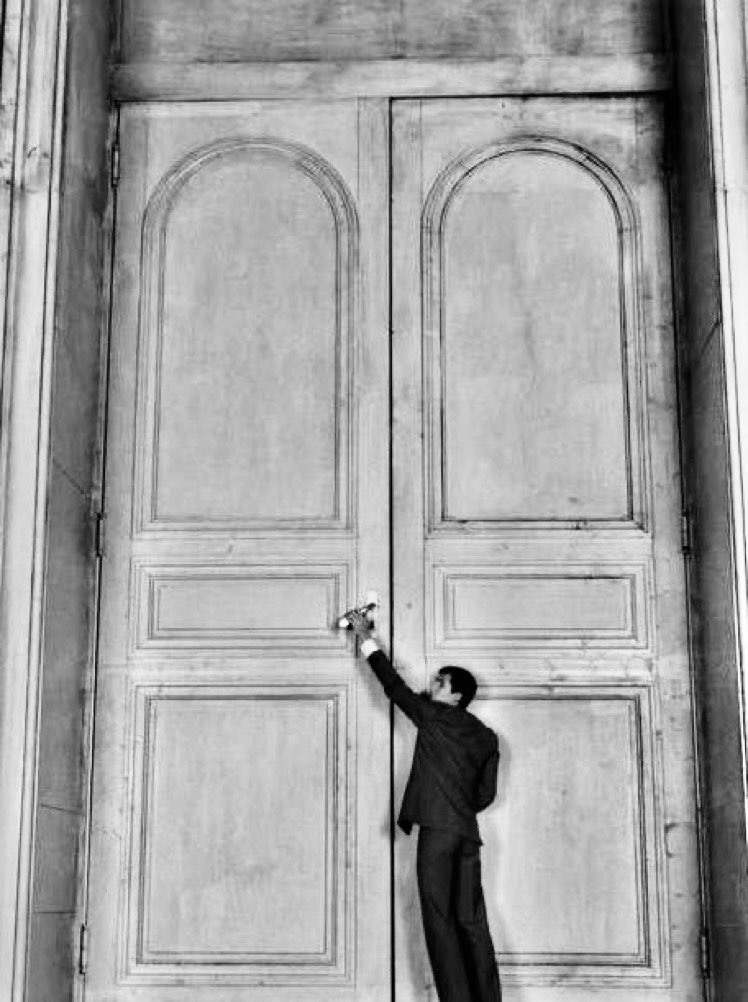
THE TRIAL by Kafka was ideal holiday reading. I may judge books by their covers after all. For a long time I avoided these new editions from Shocken Books because of their slick minimalist covers, whose bold colors and obvious eyeball iconography rubbed me the wrong way. I took them to be lazy and trendy reskins of facsimiles of older translations, similar to Vintage’s monochrome covers for Camus books. I was ignorant of Shocken’s publication history with Kafka in the 30s, in the context of a pro-Jewish cultural assertion against Nazism, and that in the case of THE TRIAL the new cover came with a new translation by Breon Mitchell, one that, according to his preface tries to preserve both the foregrounding of, one, legalese and other professional idioms that are woven in the text (for example, the opening line uses the word “slander” as opposed to the mundane “telling lies”); and two, the general rough character of Kafka’s prose, with its irregularly placed subordinate clauses and massive unbroken paragraphs. These aspects were eclipsed in the translation by the Miurs.

THE TRIAL opens with an absurd scene that from the beginning is presented in a theatrical way (and theatre jargon is used throughout the novel along with legal terms). Every dramatic beat is a comic reversal: K. rings for food, and his arresting officer enters the room, saying, “You rang?” When K., sitting in bed, explains that he wanted the landlady’s cook Anna to bring him breakfast, the stranger goes to the door, opens it a little, and calls into the next room, “He wants Anna to bring him breakfast,” and “a short burst of laughter” comes in response. Ever agitated, K. wonders if what’s happening to him is a joke by his coworkers for his 30th birthday, and worries he’ll come off bad for not taking a joke. He tries to cooperate by offering his papers, but the men in his home take this as an obnoxious play: “you’re behaving worse than a child. What is it you want? Do you think you can bring your whole damn trial to a quick conclusion by discussing your identity and arrest warrant with your guards? We’re lowly employees who can barely make our way through such documents, and whose only role in your affair is to stand guard over you ten hours a day and get paid for it.” But then when K. protests his innocence (to a charge that is never made explicit), they chide him for making a claim in ignorance of the Law. 

K. is in a game with no correct moves. Such is the atmosphere of dread and anxiety in Kafka’s fictive worlds. It is not a “totalitarian” or absolutist bureaucratic society that is the host of this arbitrary, inconsistent, pervasive and petty legal antagonist. It is in the Family structure where such oppression comes into play. The court of THE TRIAL uses the homes of its employees and defendants, in a series of running gags where furniture is being constantly shifted around the room, like stagehands preparing a scene for a play. But lest we get carried away with all this laying bare of the devices of fiction, the priest slash prison warden in the cathedral reminds us to respect the basic narrative integrity of the texts we consume. When K. imposes his reading of the parable of the Law and the door that climaxes this book, the priest critiques him with this remark: “You don’t have sufficient respect for the text and are changing the story.” This line could be addressed to all who say THE TRIAL is simply a dream, or an allegory, and not a story of an individual man, one who, for all intents and purposes, is real. And he really is guilty.

#
(source)

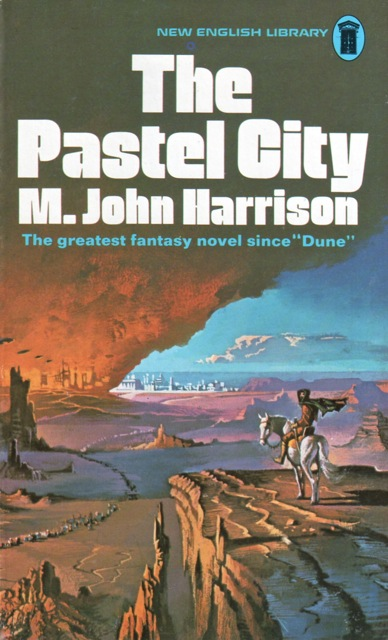
M. John Harrison wasn’t even on my map until 2020 when his latest novel, THE SUNKEN LAND BEGINS TO RISE AGAIN, took the Goldsmith Prize. It’s funny that I’d never heard his name in the same breath as Sturgeon or Le Guin, because he is another fantasy writer with excellent prose. Really, he is another great British master from the 70s I didn’t know about in my typical American ignorance.

PASTEL CITY is about and is another name for VIRICONIUM, a city/statelet in a world that has seen better days. This civilization sits atop layers of detritus from earlier, more advanced societies, so like pulp operas or like Wolfe’s BOOK OF THE NEW SUN, you get swords and sorcery in a landscape full of SF gadgetry.

We follow Lord Cromis, a warrior-poet who sets out to regroup the posse of knights called the Order of Methven, who defend the young Queen Jane, currently in a civil war for the throne of Viriconium with her half sister Canna Moidart. It’s like a western, only the landscape is one of rusted metal. And there are mechanical birds.

The “Lord of Birds” who created these cybernetic familiers resides in the tower of Cellur, an Orthanc-like obsidian structure in the marshes of Cladich. Harrison’s writing is like Le Guin’s in the sense that the quality of the prose isn’t flashy or ostentatious, but simply in the satisfying way in which the words “snap” together. The first book of the VIRICONIUM cycle is a straight ahead SF novel with all the proper western plot beats, but there’s still an extra layer of elegance in the phrasing and word choice. Here’s the description of Cellur in PASTEL CITY:

They reached the tower of Cellur in the evening of the second day. Cresting a ridge of pitted dolerite, they came upon the estuary of one of the unnamed rivers that ran from the mountains behind Cladich. Luminous in the fading light, the water spread itself before them like a sheet of metal. High black escarpments dropped sheer to its dark breaches; the cold wind made ephemeral, meaningless patterns on its surface.

Set in the shallows near the western bank was a small domed island, joined to the mainland by a causeway of crumbling stone blocks. It was barren but for a stand of white, dead pines.

Out of the pines, like a strong finger diminished by distance, rose the tower. It was five-faced, tapering: black. A tiny light shone near its summit, a glow that flickered, came and went. Birds wheeled about it, wailing mournfully, dipping to skim the water—fish eagles of a curious colour, with wings like cloaks in a gale. 

Now check out this romanticist, picturesque, more Tolkein-leaning description of the same locale 80 years later, that is also the opening paragraph of the sequel book A STORM OF WINGS:

In the dark tidal reaches of one of those unnamed rivers which spring from the mountains behind Cladich, a small domed island in the shallows before the sea, fallen masonry of a great age close faintly under the eye of an uncomfortable moon. A tower once stood here in the shadow of the estuarine cliffs, made too long ago for anyone to remember, in a way no one left can understand, from a single obsidian monolith fully two hundred feet in length. For ten thousand years wind and water scoured its southern face, finding no weakness; and at night a yellow light might be discerned in its topmost window, coming and going as if someone there passed before a flame.

Other reads from December: more Ashbery, early poetry by W.S. Merwin (some epic fantasy in its own right), and Tolkein’s THE FALL OF GONDOLIN for the LOTR Holidays of 2021.

Hell is no more people–topical reads in March

We live in a camp … Stanzas of final peace
Lie in the heart’s residuum … Amen.
But would it be amen, in choirs, if once
in total war we died and after death
Returned, unable to die again, fated
To endure thereafter every mortal wound,
Beyond a second death, as evil’s end?

Wallace Stevens, “Extracts From Addresses to the Academy of Fine Ideas”

Why yes, it was creepy to re-read THE PLAGUE by Camus while COVID-19 swept through Eurasia. But Camus’s novel is not a procedural drama; one notices what little interest the narration takes in the finer logistics of the quarantine, like where and how does the food and “serum” get shipped in. It leans toward the allegorical, and the main cast represent different philosophical stances toward the suffering and enclosure.

On re-reading I enjoyed the crackling dialogue. The sequence with Rambert the journalist attempting to break out of Oran under quarantine early in the novel plays out in public meetings where characters and authority figures keep crossing paths and bumping into each other. It could be staged like a play, and it emphasizes the lack of privacy.

Spoilers. The unknown narrator reveals himself in the end to be the doctor Rieux. Not that it was a difficult guess; he is the first character introduced after the descriptions of Oran during normal times, with its citizens living their lives in the way the existentialists lovingly called stupid humanism.

Why have the Doctor the narrator of the book at all? As a character he’s even tempered and stoic, noncommittal in his conjectures, almost like Jacques the Fatalist, really. His judgements come out more so in his record of events:

In this respect our townsfolk were like everybody else, wrapped up in themselves; in other words they were humanists: they disbelieved in pestilences. A pestilence isn’t a thing made to man’s measure; therefore we tell ourselves that pestilence is a mere bogy of the mind, a bad dream that will pass away. But it doesn’t always pass away and, from one bad dream to another, it is men who pass away, and the humanists first of all, because they haven’t taken their precautions. Our townsfolk were not more to blame than others; they forgot to be modest, that was all, and thought that everything still was possible for them; which presupposed that pestilences were impossible. They went on doing business, arranged for journeys, and formed views. How should they have given a thought to anything like plague, which rules out any future, cancels journeys, silences the exchange of views. They fancied themselves free, and no one will ever be free so long as there are pestilences.

The first person does make the middle section more impactful with its switch to the collective “We” pronoun. You could argue that the narrative’s ultimately affirming stance is based on how the story is commemorated by a witness.

Between Rieux’s stoic resistance to the absurdity of the plague and the repentant Communist Tarrou’s belief that humankind is at bottom good, or at least “better than they seem,” and that it’s a matter of comprehending people in all their aspects and reaching understanding, is Camus’s ideal way to exist. They’re the two ethical saints of the narrative, with Tarrou meeting his end as a martyr to the plague. Rieux is the confessor.

The book is so well paced; not a single part of it drags. The wave of dead and dying rats that wells up into the town is described in the creepiest ways.

I had thought that THE FIRST MAN, his unfinished autofiction was my favorite work mainly for its style. But the architecture of PLAGUE is something to behold. I’ll always admire Camus for his style above all else, certainly over his philosophy and politics. The argumentative skeleton of THE REBEL is not so great, let’s be honest. And the heroic non-committal stance of the absurdist, this absolute refusal of absolutism, didn’t look so great when it came to the question of Algerian liberation and independence. The instincts he did have was for representation, for literary flair and flow. When I think of “Myth of Sisyphus” I don’t give “One must imagine Sisyphus happy” much weight. No, what I will always remember is his description of Sisyphus’s plight itself, plied out in sensuous detail.

As for this myth, one sees merely the whole effort of a body straining to raise the huge stone, to roll it, and push it up a slope a hundred times over; one sees the face screwed up, the cheek tight against the stone, the shoulder bracing the clay-covered mass, the foot wedging it, the fresh start with arms outstretched, the wholly human security of two earthclotted hands. At the very end of his long effort measured by skyless space and time without depth,the purpose is achieved. Then Sisyphus watches the stone rush down in a few moments toward that lower world whence he will have to push it up again toward the summit. He goes back down to the plain.

#

I’m sure I don’t know.

The pandemic status of the coronavirus crisis renewed interest in Soderbergh’s 2011 movie CONTAGION. This is much more of a procedural, naturalistically acted, and terrifying for all of its plausibility.

That is decisively not the experience with NIGHT OF CAMP DAVID. This 1965 political thriller by Fletcher Knebel shares in the Cold War anxieties of privacy and authoritarianism. The madness of the POTUS is signaled by his grand wiretapping scheme. (The Nero Wolfe novel THE DOORBELL RANG is similar in this regard.)

With the US ruling class about to replace one doddering old fool with another in the presidency, it may also be a good time to reflect on presidents who lost their touch while serving in US history, from Reagan and Johnson. And in fiction, as the marketing at Vintage hoped, we can read about Mark Hollenbach, whose paranoia, unfortunate outbursts, and delusional ambitions of a new world order triggers an investigation by senator Jim McVeigh who then tries to round up a posse to pull a civilian coup.

The scenario is not exaggerated in order to keep it plausible, but it only makes the suspenseful parts underwhelming. The male characters are so boring and their dialog, while crisp, is full of boys club ribaldry. The two women, the protagonist’s wife and lover, are patchworks of cliches of course. Rather everyone just stay focused and talk about work!

The plot sadly drags on in the early moments; elements are set up and left hanging till the final four chapters where everything culminates, dissolves and re-culminates thanks to these elements swooping right in time. But that means there’s a lot of backfill through investigations while we wait. And the material is drab, in keeping with the grounded realism.

The actual historical mad kings of America were much more vivid in their madness than what Fletcher paints here.

#

For something different, the delightful “Tale of Ivan the Fool” by Tolstoy. Apparently Thomas Mann adored this story.

The petty-bourgeois work ethic of the Russian peasantry is on display here. No need to worry about the hard work that needs to be done; enchantment helps you out. Devils and imps are not so profoundly evil here; their tricks bring to mind the line in Wallace Stevens that “good is evil’s last invention.” Ivan is a fool because he does nothing for himself. His sister Martha is also a fool but only in the way that she’s mute (but why?). Yet by doing nothing Ivan eventually ends up the tzar of his own kingdom.

For the modern urban petty bourgeoisie currently self-isolating in their rooms, as I currently am at the time of writing, we can consider ourselves our own foolish lords.

Pynchon is surrealist in travel

GRAVITY’S RAINBOW
Thomas Pynchon
Penguin 2000

Toward the end of the 1924 First Manifesto, Breton distinguishes between “absolute surrealists,” like himself and his colleagues like Aragon, and artists outside of or predating the surrealist camp but who nevertheless may be surrealist in a certain area. So Jonathan Swift is a “surrealist in malice,” and the Marquis de Sade is a “surrealist in sadism,” which seems odd. Baudelaire was a surrealist in morality, and apparently Sartre (Breton must have said it elsewhere) was a surrealist in quietude.

I offer a reading of Pynchon as a surrealist in travel writing. Sometimes his landscapes are products of deep research, and other times they are 100% phantasy, like the plastic candyland version of hell that he throws two characters in for no reason that I’ve comprehended.

Part 3, “In the Zone,” is visibly the bulkiest. Weisenburger’s companion tells us that it’s as if this part has drawn in, accumulated, assimilated more episodes than all the rest, 32 in all. The Zone, postwar Germany, where all regulating forces have been suspended, is a “center of gravity,” pulling on the cast and the narrative material (things fall at 32 feet per second per second). There are several plotlines creating near misses: Slothrop’s quest for self-knowledge and rocket 00000, chased by a crazed American Major; the Soviet agent Tchitcherine’s mission to find and liquidate his half brother Enzian, leading one faction of the split Shwarzkommando; a quick heist to extract a bag of hashish out of the Potsdam conference; episodes on an aristocratic yacht party; and the story of Pokler, enlisted by Blicero (the kinky SS officer who also goes by Weissmann, whose brainchild is rockets 00000 and 00001 with the black device inside each), which is played totally straight, and makes a core of pathos for the whole book.

I shouldn’t offer yet another impossible summary. My own takeaway is that GR in one sense has the 50s 60s and 70s imaginatively superimposed on the 20s 30s and 40s, two overlapping chronotopes. (Which is bewildering in Pynchon but can also be sober and poignant, like in David Albahari’s novels.) Thinking about America, or the idea of America in 1973, what would it mean to revisit Europe and the second world war so fabulously? We have to follow baby-faced young American Slothrop back to the old world…into death.

Here’s a less lazy thought: GRAVITY’S RAINBOW is very similar to Goethe’s FAUST, especially part 2. I mean they share the same basis for many complaints of overstuffing the narrative to the point of boredom. The Zone functions like the “classical walpurgisnacht,” a center of gravity drawing out gods, mythical creatures, soul-bearing angels, all the entities through all the ages. They both allow their heroes to escape capture through cartoonish switcheroo gags. I vacillate between finding GR very very hard to recommend to people, and touting it as -the- literary work of the modern epic.

But as to being a surrealist in travel.

Light pulses behind the clouds. Tchitcherine tracks mud off the street into the Center, gets a blush from Luba, a kind of kowtow and mopflourish from the comical Chinese swamper Chu Piang, unreadable stares from an early pupil or two. The traveling “native” schoolteacher Dzayp Qulan looks up from a clutter of pastel survey maps, black theodolites, bootlaces, tractor gaskets, plugs, greasy tierod ends, steel map-cases, 7.62 mm rounds, crumbs and chunks of lepeshka, about to ask for a cigarette which is already out of Tchitcherine’s pocket and on route. […]

Here [Luba] has become a connoisseuse of silences. The great silences of Seven Rivers have not yet been alphabetized, and perhaps never will be. They are apt at any time to come into a room, into a heart, returning to chalk and paper the sensible Soviet alternatives brought out here by the Likbez agents. They are silences NTA cannot fill, cannot liquidate, immense and frightening as the elements in this bear’s corner—scaled to a larger Earth, a planet wilder and more distant from the sun…. The winds, the city snows and heat waves of Galina’s childhood were never so vast, so pitiless. Se had to come out here to learn what an earthquake felt like, and how to wait out a sandstorm. What would it be like to go back now, back to a city? […]

Out into the bones of the backlands ride Tchitcherine and his faithful Kirghiz companion Dzaqyp Qulan. Tchitcherine’s horse is a version of himself—an appaloosa from the United States named Snake. Snake used to be some kind of remittance horse. Year before last he was in Saudi Arabia, being sent a check each month by a zany (or, if you enjoy paranoid systems, a horribly rational) Midland, Texas oil man to stay off the U.S. rodeo circuits, where in those days the famous bucking bronco Midnight was flinging young men right and left into the sun-beat fences. […]

They’re riding away from the railroad: farther away from the kinder zones of Earth. Black and white stars explode down the appaloosa’s croup and haunch. At the center of each of these novae is a stark circle of vacuum, of no color, into which midday Kirghiz at the roadsides have taken looks, and grinned away with a turn of the head to the horizon behind.

Amongst all the backfilling details, the noun clauses, and these other crufty elements, the figures of Tchitcherine and Qulan riding horseback in central Asia stand out. I enjoyed these moments the most, the voice working like in a Robert Howard pulp story; he gives the impression that these landscapes, “zany” as they are, can be inhabited and deeply understood. The moments are like Weird Tales but also simply tall tales, stories and rumors about Tchitcherine and his ward that the narrator has gathered.

And it’s these situations that have stayed in my memory, against the more esoteric material. (I finished the whole thing in the last week of April.)

Early in this part is a long stretch of backfill on the Shwarzkommando and the history of the Herero people in southern Africa under colonization.

A generation earlier, the declining number of live Herero births was a topic of medical interest throughout southern Africa. The whites looked on as anxiously as they would have at an outbreak of rinderpest among the cattle. How provoking, to watch one’s subject population dwindling like this, year after year. What’s a colony without its dusky natives? Where’s the fun if they’re all going to die off? Just a big hunk of desert, no more maids, no field-hands, no laborers for the construction or the mining—wait, wait a minute there, yes it’s Karl Marx, that sly old racist skipping away with his teeth together and his eyebrows up trying to make believe it’s nothing but Cheap Labor and Overseas Markets…. Oh no. Colonies are much, much more. Colonies are the outhouses of the European soul, where a fellow can let his pants down and relax, enjoy the smell of his own shit. Where he can fall on his slender prey roaring as loud as he feels like, and guzzle her blood with open joy. Eh? Where he can just wallow and rut and let himself go in a softness, a receptive darkness of limbs, of hair as woolly as the hair on his own forbidden genitals. Where the poppy, and cannabis and coca grow full and green, and not to the colors and style of death, as do ergot and agaric, the blight and fungus native to Europe. Christian Europe was always death, Karl, death and repression. Out and down in the colonies, life can be indulged, life and sensuality in all its forms, with no harm done to the Metropolis, nothing to soil those cathedrals, white marble statues, noble thoughts…. No word ever gets back. The silences down here are vast enough to absorb all behavior, no matter how dirty, how animal it gets….

(Now I see where David Foster Wallace got so much of his haughtiness.)

Is it just because of the rejection of Marx that passages like this one strike me as the most postmodern, ideologically? The narrator clearly prefers the chapter in Brown’s LIFE AGAINST DEATH on excrement over the closing chapters of CAPITAL volume 1 on primitive accumulation. He prefers the language of desire over that of political economy (“Christian Europe was always death and repression”). The latter merely explains while the former describes, maybe endlessly. Overall, it’s a move from class politics to instrumental rationality as a way to take stock of capitalism in its imperialist stage. And would Pynchon or the narrator prefer the colonial products, the opium, weed and coke, over the European fungal component of LSD?

You’ll notice how evasive I’ve been about the shwarzkommando, a black battalion for national socialism. I can’t explain, but can describe Pynchon’s reading of German ethnographic monographs on Herero organization and political struggle, including the use of suicide, worked into the novel as a line struggle over the question of the V-2 rocket. He wrote in a letter:

But I feel personally that the number done on the Herero head by the Germans is the same number done on the American Indian head by our own colonists and what is now being done on the Buddhist head in Vietnam by the Christianity minority in Saigon and their advisors: the imposition of a culture valuing analysis and differentiation on a culture that valued unity and integration.

I take his point that cheap labor and overseas market as explanatory phrases doesn’t do justice to the irreducible sensuous manifold of elephantine proportions that is the Pynchon Novel. It’s just that the words of the skipping Marx are not simply reductions (or else Marxism isn’t anything). And GR’s sprawling plurality can itself be an inverted reduction, into a new universalized stew, as homologous as it is eclectic.


GRAVITY’S RAINBOW

  1. Oh, banana!
  2. Anal explosive
  3. Pynchon is surrealist in travel
  4. I may have lost the plot