Hard hitters in September

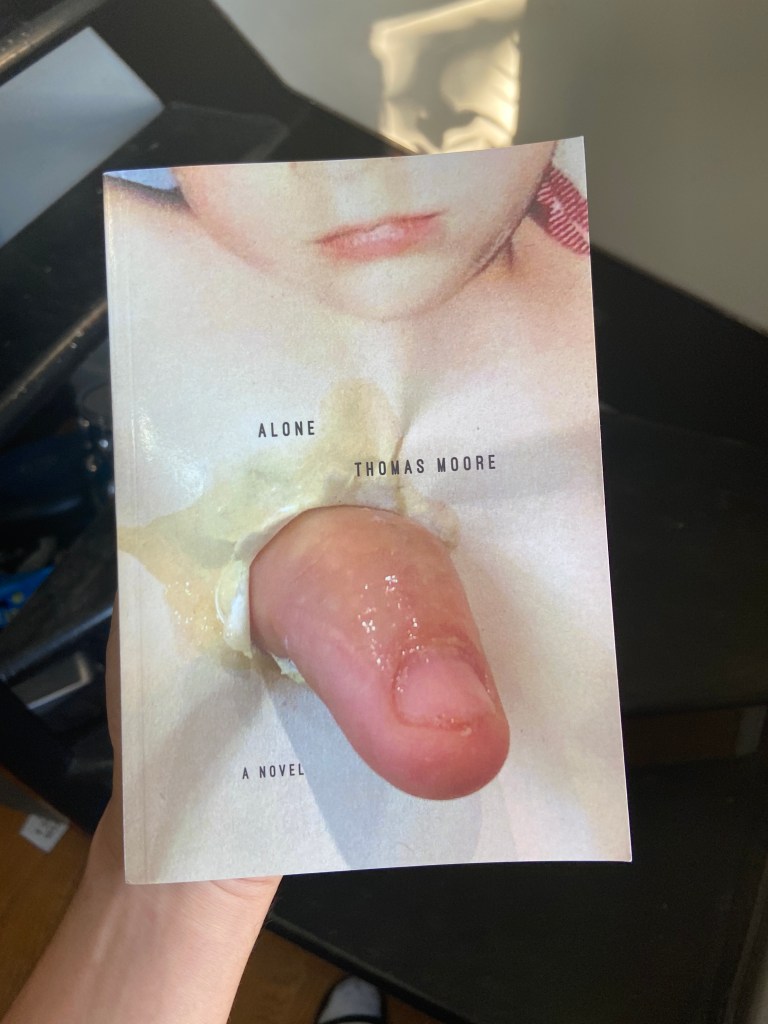
ALONE: A NOVEL by Thomas Moore, Amphetamine Sulphate 2020

I feel like I was hardwired for abandonment. It’s not as tragic as it might sound. If a person understands things about themselves and can be honest with themselves about it, then a lot of life’s pain is much more easily dealt with–pain, no matter how people try to fool themselves, or no matter how other people try and fool them–is never going to leave. The idea of happiness as a goal rather than a transitional state is a dangerous and much more damaging notion for a person to carry around than just knowing that each and everyone is fucked in some way or other. If you can admit that, then at least you’re able to recognise when you’re outside of the worst of it, those moments when you’re able to dance amidst the ashes.

What hit me repeatedly with this breathtaking short book by Thomas Moore is its agonizing clarity. These thoughts are so raw, so painful, and perfectly formulated.

The type is set so that there are hardly more than ten syllables per line of text–like a poem, practically. The rhythm is pounding in a fantastic way. I read this in one day.

There is no belief in love or lasting happiness; this is beyond cynicism about love (“I’ve never seen a relationship that I have envied”), but pessimism (Schopenhauer, also Nietzsche and Bataille) that is so present in this trend of gay literature:

I sometimes feel like I really hate language. As in I detest it. Language is a lie that we are all guilty of and have told so many times that most of the time we either believe it or are too tired to be able to fight off–I think it’s the latter.

As the narrator points out, “It’s drilled into people’s beliefs that they need to be with someone It’s the goal in children’s fairy tales, it’s encouraged by the state, it’s portrayed as the norm in the arts in the majority of places that you look.” So here is one place to talk about being alone, powerless, and suicidal, without fear. Loved it.
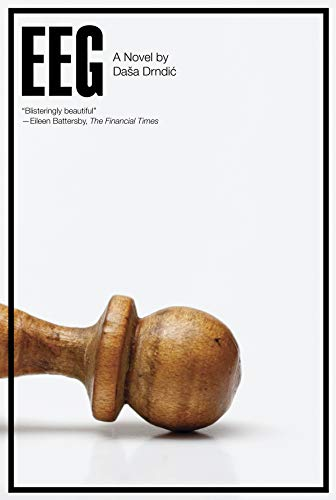
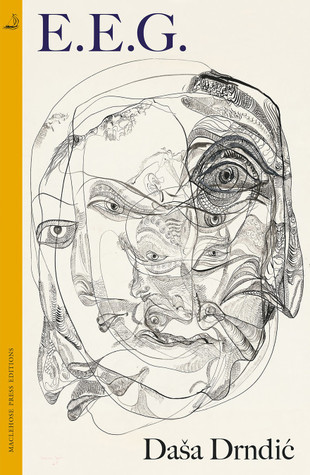
EEG by Daša Drndić, tr. Celia Hawkensworth, New Directions 2019

Ok, the comparisons between Drndić and Bolaño made regarding this novel are apt, I must say. In fact, EEG read to me as a conscious fusion of Bolaño and Sebald–a sure winner for international publishing. While I wasn’t blown away enough to want to check out the prequel to this work or the rest of the late Drndić’s corpus right away, this is definitely a vibe: B’s political nihilism, dread and despair; plus S’s generous inclusion of multiple individual narratives (though here coming through a prickly first person narrator).

It begins with a failed suicide on the surface, and it also launches this recurring image of congealing and concentration, of the horrific history of 20th century central Europe (one of its many long-standing conflicts suddenly and violently erupting at the end of September) into something formless.

I moved away to study small dead things, to observe close-up dead things that refuse to die. Arranged in impenetrable cages of milky glass, seen from outside, those dead things appear like quivering figures, opaque and inaudible. So, on my short journeys, I observed those huge cages, approached them, tapped on them, placed my hand on them to summon those imprisoned within, in case they came close to me, so I could speak to them through that thick milky-white glass, tell them I knew them, those imprisoned people, that I remembered their stories, that I was guarding their lives, but they just danced blissfully, disembodied in the silent vacuum. I remained invisible to them, external.

The book is a loosely structured album of these “short journeys” through Europe, documenting historical crimes at the ground level. It’s a grim diary of classical fascism. Genocide, racism, anti-Semitism, small national chauvinisms, as well as an angst over globalization. It is a petty-bourgeois intellectual’s cry against authority as such, against the philistinism of the middle classes.

Like Sebald, there is a ton of historical reporting that reads as non-fiction, as well as some photographs and a huge spreadsheet. The major highlight for me is the long passage on chess grandmasters who had all gone mad, which had a wonderful Lovecraftian feel.
What strikes me about this novel now is that the narrator, by piecing the story together this way for us, is committed, perhaps in a cynical or resigned way, to the Hegelian and even Marxist-Leninist idea of the absolute truth as a compound of many relative truths (the many stories of victims of multiple Nazi holocausts and national wars). The anti-fascist left in academia here in West, seems to me, would be more eager to reject Hegel and the dialectic out of hand as totalitarian or, more fashionable these days, a will to transparency.  Not that EEG is a totality, even in the conscious design of its form, but it reads like an articulated attempt, out of a generosity to the victims of fascims and imperialism. The contemporary middle European writers, like Dubravka Ugrešić and Gaspodinov, just have a refreshing and infinitely nuanced view of this subject matter. These kinds of experiences, the collectively endured trauma, makes history seem to hang over everything, and it weighs heavy. 

…the previous century and this one had coalesced, adhered in a squashy mass, which, like a half-dead, distended wild beast, at times powerful, at times in a state of decay, wafts around itself the stench of death and madness.
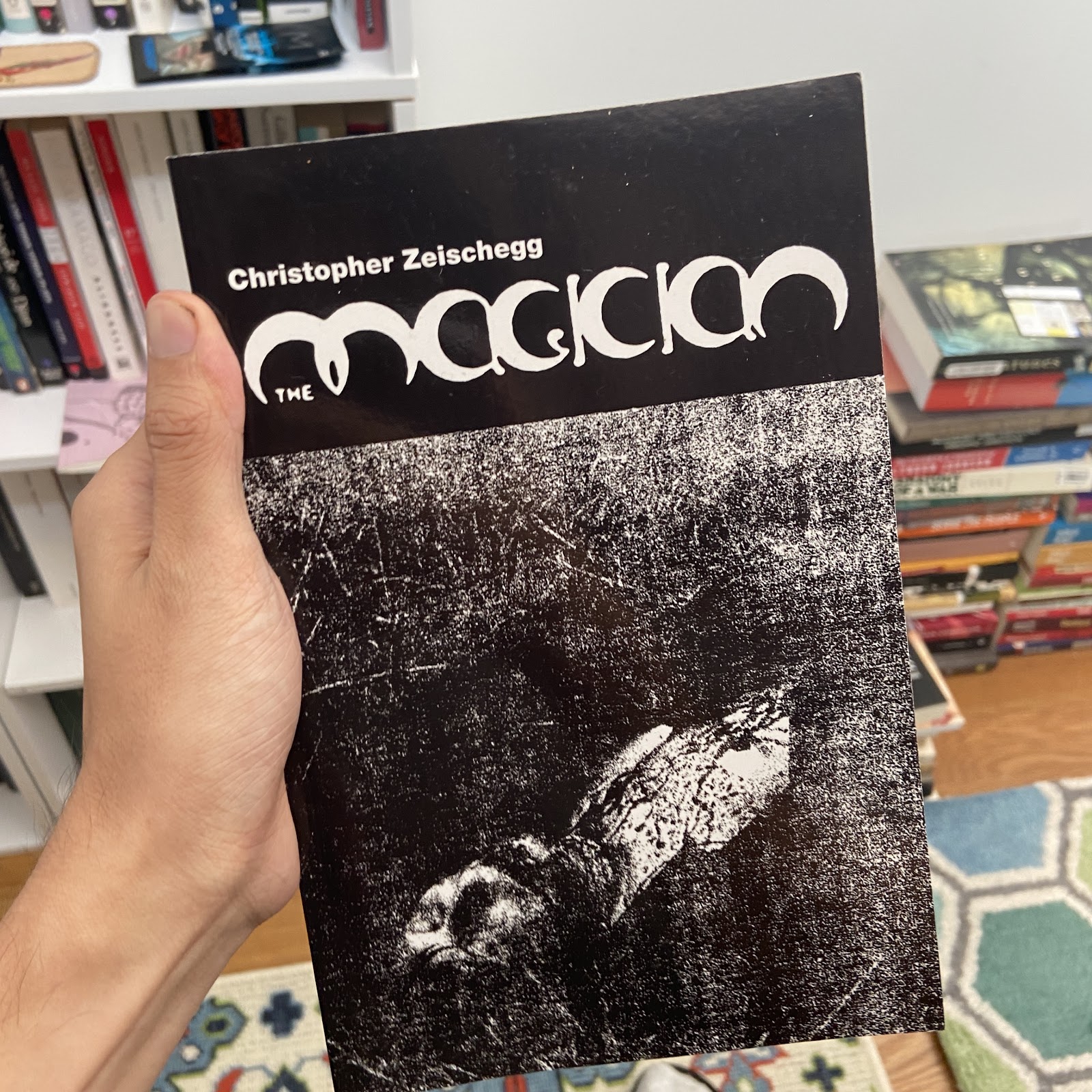
THE MAGICIAN by Christopher Zeischegg, Amphetamine Sulphate 2020

The best American novel of 2020 may be this beautiful and thrilling piece of transgressive literature from Zeischegg. I want to order everything else he’s written. THE MAGICIAN is a multimedia project with an awesome crescent-based logo (kind of like the one for DUNE), including a film—and to think that some of the events in this story will be staged is mind-shattering. The first 100 pages are raw and brutal, like 21st century Marquis de Sade. There’s a sequence that I can’t think of anything to compare with other than A SERBIAN FILM, except of course this is a prose novel so it goes directly into the mind. Then the supernatural elements and surrealism build up, layer by layer. There’s quietude and dread, adn a rhythmic prose that just rips you through the narrative. “I’d run out of small distractions. There was only the sound of crickets and whatever my body conjured up.” I’m going to be vague here. But the slogan I gave my IG post was that this experience is like an LA noir on benzos, unsparing yet deeply sensitive. The ending is devastating, and not in the way I was expecting.

Some jottings on Don César

THE LITTLE BUDDHIST MONK / THE PROOF
César Aira, tr. Nick Caistor
New Directions, 2017

Exhaustion. In his interviews, Aira seems to take seriously an idea from Ortega y Gasset, that literature is like a mountain, and its practitioners are mining it. Which makes literary art a finite resource that can be exhausted. And that’s why his books are so lean, not just because he likes to be elegant, or respect his readers’ time, or that his Louis Aragon or dada-like fantastic narratives are hard to sustain for long, but simply that this mode of production is on its way out.

It’s edgy to elegize for the novel, but believing or pretending to believe that art is dead is the right position to be in for creating. And besides, it had a beginning; surely it has an end. Literature could have died in its sleep a generation ago, and  now carries on in an afterlife, much like liberalism.

Infantile disorder. The tonal whiplash and narrative switchbacks in Aira’s work remind me of the way kids tell stories, a storytelling that’s hardcore diachronic: and then, and then, and then. Just as it’s said somewhere that Picasso once visited an exhibit of art by children, and remarked that it took him years to learn how to draw like that. This return to a more naive space is in keeping with surrealism (between automatic writing and OuLiPo’s input-based creation) as well as Utopian SF or fantasy (Olaf Stapledon).

The commitment to high modernism remains, but there’s no more desire for grand, solemn mega novels that strain to capture the totality of bourgeois or monopoly capitalism. The Joyces and Musils and Prousts and Manns that amount to secular religions.

Absolute Formalism. Aira’s books are so overwhelmingly about themselves, about their own aboutness in the way the formalists wanted them to be. Their content is a projection of their form, of the elements selected to build the story. It’s most obvious in VARAMO, while MIRACLE CURES OF DR. AIRA presents a mystified version of the creative process. As with Kafka, there’s a risk of turning his stories back to realism by reading them as social parables. On the other hand, the weirdness of Aira’s books, as I read them, are about renewing our own perceptions of literary theory.

Which is why I felt that THE LITERARY CONFERENCE is a jab or at least an elbow nudge against Carlos Fuentes. The giant blue silkworms that lumber down the hills and attack the city, are they not like that writer’s mega novels and others like his? The threat is overcome by the narrator’s device that was a prop for one of his plays — a retreat or regression to fairy tale logic. (Fuentes giving the Nobel to Aira in one his stories is no less of a backhanded compliment.)

How to apply the word novel vs. novella is really inconsistent these days. Novellas were more easily distinguishable in the 19th century institution of the triple-decker novel that allowed library systems to loan out the same work to three people. But now most novels aren’t that long, besides the few middle-brow prestige pieces that come out in the US each year. Novels can be any length these days, and Aira’s output then addresses, not formalism, but the redefining of the novel form itself. Perhaps they aren’t novels at all.

Revolutionary break. I’ve never totally loved an Aira book right away, except for EPISODE IN THE LIFE OF A LANDSCAPE PAINTER and HOW I BECAME A NUN. Other than those two, I finish them thinking it’s second-tier Aira and wait for them to grow on me over the weeks till I know it’s a new favorite. THE PROOF’s own narrative switchback into a genre of surreal ultra-violence has tyrannical reign over both that story and the whole book. But that’s also appropriate.

Two young women named Mao and Lenin hold up a supermarket in the name of love, as the Love Brigade. It’s amusing to read this under Cold War liberal programming: revolutionary situations as a terroristic surge led by hopeless Utopian romantics. But then again, was Marxism not a product of Romanticism, if only as a rebellion against it? Forget thesis-antithesis-synthesis. Real dialectics means appearance-reality-appearance again.

Aira never respects the reality principle, but even then the very end of THE PROOF goes beyond unreal. As the store catches fire, we read about one woman whose body melts until she’s like a Modigliani painting on crack. It appears this mundane “revolutionary” act (all the world’s a supermarket in globalization) has torn the fabric of reality apart and anything is possible, is aesthetically legitimate.

Which is why Aira’s work I think speaks so earnestly to our historical moment. It’s a different tack from Roberto Bolaño, who usually stays close to realism in order to show us why such a commitment is no longer truly possible. The liberal consensus in the last couple of decades has become more authoritarian as per the needs of the ruling class. In our own country, NFL workers taking a knee during the anthem is unacceptable, let alone taking to the streets in a serious stance against white power and its servants in the police force. That’s just one example of the hard constraints on political imagination (insert the obligatory quote of capitalist realism and imagining the end of the world here). Thinking also of the appalling repression on J20, and the situation in Argentina today.

I won’t say that Aira’s is the authentic realism for today. Just that his way of producing stories do the urgent work of presenting any and all alternatives to what we have. It’s hard to see exactly how his work upholds the historical perspective of the proletariat. But that may be precisely it: such a historical perspective has been lost in the wake of the end-of-history 90s (9/11 not being a wake up call for the global metropolis but the trigger for denial), as well as the disembodiment and amnesia that makes up the spectacle, the culture of late capitalism.

Around the same time I was flying through Aira’s translated ouvre, I read an incredible insight in Jameson’s POLITICAL UNCONSCIOUS. It may well have been what permitted me to start writing fiction again. What he said made me realize that it wasn’t realism that bothered me. Realism is noble, difficult to do, and, if the Marxists are right, the plebian weapon of choice against aristocratic form. What I couldn’t stand in today’s literature was the reification of realism. So there’s a new notion of what is realistic, aside from the reality principle and character psychology: that which simply keeps the historical dialectic going in its own representations. Those books are to be prized, especially as our own literary darlings seem hellbent, more often than not, on stopping it.