The last month of 2021 saw another review piece for FULL STOP, this time on the latest novel from the great Rikki Ducornet. I made some spicy remarks in this one (at least they might be), and they don’t have to do with Steely Dan trivia.
(source)
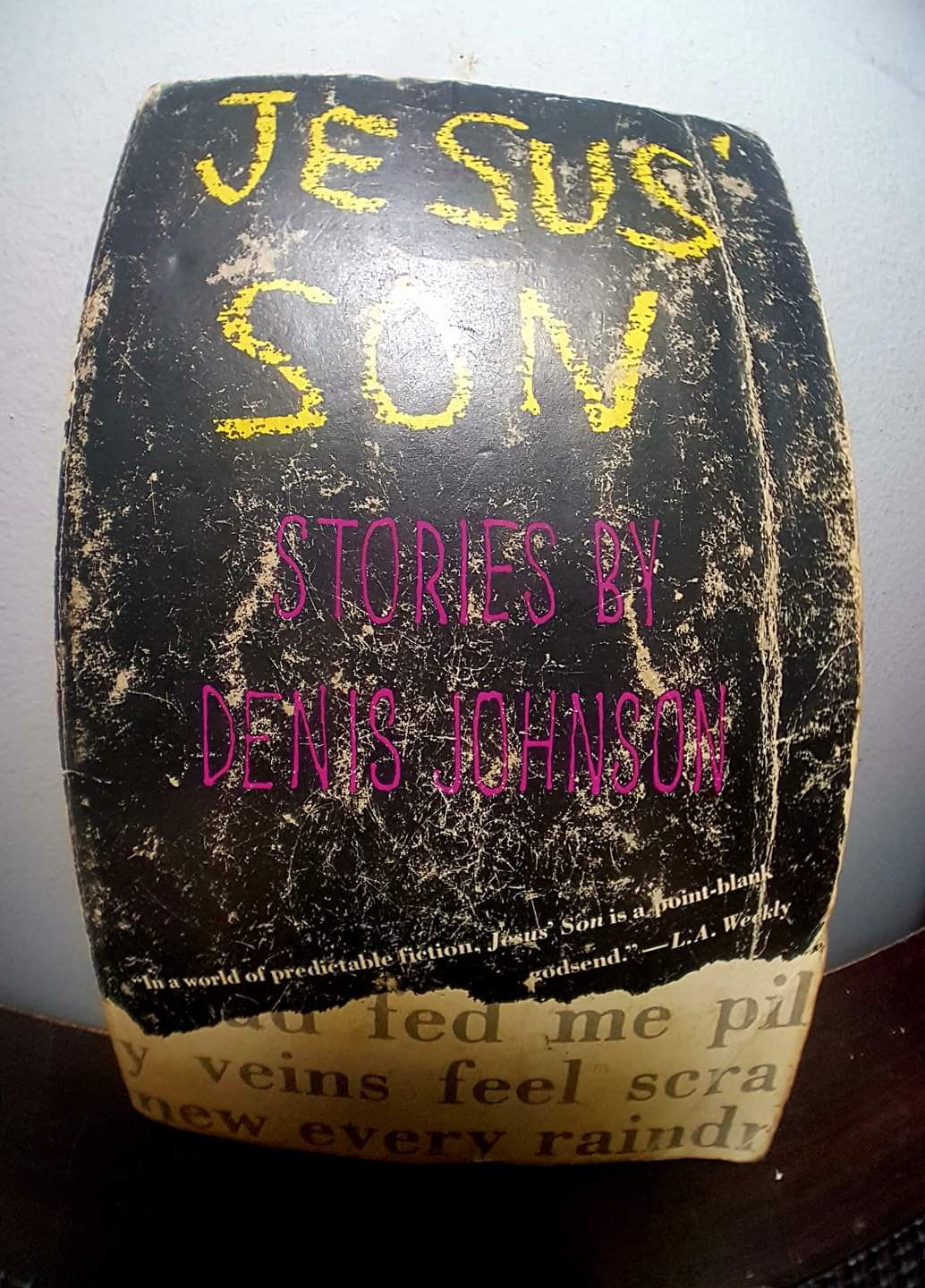
On my way back from one of the rallies for striking grad workers at Columbia, I picked up JESUS’ SON at a curbside book sale for four bucks. Denis Johnson was a great writer. TREE OF SMOKE was utterly engrossing (in a dark period), TRAIN DREAMS and SEAMAIDEN also excellent. But this collection from the 90s was an absolute knockout. The language is so clean and precise while still making all kinds of irregular choices in words and phrasing. When the speaker says he is a “whimpering dog inside” and nothing more, I felt it instantly. With Johnson there’s always this immediate connection so that you feel something for his cast of gentlemen losers. It brings to mind an image from Bruno Schulz of the writer and reader secretly holding hands under the table across which they face.
Every story in this cycle is a brief episode in the speaker’s drifting, dreg-filled life (the only name he goes by is Fuckhead). At the same time each story often breaks down into fragments that can read on their own like prose poems. Here’s one from “Emergency.”
Georgie and I had a terrific time driving around. For a while the day was clear and peaceful. It was one of the moments you stay in, to hell with all the troubles of before and after. The sky is blue and the dead are coming back. Later in the afternoon, with sad resignation, the county fair bares its breasts. A champion of the drug LSD, a very famous guru of the love generation, is being interviewed amid a TV crew off to the left of the poultry cages. His eyeballs look like he bought them in a joke shop. It doesn’t occur to me, as I pity this extraterrestrial, that in my life I’ve taken as much as he has.
#

I couldn’t have asked for a better companion on a long plane ride than ZONE, a selection of Guillaume Apollinaire’s poetry translated by the great Ron Padgett. This book is the “fruit of [his] fifty-year engagement” with Apollinaire, and it’s hard to imagine a better fit between two poetic temperaments. Both are playful yet frank and unpretentious. Apollinaire’s lines are clear, even without punctuation, yet also have a capacity for avant-gardism that punches through every now and again, like in “Il pleut” and “The Little Car.” Padgett himself has a deadpan diction the majority of the time (BIG CABIN was a favorite read of last year) but he’s also written the most successful Oulipo text ever, in the form of a haiku that describes how a haiku works within the form of a haiku.
Many of Apollinaire’s poems are made of snatches of everyday conversation, and others are like stories or newspaper articles cut up into lines. And while they’re stuffed with references to mythology, religion, and ancient western literature, his poems are often funny. In “Annie,” the speaker sees a woman walking down a tree-lined road in Texas. This could be the easy occasion for some flaneur-like address to the eternal feminine, or to serendipitous encounters on the street; instead he finishes the poem like this:
Comme cette femme est mennoite
Ses rosiers et ses vêtements n’ont pas de bouttons
Il en manque deux à mon veston
La dame et moi suivons presque le même rite
(Since that woman is a mennonite
There are no buds or buttons on her clothes
Two of them are missing from my coat
The lady and I follow almost the same rite)
This project has become a new favorite book, and I speak as someone who thought he was over the romance of French bohemianism and all that early 20th century business. I was won over by how Apollinaire via Padgett can conjure that opium-addled atmosphere with such beautiful linguistic simplicity.
#
(source)
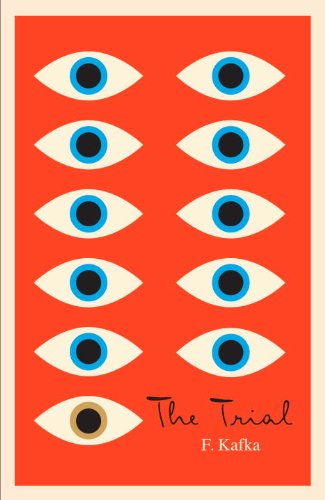
THE TRIAL by Kafka was ideal holiday reading. I may judge books by their covers after all. For a long time I avoided these new editions from Shocken Books because of their slick minimalist covers, whose bold colors and obvious eyeball iconography rubbed me the wrong way. I took them to be lazy and trendy reskins of facsimiles of older translations, similar to Vintage’s monochrome covers for Camus books. I was ignorant of Shocken’s publication history with Kafka in the 30s, in the context of a pro-Jewish cultural assertion against Nazism, and that in the case of THE TRIAL the new cover came with a new translation by Breon Mitchell, one that, according to his preface tries to preserve both the foregrounding of, one, legalese and other professional idioms that are woven in the text (for example, the opening line uses the word “slander” as opposed to the mundane “telling lies”); and two, the general rough character of Kafka’s prose, with its irregularly placed subordinate clauses and massive unbroken paragraphs. These aspects were eclipsed in the translation by the Miurs.
THE TRIAL opens with an absurd scene that from the beginning is presented in a theatrical way (and theatre jargon is used throughout the novel along with legal terms). Every dramatic beat is a comic reversal: K. rings for food, and his arresting officer enters the room, saying, “You rang?” When K., sitting in bed, explains that he wanted the landlady’s cook Anna to bring him breakfast, the stranger goes to the door, opens it a little, and calls into the next room, “He wants Anna to bring him breakfast,” and “a short burst of laughter” comes in response. Ever agitated, K. wonders if what’s happening to him is a joke by his coworkers for his 30th birthday, and worries he’ll come off bad for not taking a joke. He tries to cooperate by offering his papers, but the men in his home take this as an obnoxious play: “you’re behaving worse than a child. What is it you want? Do you think you can bring your whole damn trial to a quick conclusion by discussing your identity and arrest warrant with your guards? We’re lowly employees who can barely make our way through such documents, and whose only role in your affair is to stand guard over you ten hours a day and get paid for it.” But then when K. protests his innocence (to a charge that is never made explicit), they chide him for making a claim in ignorance of the Law.
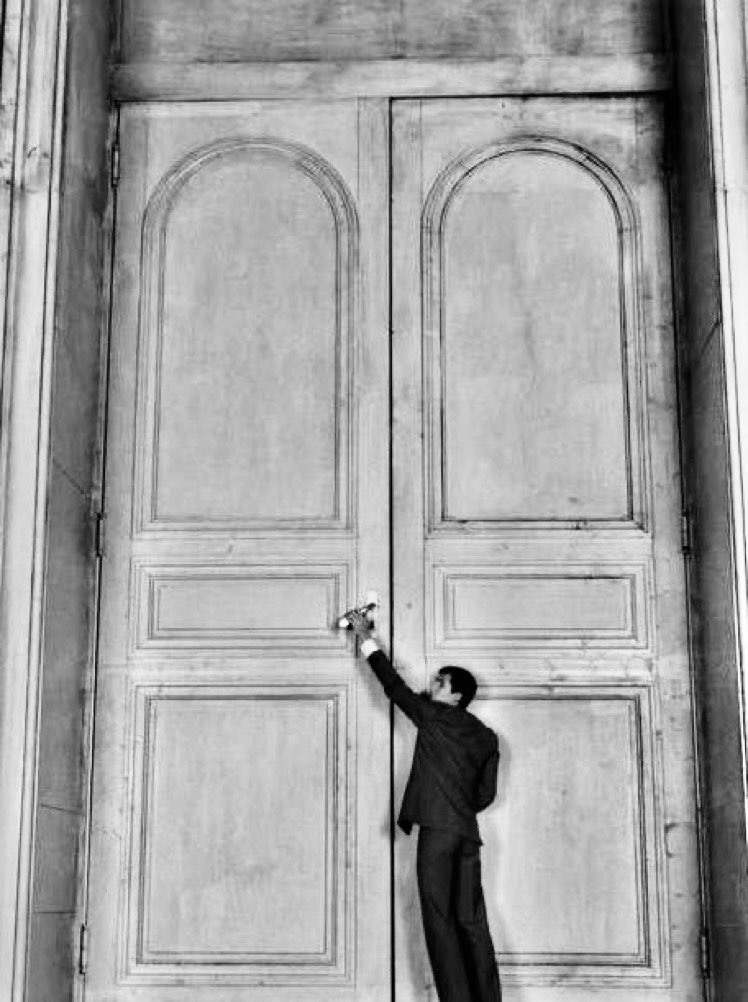
K. is in a game with no correct moves. Such is the atmosphere of dread and anxiety in Kafka’s fictive worlds. It is not a “totalitarian” or absolutist bureaucratic society that is the host of this arbitrary, inconsistent, pervasive and petty legal antagonist. It is in the Family structure where such oppression comes into play. The court of THE TRIAL uses the homes of its employees and defendants, in a series of running gags where furniture is being constantly shifted around the room, like stagehands preparing a scene for a play. But lest we get carried away with all this laying bare of the devices of fiction, the priest slash prison warden in the cathedral reminds us to respect the basic narrative integrity of the texts we consume. When K. imposes his reading of the parable of the Law and the door that climaxes this book, the priest critiques him with this remark: “You don’t have sufficient respect for the text and are changing the story.” This line could be addressed to all who say THE TRIAL is simply a dream, or an allegory, and not a story of an individual man, one who, for all intents and purposes, is real. And he really is guilty.
#
(source)
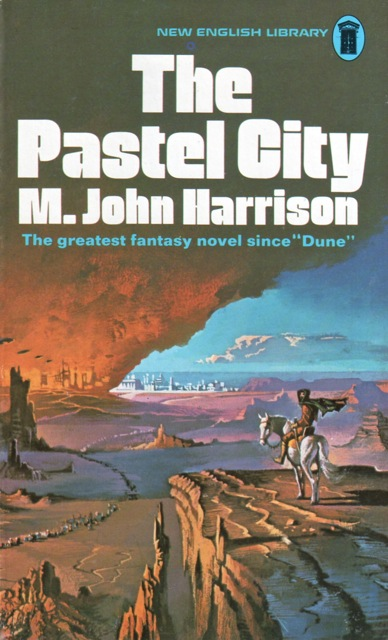
M. John Harrison wasn’t even on my map until 2020 when his latest novel, THE SUNKEN LAND BEGINS TO RISE AGAIN, took the Goldsmith Prize. It’s funny that I’d never heard his name in the same breath as Sturgeon or Le Guin, because he is another fantasy writer with excellent prose. Really, he is another great British master from the 70s I didn’t know about in my typical American ignorance.
PASTEL CITY is about and is another name for VIRICONIUM, a city/statelet in a world that has seen better days. This civilization sits atop layers of detritus from earlier, more advanced societies, so like pulp operas or like Wolfe’s BOOK OF THE NEW SUN, you get swords and sorcery in a landscape full of SF gadgetry.
We follow Lord Cromis, a warrior-poet who sets out to regroup the posse of knights called the Order of Methven, who defend the young Queen Jane, currently in a civil war for the throne of Viriconium with her half sister Canna Moidart. It’s like a western, only the landscape is one of rusted metal. And there are mechanical birds.
The “Lord of Birds” who created these cybernetic familiers resides in the tower of Cellur, an Orthanc-like obsidian structure in the marshes of Cladich. Harrison’s writing is like Le Guin’s in the sense that the quality of the prose isn’t flashy or ostentatious, but simply in the satisfying way in which the words “snap” together. The first book of the VIRICONIUM cycle is a straight ahead SF novel with all the proper western plot beats, but there’s still an extra layer of elegance in the phrasing and word choice. Here’s the description of Cellur in PASTEL CITY:
They reached the tower of Cellur in the evening of the second day. Cresting a ridge of pitted dolerite, they came upon the estuary of one of the unnamed rivers that ran from the mountains behind Cladich. Luminous in the fading light, the water spread itself before them like a sheet of metal. High black escarpments dropped sheer to its dark breaches; the cold wind made ephemeral, meaningless patterns on its surface.
Set in the shallows near the western bank was a small domed island, joined to the mainland by a causeway of crumbling stone blocks. It was barren but for a stand of white, dead pines.
Out of the pines, like a strong finger diminished by distance, rose the tower. It was five-faced, tapering: black. A tiny light shone near its summit, a glow that flickered, came and went. Birds wheeled about it, wailing mournfully, dipping to skim the water—fish eagles of a curious colour, with wings like cloaks in a gale.
Now check out this romanticist, picturesque, more Tolkein-leaning description of the same locale 80 years later, that is also the opening paragraph of the sequel book A STORM OF WINGS:
In the dark tidal reaches of one of those unnamed rivers which spring from the mountains behind Cladich, a small domed island in the shallows before the sea, fallen masonry of a great age close faintly under the eye of an uncomfortable moon. A tower once stood here in the shadow of the estuarine cliffs, made too long ago for anyone to remember, in a way no one left can understand, from a single obsidian monolith fully two hundred feet in length. For ten thousand years wind and water scoured its southern face, finding no weakness; and at night a yellow light might be discerned in its topmost window, coming and going as if someone there passed before a flame.
Other reads from December: more Ashbery, early poetry by W.S. Merwin (some epic fantasy in its own right), and Tolkein’s THE FALL OF GONDOLIN for the LOTR Holidays of 2021.

 Second Slope