See ya later, doppelgänger! October summed up

First things first.

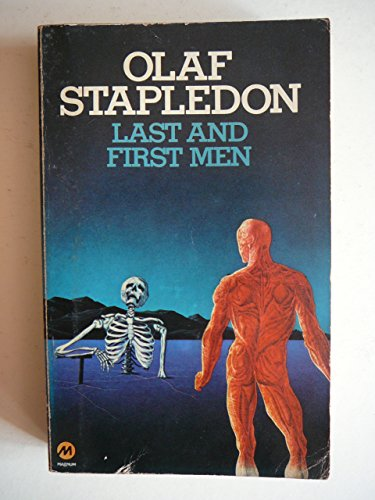
I had a new story published in Passages North at the beginning of the month, inspired by Olaf Stapledon but really more in the manner of A. E. Van Vogt. Neat! I read it out loud at the open mic in the cafe where I wrote it. There were so many stand-up comics doing sets at the show that even I got heckled. Laugh-a-minute. I put cinnamon in my coffee every day till I saw DUNE in theaters.

More reads: Anne Carson’s SHORT TALKS | Paul Curran’s LEFT HAND| Thomas Mann’s MAGIC MOUNTAIN (whew!) | Stevens’s PARTS OF A WORLD | Ashbery’s CAN YOU HEAR, BIRD | 

And a press copy of my most anticipated novel of the year, for two years in a row: WARNING TO THE CROCODILES by Antonio Lobo Antunes, translated by Karen C. Sherwood Solentino, from Dalkey Archive.
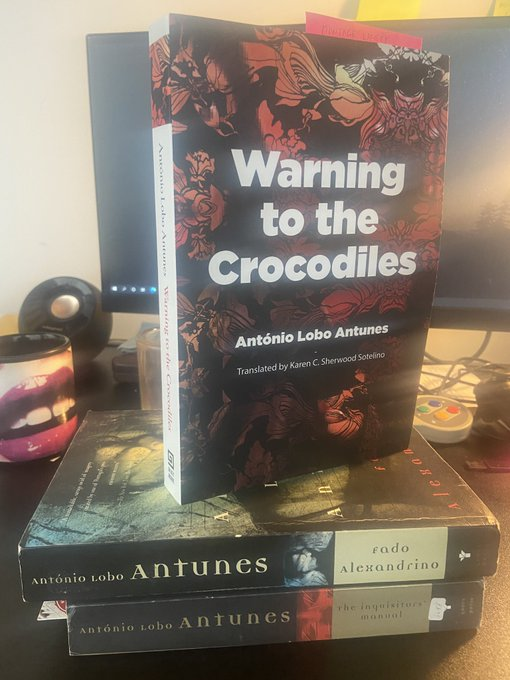
If you’re at all interested in translated literature then I urge you not to sleep on this great Portuguese novel from 1999. Lobo Antunes is a living grandmaster of literary modernism, and even all my personal hype did not prepare me to realize that this translation is very important, as this work is a summation of the tendencies in his 90s output, in the same way FADO ALEXANDRINO (perhaps his masterpiece) works as a summation of the 80s. A review to come, probably next year. As for the cover, I like the palette, and when you look past the fractal floral pattern and see that it is masking a strange image with pixelated faces, which is suggestive and fits as a depiction of the Lobo Antunes literary experience, with its ultra-subjective haziness. But my reflexive tastes definitely prefer the monochrome with red accent minimalism of Dalkey’s typical covers. Perhaps uniform covers are on their way out more generally.

Now for my trip to Norway via Fosse.

#
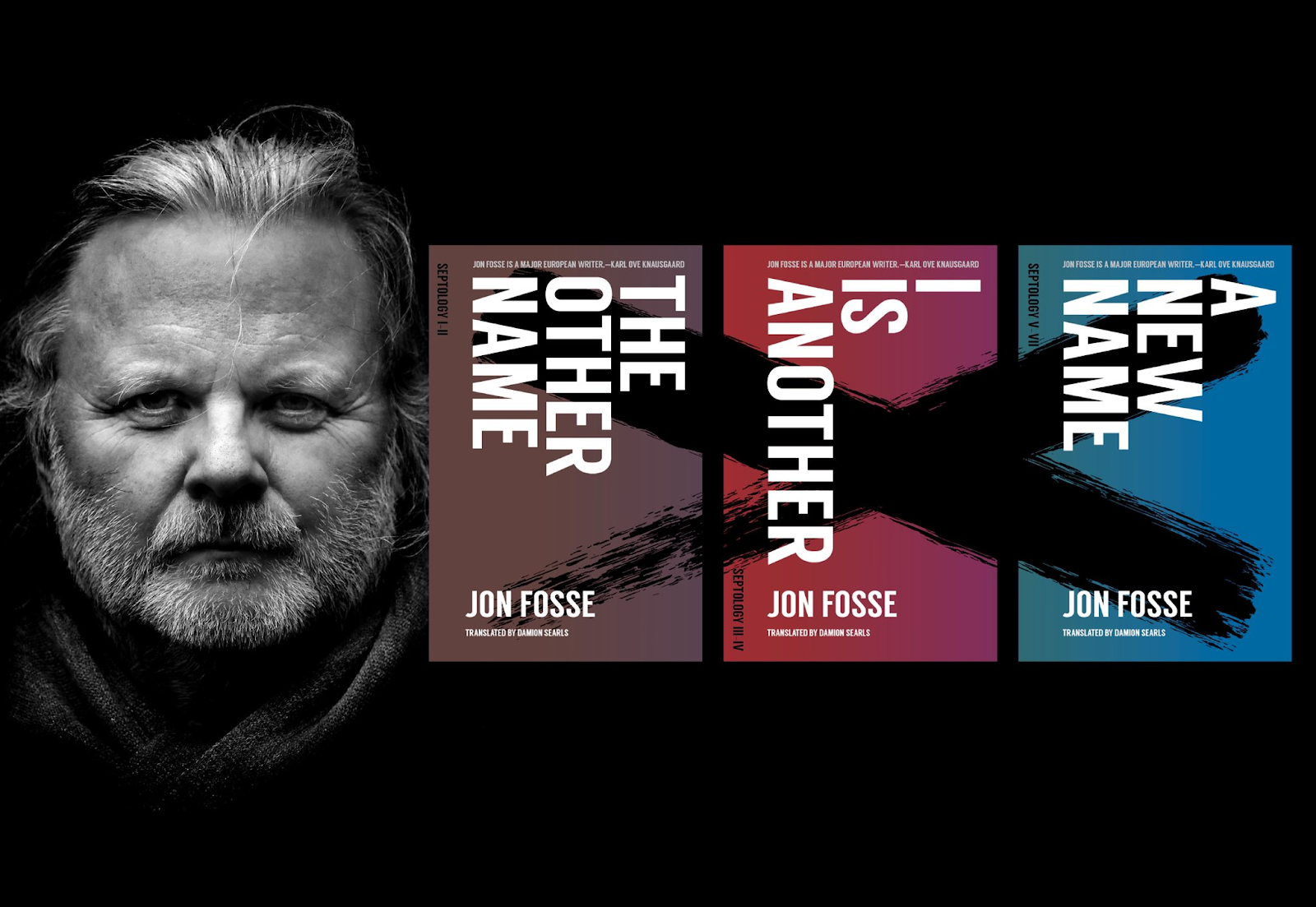
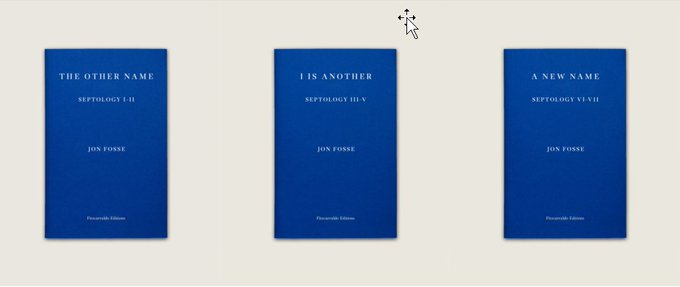
During the day I wrote the opening of Septology. I just started with my laptop on my stomach in bed. I write easily. Something comes to me when I sit down to write. I have never had writer’s block. […] What I experience when I write has as great an impact, if not greater, than what I experience in life. To write is to dream while awake, to place oneself in a controlled dreamlike state where one advances by listening.

Jon Fosse, interview in MUSIC AND LITERATURE

SEPTOLOGY follows a painter named Asle, seemingly from one day to the next. Every morning he imagines or “sees himself” looking at his latest picture, made of a purple and brown line that cross diagonally; and every night he ends the day with his rosary, reciting the Lord’s Prayer in latin, slowly, till it comes one or two words at a time as he inhales and exhales. Which encapsulates nicely the extreme down-tempo nature of this literary experience. Each day begins and ends the same way, with slight variations on what crosses Asle’s mind when he contemplates his picture, will he sell it, will he gift it to his neighbor Åsleik’s sister named Guro but is called Sister, will he stow it away in his crawl space, will he give up painting all together? And in his closing prayer sometimes he wonders if he really believes. “…then I say Ave Maria and that usually helps, I think and sitting there in my car I take my rosary out from under my pullover and I think now do I really believe in this, no, not really, I think…” (Part V) 

I fell in love with this bleak and beautiful fictional world, a world of habits, routines, grieving (for his late wife Ales), and the peculiar human sight made possible in complete darkness, which is how Asle prefers to look at his pictures to make sure they’re truly good and finished. But that’s not all. When we follow Asle heading into the town of Bjørgvin in the first book, he finds his double passed out on the snow: another Asle, also a painter. This Asle is an alcoholic, while our narrator Asle has gone sober; the narrator was devoted to Ales and it was love at first sight, while the double is twice-divorced with distant children; the double has a dog while the narrator doesn’t (though he’d like one); the double’s life is considerably more fucked up, and he spends much of the story recovering in a clinic after the narrator drops him off. Everyone takes the doppelgangers in stride (and there’s another doubling in Åsleik’s sister and a local woman of the same name who bumps into the narrator a few times). The biggest point of tension in the first book is who will take care of the dog Bragi. I found all of this to be profoundly beautiful.

Most of the novel’s space is taken up with the narrator’s almost clairvoyant visions of his life, childhood, a sexual attack by The Bald Man, attending Art School, falling in love with Asle, sneaking cigarettes in those slate roof boat houses that dot the west Norwegian coast. It read to me like he was seeing pictures in his mind not unlike what he paints, and we are reading the “language of pictures,” in the narrator’s phrase, especially since he seems to experience them as compulsive images that wash over whatever he’s doing in the present moment the same way his ideas for paintings do. “I have all these pictures inside me, yes, so many pictures that they’re a kind of agony, yes, it hurts me when they keep popping up again and again, like visions almost” (Part II?). The phrase “I see myself” that heads every part, mantra-like, so perfectly condenses Fosse’s procedures, a narrative act that arrests narrative time in the same moment of its expression.

SEPTOLOGY’s landscape is overwhelmingly darkened snow: the narration so telescoped on individual acts and objects, the pace so languid, the tone so even and gentle, it puts not a movie but a black box play in the mind’s eye. Fosse is a highly mature child of Beckett and Bernhard, but not so caustic as either, taking the former’s absurdism and the latter’s music.
and I grip the edge of the table tight and then I look at Bragi standing there and looking at me with his dog’s eyes and I think that dogs understand so much but they can’t say anything about it, or else they can say it with their dog’s eyes, and in that way they’re like good art, because art can’t say anything either, not really, it can only say something else while keeping silent about what it actually wants to say, that’s what art is like and faith and dogs’ silent understanding too, it’s like they’re all the same, no now I’m getting in over my head with these thoughts, I think, because I’ve never been a thinker, and the only language I’ve so to speak mastered is the language of pictures, I think and I look at Bragi and maybe he’s hungry or thirsty… (Part V)

The last book really threw me in for a loop. First of all, it seems several weeks have elapsed before the beginning of Part VI. I’d thought the seven parts naturally lent themselves to a week (they’re collected in three volumes, just like LORD OF THE RINGS’s seven books, incidentally). But that’s not all, Asle’s schedule changes, as he spends most of this section at night staring out his window at some landmark in the darkness over the Sygne Sea. Asle seems to have been a gifted painter from the beginning. He’s so talented he can start Art School without finishing high school, and after that the Art School runs out of things to teach him. There’s no resistance to his artistic upbringing. It’s God’s grace. I loved the intense mixture of modes in this gentle transformation of the story at the very end.
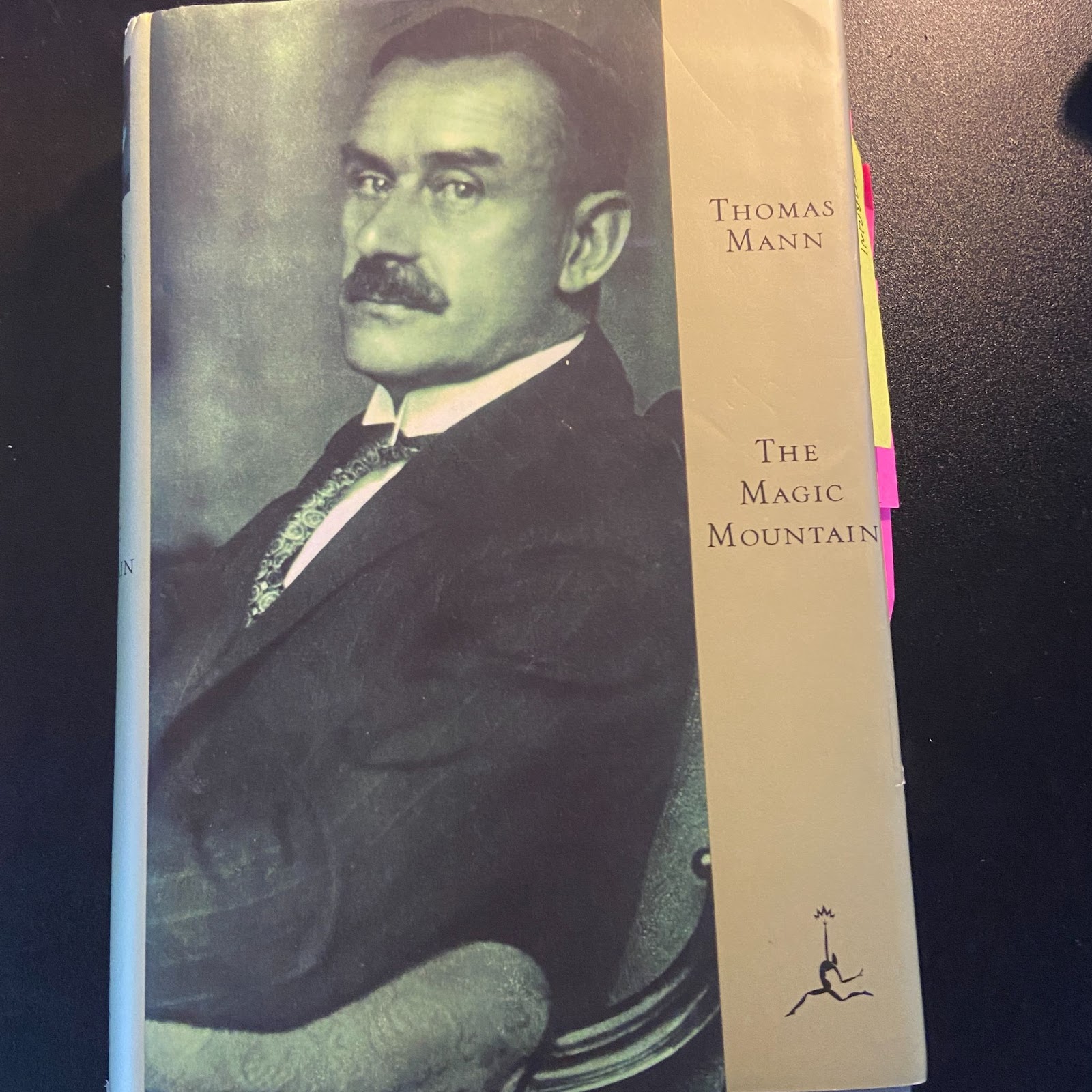
Mann’s MAGIC MOUNTAIN was three months of delectable reading. I may have enough to say about it to make a proper essay, though the didactic allegory and the ironized bildungsroman conceit Mann employed so masterfully here have been rendered transparent by scholars already. The experience itself is like climbing a mountain by stages, first unrolling slowly until around the sixth of the big chapters, things develop faster, the narrator starts summarizing more, the tone gets funnier and more deranged as we go along, and before you know it you’ve careened over the finish line in a runaway toboggan. 

I read a hard copy of the Lowe-Porter translation, pictured above, but also ended up reading large stretches of it electronically through the more recent John E. Woods translation. This was interesting if irresponsible. They are quite different, with Woods overall being very smooth to read, as I expected after his DOKTOR FAUSTUS, while Lowe-Porter goes for an antiquated pastiche with lots of idioms and untranslated French. Which approach is more faithful to the German I can’t say; the two translations read to me as trying to get to Mann’s sense of humor in different ways. In the first chapter, Hans Castorp laughs his head off at a particular word used by his cousin and asylum resident Joaquim. In Mann, the word is “Seelenzergliederung” which means psychoanalysis, but literally can mean soul dissection. Lowe-Porter translates this to “psychoanalysis” which in the scene made me laugh, while in Woods it’s “psychic dissection.” Is Wood’s more literalized choice a way to make the concept as bewildering as it might be to Castorp’s perspective?

It’s probably because I’m still high from finishing it, but the very best comparison sentence for me is the very last one. 

Lowe-Porter:

Out of this universal feast of death, out of this extremity of fever, kindling the rain-washed evening sky to a fiery glow, may it be that Love one day shall mount?

And Woods:

And out of this worldwide festival of death, this ugly rutting fever that inflames the rainy evening sky all around—will love someday rise up out of this, too?

I originally went to Lowe-Porter because, being a hopeless aesthete, I’d previously found Woods suspiciously accessible, but I prefer the Woods formulation here. The fever is more concrete with its “ugly rutting,” and while “feast of death” and “kindling the rain-washed evening sky” have an old macabre ring, “festival” and “inflames” seem more precise. And Woods adds some structural redundancy with the repeated prepositional phrase “out of this” while Lowe-Porter’s sentences are much of the time extremely heavy on either the front or the back end in terms of what you have to keep in mind about the subject while reading through these long sentences. Putting the main verb mount at the very end felt awkward, no doubt because of my modern American ears.

So if I had to recommend the best translation on the market, I don’t know, I’d probably say go with Woods then Lowe-Porter on a possible reread.

Next read: a trip with Mr. Lowry to Mexico, on All Saints’ Day, and something about a dead dog?
Confucian comedy

Confucius

The astounding avant-garde daily Babel Tower Notice Board kindly published my short story “Fifteen Family Sagas” last month. I’m fascinated by multi-generational epic novels, not least because they get a lot of attention on the prize circuit. I told a friend this was going to be my claim to fame, but I messed up since I’d forgotten the family tree.

It’s not that original, granted–it’s a set of riffs on old Chinese tales about filial piety. But it is very, very personal so I remain proud.

This goes out to everyone unfortunate enough to believe they had a happy childhood!

Some jottings on Don César

THE LITTLE BUDDHIST MONK / THE PROOF
César Aira, tr. Nick Caistor
New Directions, 2017

Exhaustion. In his interviews, Aira seems to take seriously an idea from Ortega y Gasset, that literature is like a mountain, and its practitioners are mining it. Which makes literary art a finite resource that can be exhausted. And that’s why his books are so lean, not just because he likes to be elegant, or respect his readers’ time, or that his Louis Aragon or dada-like fantastic narratives are hard to sustain for long, but simply that this mode of production is on its way out.

It’s edgy to elegize for the novel, but believing or pretending to believe that art is dead is the right position to be in for creating. And besides, it had a beginning; surely it has an end. Literature could have died in its sleep a generation ago, and  now carries on in an afterlife, much like liberalism.

Infantile disorder. The tonal whiplash and narrative switchbacks in Aira’s work remind me of the way kids tell stories, a storytelling that’s hardcore diachronic: and then, and then, and then. Just as it’s said somewhere that Picasso once visited an exhibit of art by children, and remarked that it took him years to learn how to draw like that. This return to a more naive space is in keeping with surrealism (between automatic writing and OuLiPo’s input-based creation) as well as Utopian SF or fantasy (Olaf Stapledon).

The commitment to high modernism remains, but there’s no more desire for grand, solemn mega novels that strain to capture the totality of bourgeois or monopoly capitalism. The Joyces and Musils and Prousts and Manns that amount to secular religions.

Absolute Formalism. Aira’s books are so overwhelmingly about themselves, about their own aboutness in the way the formalists wanted them to be. Their content is a projection of their form, of the elements selected to build the story. It’s most obvious in VARAMO, while MIRACLE CURES OF DR. AIRA presents a mystified version of the creative process. As with Kafka, there’s a risk of turning his stories back to realism by reading them as social parables. On the other hand, the weirdness of Aira’s books, as I read them, are about renewing our own perceptions of literary theory.

Which is why I felt that THE LITERARY CONFERENCE is a jab or at least an elbow nudge against Carlos Fuentes. The giant blue silkworms that lumber down the hills and attack the city, are they not like that writer’s mega novels and others like his? The threat is overcome by the narrator’s device that was a prop for one of his plays — a retreat or regression to fairy tale logic. (Fuentes giving the Nobel to Aira in one his stories is no less of a backhanded compliment.)

How to apply the word novel vs. novella is really inconsistent these days. Novellas were more easily distinguishable in the 19th century institution of the triple-decker novel that allowed library systems to loan out the same work to three people. But now most novels aren’t that long, besides the few middle-brow prestige pieces that come out in the US each year. Novels can be any length these days, and Aira’s output then addresses, not formalism, but the redefining of the novel form itself. Perhaps they aren’t novels at all.

Revolutionary break. I’ve never totally loved an Aira book right away, except for EPISODE IN THE LIFE OF A LANDSCAPE PAINTER and HOW I BECAME A NUN. Other than those two, I finish them thinking it’s second-tier Aira and wait for them to grow on me over the weeks till I know it’s a new favorite. THE PROOF’s own narrative switchback into a genre of surreal ultra-violence has tyrannical reign over both that story and the whole book. But that’s also appropriate.

Two young women named Mao and Lenin hold up a supermarket in the name of love, as the Love Brigade. It’s amusing to read this under Cold War liberal programming: revolutionary situations as a terroristic surge led by hopeless Utopian romantics. But then again, was Marxism not a product of Romanticism, if only as a rebellion against it? Forget thesis-antithesis-synthesis. Real dialectics means appearance-reality-appearance again.

Aira never respects the reality principle, but even then the very end of THE PROOF goes beyond unreal. As the store catches fire, we read about one woman whose body melts until she’s like a Modigliani painting on crack. It appears this mundane “revolutionary” act (all the world’s a supermarket in globalization) has torn the fabric of reality apart and anything is possible, is aesthetically legitimate.

Which is why Aira’s work I think speaks so earnestly to our historical moment. It’s a different tack from Roberto Bolaño, who usually stays close to realism in order to show us why such a commitment is no longer truly possible. The liberal consensus in the last couple of decades has become more authoritarian as per the needs of the ruling class. In our own country, NFL workers taking a knee during the anthem is unacceptable, let alone taking to the streets in a serious stance against white power and its servants in the police force. That’s just one example of the hard constraints on political imagination (insert the obligatory quote of capitalist realism and imagining the end of the world here). Thinking also of the appalling repression on J20, and the situation in Argentina today.

I won’t say that Aira’s is the authentic realism for today. Just that his way of producing stories do the urgent work of presenting any and all alternatives to what we have. It’s hard to see exactly how his work upholds the historical perspective of the proletariat. But that may be precisely it: such a historical perspective has been lost in the wake of the end-of-history 90s (9/11 not being a wake up call for the global metropolis but the trigger for denial), as well as the disembodiment and amnesia that makes up the spectacle, the culture of late capitalism.

Around the same time I was flying through Aira’s translated ouvre, I read an incredible insight in Jameson’s POLITICAL UNCONSCIOUS. It may well have been what permitted me to start writing fiction again. What he said made me realize that it wasn’t realism that bothered me. Realism is noble, difficult to do, and, if the Marxists are right, the plebian weapon of choice against aristocratic form. What I couldn’t stand in today’s literature was the reification of realism. So there’s a new notion of what is realistic, aside from the reality principle and character psychology: that which simply keeps the historical dialectic going in its own representations. Those books are to be prized, especially as our own literary darlings seem hellbent, more often than not, on stopping it.

Memoir’d out

TÓMAS JÓNSSON, BESTSELLER
Guðbergur Bergsson, tr. Lytton Smith
Open Letter Books, 2017

I am recommending a novel from the outfit Open Letter Books, which is having a fundraiser at the moment.

In the film SE7EN the detectives find and search John Doe’s apartment, and he doesn’t live well to say the least. In a notorious piece of production design, Morgan Freeman’s character leafs through one of many composition notebooks, which were all actually filled up with deranged writing. If someone went through 18 such notebooks and typed them up, you’d get something like this Icelandic novel.

In the 60s, memoirs are all the rage, as they are today. A senile, pervy petty-bourgeois man, who worked as an accountant and also rents out rooms in his house, wants in on the market, and combines his notebooks to form his own memoir, a certain bestseller.

Of course it’s actually an avant-garde mashup of trivial thoughts, strange tales, a passport for his dick; a composition method closer to Kathy Acker than to Lena Dunham. I returned it to the library a while ago but you can read the opening paragraphs HERE.

It’s the aesthetic end point outlined by the early formalists, and followed through by Walter Benjamin and others: a literary work, to bring forth the repressed truth that discourse is always made up of other pre-existing pieces of language, would have to itself become a bricolage of found textual material.

Moreover, these handwritten notebooks, which are inconsistently titled in a funny way, are being typed up, if I remember right, by one of his tenants. And he also makes choices in preserving the formatting and punctuation — sometimes there isn’t any. As I read it, it made me think about how language intervenes, prism-like, into the speech we try to convey in practical living. It doesn’t take too many adjustments to actually de-familiarize the most basic and familiar forms of personal writing.

A few weeks later, though, what’s fascinating about this book is that it highlights that particularity of first-person narration. On one hand, you have the clarity of the most celebrated personal essays, with I guess E.B. White’s “Once More to the Lake” as a ur-text. The valorization of personal non-fiction at this moment, generating a lot of discourse, indicates a market for lucid gut-spilling, indeed, the most fruitful outlet for black women, women of color and other marginalized subject positions, at the cost (I worry) of folding literary culture into the inspiration industry.

(There’s a lot more to say. I’ve read powerful arguments that these books are super commercial and are not created the kind of breakthroughs that cultural production is starving for under neoliberal capitalism. At the same time the personal essay is less white than ever, which is of course a good thing. In NY you can go, as I have sometimes, to panels organized by We Need Diverse Books. The slogan may imply that certain forces or counter-forces must be created to break open the door. What of the existing forces that are keeping the “diverse” voices out, except for through certain texts produced in a certain way?)

On the other hand, for writers like Nabokov and Gass, who whip up language in a way that sometimes overwhelms the speech (the language/speech distinction is crucial for me), rely on the first person as well. The pyrotechnics of their prose styles come off better if the narrator is unreliable and probably insane. The centralizing power of the voice of the I-pronoun is the promise of a subjective truth and the most elaborate of rhetorical masks, all at the same time.

It’s this contradiction that TJ,BS brings forth with a dry irony. It’s constantly reshaping itself too. Even the title changes, with sometimes a colon or a comma or nothing at all. It’s obsessed with the material body, which is the only significant link that makes it the “Icelandic ULYSSES” the cover blurb says it is. But it’s full of modernist games. And like the best satire, it clearly shows that the issues it provokes have not gone away.

I only took down one quote: “What’s literature but mental masturbation for the emotions?” (42).