Diary

In touch with the wave function // philosophical musings on quantum mechanics

To begin with, I’m not a physicist or natural scientist. Math was a struggle for most of my education. But I have been fascinated by theoretical physics since I watched some documentaries on public TV. It was the education I was missing in middle school. I loved the marvels it described, proliferating dopplegangers, objects phasing through walls. I thought science was justifying surrealism. –At least, quantum mechanics could be surrealistic in its implications, with the infinite degrees of freedom in a finite quantum field.

The lockdown in 2020 reawakened this fixation, with the help of the Sixty Symbols YouTube channel and in particular the work of Sean Carroll, who has quickly become my science communicator of choice.

In the decades since I watched those documentaries, I’ve received a decent amount of philosophical training. And looking back on my (superficial, popularized) learning in physics, so much of the ideological and theoretical commitments I hold to are corroborated by this very scientific field that has left so many professionals baffled and in need of positivism, pragmatism, and straight up metaphysics to cope with what quantum mechanics is telling us about the universe, namely that it’s a single, smoothly evolving wave function.

I listened to these professional physicists talk about the history of their own field, and it got me thinking about revolutionary history. It’s popular to believe that rigorous science can only be applied to the natural sciences specifically, while a science of society is impossible. The name of that science of society traditionally is Marxism. Marxism has no business calling itself a science, people say. But the history of the Communist movement has been and is a history of line struggles within Communist Parties, and of social revolutions, in which various state systems were torn down and new ones organized, and class modes of production were consciously surpassed. What about physics? There too is a history of revolutions, of one paradigm overthrowing another, of line struggles over fundamental questions about quantum mechanics, entropy, the arrow of time, the origins of spacetime, and so on.

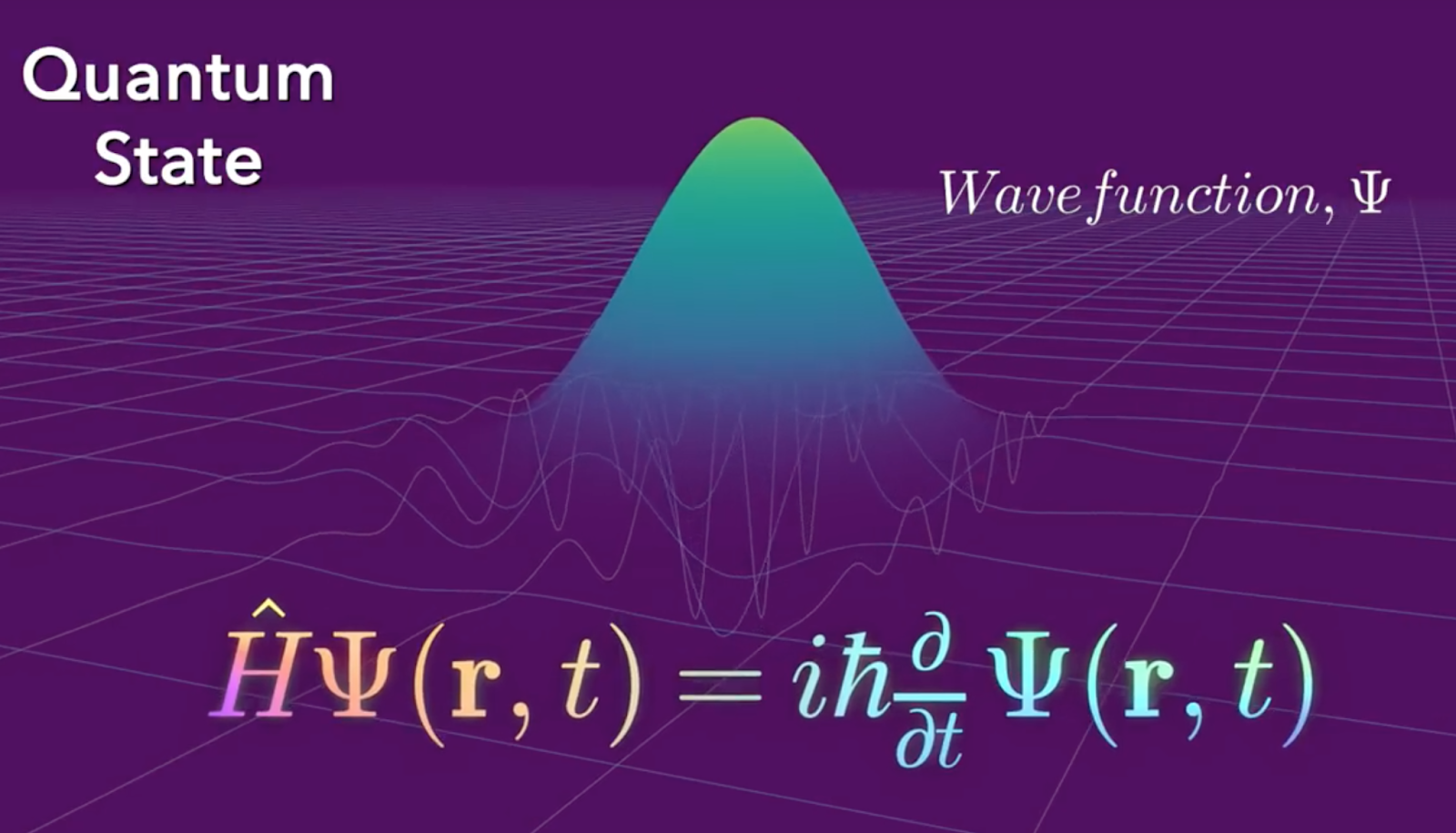
In this video for the Sixty Symbols channel Carroll talks about how there is no winning majority framework theory of quantum mechanics. The plurality goes to the Copenhagen interpretation, but against the yardstick of philosophical materialism, this is actually an agnostic position: the physical reality of particles only exists when we are looking at them?? This is a pragmatist orientation to science, an orientation that says that the math in quantum physics (the Schrödinger equation) is only a practical recipe to help our endeavors in approximating a “ghostly” matter, rather than taking mathematics to be the theoretical reflection of reality’s basic fabric. 
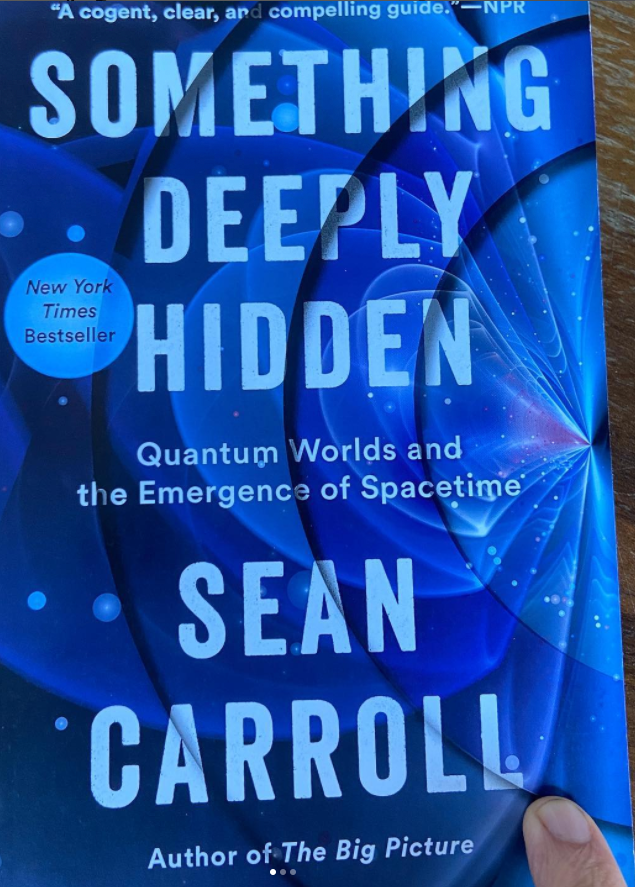
The interpretation that Carroll puts forward is the Everettian or “many worlds” framework, which, I learn in his book SOMETHING DEEPLY HIDDEN, is simply the “austere” form of quantum mechanics, the one that takes up the math as it is without any more tweaking (he quips that it’s the other interpretations that should be considered “disappearing worlds” theories). Not only is Carroll’s position in my mind the most consistently materialist, but there is also contradiction (i.e., dialectical reasoning) at work in his very prose:

You know who didn’t like the probability interpretation of the Schrödinger equation? Schrödinger himself. His goal, like Einstein’s, was to provide a definite mechanistic underpinning for quantum phenomena, not just to create a tool that could be used to calculate probabilities [emphasis mine]. “I don’t like it, and I’m sorry I ever had anything to do with it,” he later groused. The point of the famous Schrödinger’s Cat thought experiment, in which the wave function of a cat evolves (via the Schrödinger equation) into a superposition of “alive” and “dead,” was not to make people say, “Wow, quantum mechanics is really mysterious.” It was to make people say, “Wow, this can’t possibly be correct.” But to the best of our current knowledge, it is. (66)
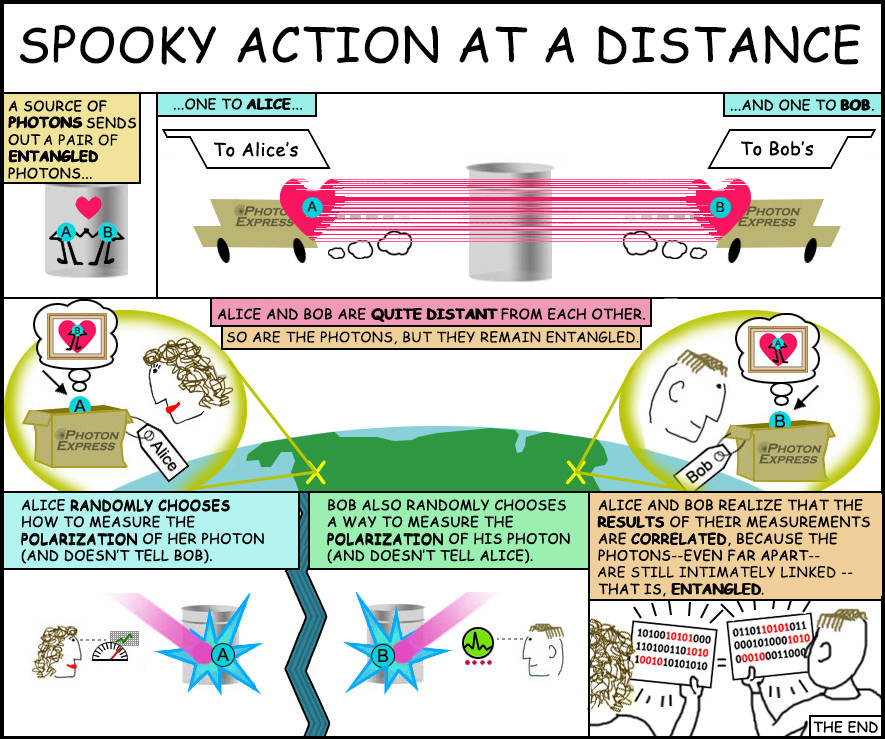
The apparent strangeness of what quantum mechanics describes about reality’s fundamentals has been an occasion for many to disregard the materialist outlook and keep the door open for New Age and metaphysical explanations for reality, with a whole subset of literature applying “entanglement” and other concepts in kooky ways, usually just a fancy way to talk about “Karma.” It is similar to the situation in the nineteenth century, when the mysteries of electromagnetism led some positivistic circles in Europe’s scientific community to abandon “naive” realism and claim reality was made of mathematical approximations. A certain author known in the indie circles has made much of the fact that the quantum theory of gravity is incomplete, and voices skepticism against Einstein’s general relativity. Are these people right? Does the framework of quantum mechanics justify idealism, subjectivism, and agnosticism? Is it the intervention of the observing consciousness that brings the variables of particles into existence?

So, is the weirdness of the quantum measurement process sufficiently intractable that we should discard physicalism itself, in favor of an idealistic philosophy that takes mind as the primary ground of reality? Does quantum mechanics necessarily imply the centrality of the mental?

No. We don’t need to invoke any special role for consciousness in order to address the quantum measurement problem. We’ve seen several counterexamples. Many-Worlds is an explicit example, accounting for the apparent collapse of the wave function using the purely mechanistic process of decoherence and branching. We’re allowed to contemplate the possibility that consciousness is somehow involved, but it’s just as certainly not forced on us by anything we currently understand. (224)

The only reason why our minds have anything to do with these processes is because we implicate our conscious experiences when we “map the quantum formalism” onto the world as we experience it. Science is indeed a subjective activity in this sense, in explaining conscious experience to ourselves, and reflecting the natural world and its structures in our minds, in the form of logical concepts and mathematics. The universe is physical and exists independently of our consciousness.

As with electromagnetism and biological evolution, successes in science have historically been grounds for reactionary ideologies to gain traction. But we should not pass over the knowledge science has accumulated because general relativity hasn’t yet been reconciled with the quantum field theory of gravity, any more than the successes in physics and chemistry in the late nineteenth century justified passing over physical matter entirely.

Carroll is not merely a brilliant working scientist but a great writer and communicator. His instinct for narrative served well (and his openness to storytelling technique as well as other humanities topics on his podcast is refreshing). SOMETHING DEEPLY HIDDEN is organized like a good quest plot of the Michael Moorcock type, where every new discovery promises to be the key to solving the next, greater riddle, like how a quantum theory of gravity becomes the key to unlocking the entropy of black holes.

So how is it that a mainstream branch of natural science is not necessarily naturalistic, or more precisely consistently materialist in the way other branches of natural science spontaneously are? Sean Carroll makes many polemical points, to the effect that bourgeois science is wilfully disinterested in the fundamental questions. The slogan, he says, is “Shut up and calculate.” But why should this be the case? 

I think Sean Carroll answers the question in the YouTube video when he says the Copenhagen interpretation is “good enough for government work.” 

In a word, it’s a matter of bourgeois society’s rampant utilitarianism. As advanced as technology has become, the capitalist mode of production can’t actually use science in the most complete way that is possible. I think with the global warming problem this issue has become transparent for a great deal of people in the last few years. Even more acute, perhaps, is the COVID situation where we see scientific expertise subsumed under the bourgeoisie’s “political expertise” at every turn.

Quantum mechanics, special relativity and general relativity, electromagnetism, theory of atoms—these are success stories of science that nevertheless, because they put a question mark over the structure of reality as it was then understood, prompted backward steps in philosophy and theory, birthing positivism (which tries to end philosophy altogether) and putting a question mark over matter itself. At this point who hasn’t seen a wise Twitter user “discover” for the zillionth time the “metaphysics” of dialectical materialism, because it posits a world independent of our first person experience of consciousness? Such a worldview allows me and I imagine the majority of the masses to move through the world just fine; it’s only the “progressive”philosophical postmodernists who take issue with such “naive” intuitions.

Actually, materialism is corroborated by the progress made in theoretical physics. Reality is much more contradictory and alive than the drab world of dead matter that the anti-materialist camp of Bataille and Deleuze and company (fashionable heroes for certain writers these days) are so fond of decrying. And a good thing, too.
Holiday reads, sayonara 2021

The Trial: A New Translation Based on the Restored Text (The Schocken Kafka  Library) - Kindle edition by Kafka, Franz, Breon Mitchell. Literature &  Fiction Kindle eBooks @ Amazon.com.

The last month of 2021 saw another review piece for FULL STOP, this time on the latest novel from the great Rikki Ducornet. I made some spicy remarks in this one (at least they might be), and they don’t have to do with Steely Dan trivia.

(source)

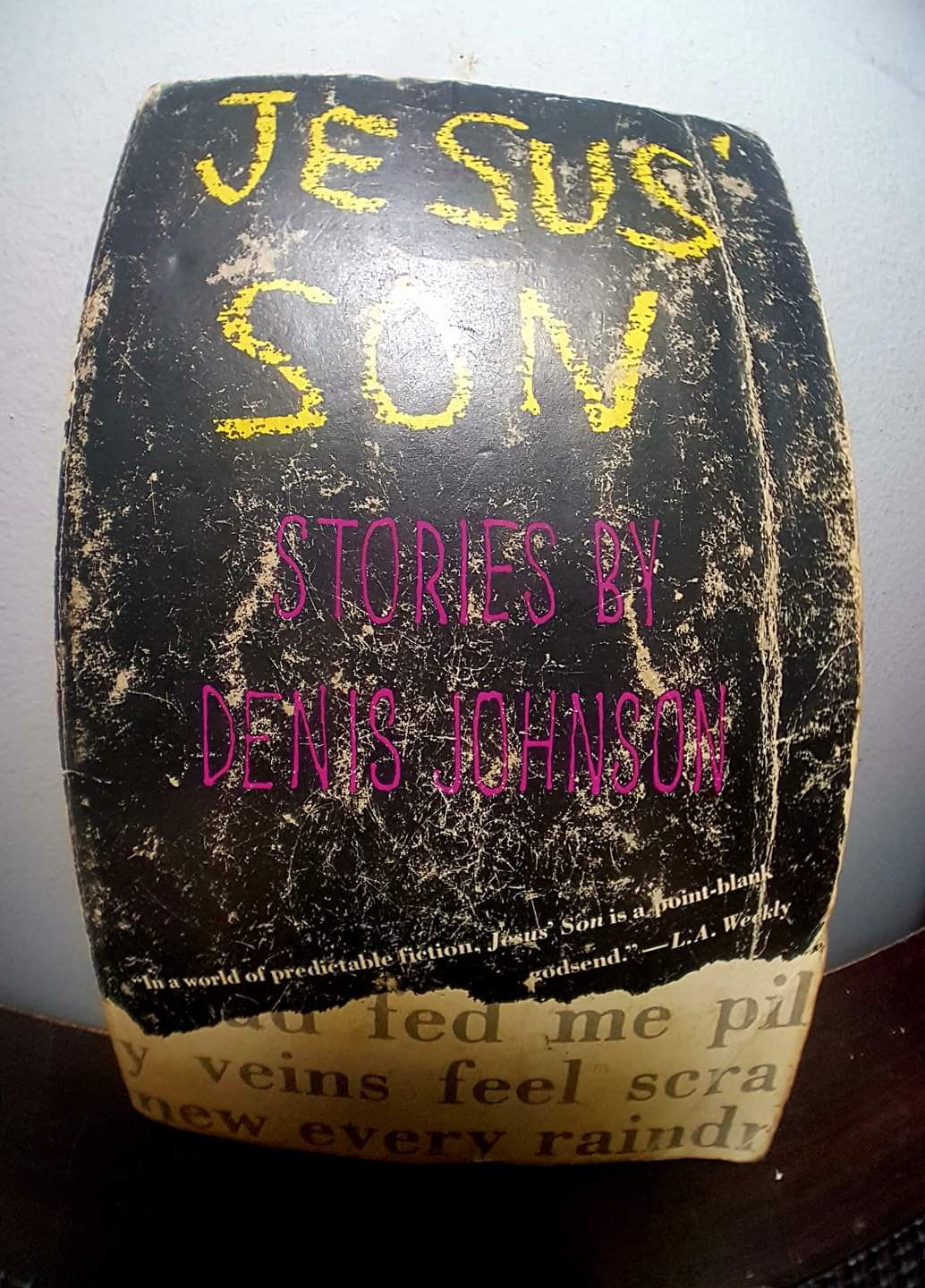
On my way back from one of the rallies for striking grad workers at Columbia, I picked up JESUS’ SON at a curbside book sale for four bucks. Denis Johnson was a great writer. TREE OF SMOKE was utterly engrossing (in a dark period), TRAIN DREAMS and SEAMAIDEN also excellent. But this collection from the 90s was an absolute knockout. The language is so clean and precise while still making all kinds of irregular choices in words and phrasing. When the speaker says he is a “whimpering dog inside” and nothing more, I felt it instantly. With Johnson there’s always this immediate connection so that you feel something for his cast of gentlemen losers. It brings to mind an image from Bruno Schulz of the writer and reader secretly holding hands under the table across which they face.

Every story in this cycle is a brief episode in the speaker’s drifting, dreg-filled life (the only name he goes by is Fuckhead). At the same time each story often breaks down into fragments that can read on their own like prose poems. Here’s one from “Emergency.”

Georgie and I had a terrific time driving around. For a while the day was clear and peaceful. It was one of the moments you stay in, to hell with all the troubles of before and after. The sky is blue and the dead are coming back. Later in the afternoon, with sad resignation, the county fair bares its breasts. A champion of the drug LSD, a very famous guru of the love generation, is being interviewed amid a TV crew off to the left of the poultry cages. His eyeballs look like he bought them in a joke shop. It doesn’t occur to me, as I pity this extraterrestrial, that in my life I’ve taken as much as he has.

#

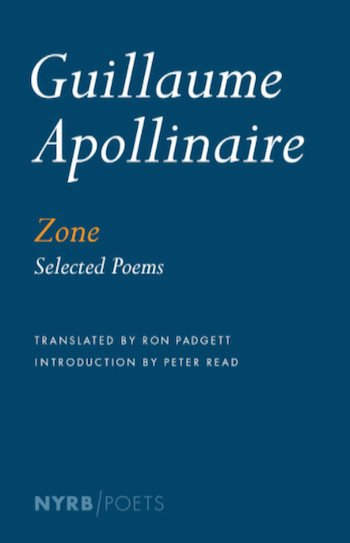
I couldn’t have asked for a better companion on a long plane ride than ZONE, a selection of Guillaume Apollinaire’s poetry translated by the great Ron Padgett. This book is the “fruit of [his] fifty-year engagement” with Apollinaire, and it’s hard to imagine a better fit between two poetic temperaments. Both are playful yet frank and unpretentious. Apollinaire’s lines are clear, even without punctuation, yet also have a capacity for avant-gardism that punches through every now and again, like in “Il pleut” and “The Little Car.” Padgett himself has a deadpan diction the majority of the time (BIG CABIN was a favorite read of last year) but he’s also written the most successful Oulipo text ever, in the form of a haiku that describes how a haiku works within the form of a haiku.

Many of Apollinaire’s poems are made of snatches of everyday conversation, and others are like stories or newspaper articles cut up into lines. And while they’re stuffed with references to mythology, religion, and ancient western literature, his poems are often funny. In “Annie,” the speaker sees a woman walking down a tree-lined road in Texas. This could be the easy occasion for some flaneur-like address to the eternal feminine, or to serendipitous encounters on the street; instead he finishes the poem like this:

Comme cette femme est mennoite
Ses rosiers et ses vêtements n’ont pas de bouttons
Il en manque deux à mon veston
La dame et moi suivons presque le même rite

(Since that woman is a mennonite
There are no buds or buttons on her clothes
Two of them are missing from my coat
The lady and I follow almost the same rite)

This project has become a new favorite book, and I speak as someone who thought he was over the romance of French bohemianism and all that early 20th century business. I was won over by how Apollinaire via Padgett can conjure that opium-addled atmosphere with such beautiful linguistic simplicity.

#

(source)

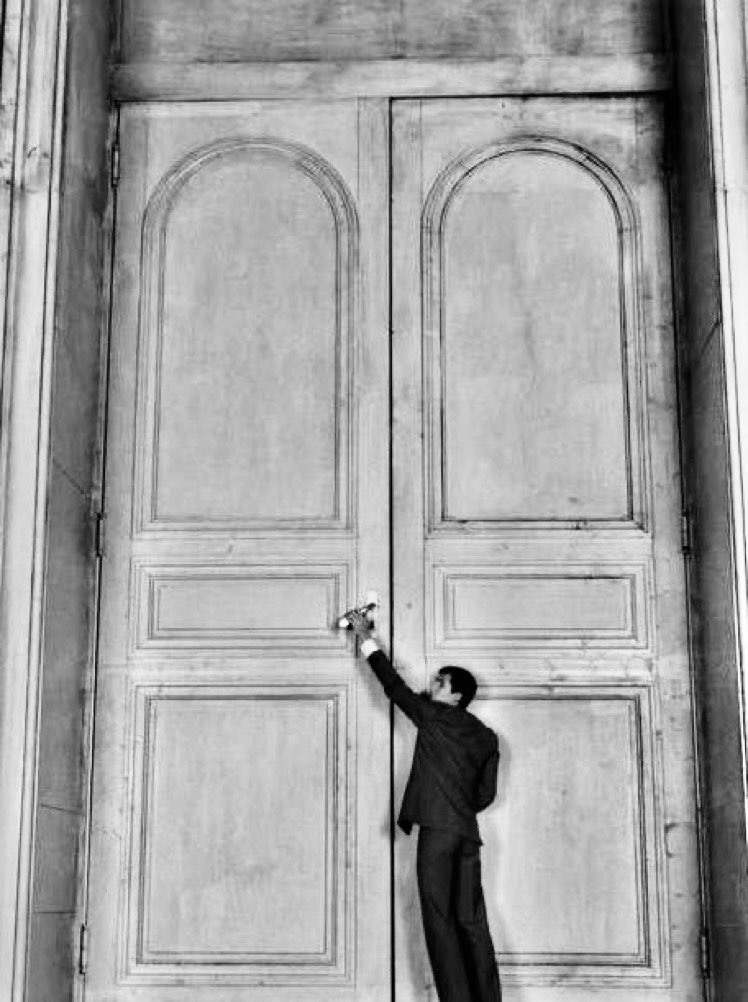
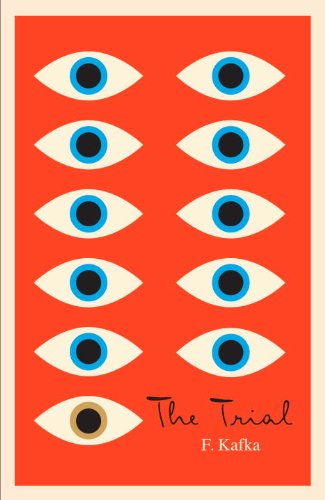
THE TRIAL by Kafka was ideal holiday reading. I may judge books by their covers after all. For a long time I avoided these new editions from Shocken Books because of their slick minimalist covers, whose bold colors and obvious eyeball iconography rubbed me the wrong way. I took them to be lazy and trendy reskins of facsimiles of older translations, similar to Vintage’s monochrome covers for Camus books. I was ignorant of Shocken’s publication history with Kafka in the 30s, in the context of a pro-Jewish cultural assertion against Nazism, and that in the case of THE TRIAL the new cover came with a new translation by Breon Mitchell, one that, according to his preface tries to preserve both the foregrounding of, one, legalese and other professional idioms that are woven in the text (for example, the opening line uses the word “slander” as opposed to the mundane “telling lies”); and two, the general rough character of Kafka’s prose, with its irregularly placed subordinate clauses and massive unbroken paragraphs. These aspects were eclipsed in the translation by the Miurs.

THE TRIAL opens with an absurd scene that from the beginning is presented in a theatrical way (and theatre jargon is used throughout the novel along with legal terms). Every dramatic beat is a comic reversal: K. rings for food, and his arresting officer enters the room, saying, “You rang?” When K., sitting in bed, explains that he wanted the landlady’s cook Anna to bring him breakfast, the stranger goes to the door, opens it a little, and calls into the next room, “He wants Anna to bring him breakfast,” and “a short burst of laughter” comes in response. Ever agitated, K. wonders if what’s happening to him is a joke by his coworkers for his 30th birthday, and worries he’ll come off bad for not taking a joke. He tries to cooperate by offering his papers, but the men in his home take this as an obnoxious play: “you’re behaving worse than a child. What is it you want? Do you think you can bring your whole damn trial to a quick conclusion by discussing your identity and arrest warrant with your guards? We’re lowly employees who can barely make our way through such documents, and whose only role in your affair is to stand guard over you ten hours a day and get paid for it.” But then when K. protests his innocence (to a charge that is never made explicit), they chide him for making a claim in ignorance of the Law. 

K. is in a game with no correct moves. Such is the atmosphere of dread and anxiety in Kafka’s fictive worlds. It is not a “totalitarian” or absolutist bureaucratic society that is the host of this arbitrary, inconsistent, pervasive and petty legal antagonist. It is in the Family structure where such oppression comes into play. The court of THE TRIAL uses the homes of its employees and defendants, in a series of running gags where furniture is being constantly shifted around the room, like stagehands preparing a scene for a play. But lest we get carried away with all this laying bare of the devices of fiction, the priest slash prison warden in the cathedral reminds us to respect the basic narrative integrity of the texts we consume. When K. imposes his reading of the parable of the Law and the door that climaxes this book, the priest critiques him with this remark: “You don’t have sufficient respect for the text and are changing the story.” This line could be addressed to all who say THE TRIAL is simply a dream, or an allegory, and not a story of an individual man, one who, for all intents and purposes, is real. And he really is guilty.

#

(source)

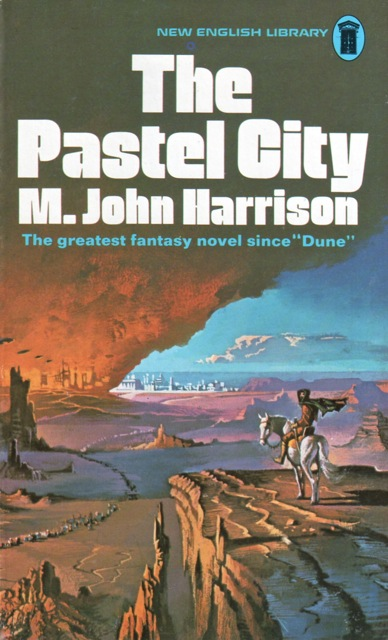
M. John Harrison wasn’t even on my map until 2020 when his latest novel, THE SUNKEN LAND BEGINS TO RISE AGAIN, took the Goldsmith Prize. It’s funny that I’d never heard his name in the same breath as Sturgeon or Le Guin, because he is another fantasy writer with excellent prose. Really, he is another great British master from the 70s I didn’t know about in my typical American ignorance.

PASTEL CITY is about and is another name for VIRICONIUM, a city/statelet in a world that has seen better days. This civilization sits atop layers of detritus from earlier, more advanced societies, so like pulp operas or like Wolfe’s BOOK OF THE NEW SUN, you get swords and sorcery in a landscape full of SF gadgetry.

We follow Lord Cromis, a warrior-poet who sets out to regroup the posse of knights called the Order of Methven, who defend the young Queen Jane, currently in a civil war for the throne of Viriconium with her half sister Canna Moidart. It’s like a western, only the landscape is one of rusted metal. And there are mechanical birds.

The “Lord of Birds” who created these cybernetic familiers resides in the tower of Cellur, an Orthanc-like obsidian structure in the marshes of Cladich. Harrison’s writing is like Le Guin’s in the sense that the quality of the prose isn’t flashy or ostentatious, but simply in the satisfying way in which the words “snap” together. The first book of the VIRICONIUM cycle is a straight ahead SF novel with all the proper western plot beats, but there’s still an extra layer of elegance in the phrasing and word choice. Here’s the description of Cellur in PASTEL CITY:

They reached the tower of Cellur in the evening of the second day. Cresting a ridge of pitted dolerite, they came upon the estuary of one of the unnamed rivers that ran from the mountains behind Cladich. Luminous in the fading light, the water spread itself before them like a sheet of metal. High black escarpments dropped sheer to its dark breaches; the cold wind made ephemeral, meaningless patterns on its surface.

Set in the shallows near the western bank was a small domed island, joined to the mainland by a causeway of crumbling stone blocks. It was barren but for a stand of white, dead pines.

Out of the pines, like a strong finger diminished by distance, rose the tower. It was five-faced, tapering: black. A tiny light shone near its summit, a glow that flickered, came and went. Birds wheeled about it, wailing mournfully, dipping to skim the water—fish eagles of a curious colour, with wings like cloaks in a gale. 

Now check out this romanticist, picturesque, more Tolkein-leaning description of the same locale 80 years later, that is also the opening paragraph of the sequel book A STORM OF WINGS:

In the dark tidal reaches of one of those unnamed rivers which spring from the mountains behind Cladich, a small domed island in the shallows before the sea, fallen masonry of a great age close faintly under the eye of an uncomfortable moon. A tower once stood here in the shadow of the estuarine cliffs, made too long ago for anyone to remember, in a way no one left can understand, from a single obsidian monolith fully two hundred feet in length. For ten thousand years wind and water scoured its southern face, finding no weakness; and at night a yellow light might be discerned in its topmost window, coming and going as if someone there passed before a flame.

Other reads from December: more Ashbery, early poetry by W.S. Merwin (some epic fantasy in its own right), and Tolkein’s THE FALL OF GONDOLIN for the LOTR Holidays of 2021.

The utterly scuppered summation for November

Image
(Source)

Read in November: Nesbo’s THE LEOPARD (much more violent, and more of a whodunnit than the dark motive-searching of Snowman; I’m glad Nesbo is willing to mix it up in this series) | Ashbery’s WAKEFULNESS.

António Lobo Antunes’s THE LAND AT THE END OF THE WORLD

An early book that has Lobo Antunes channeling Malcolm Lowry—and to better effect, since unfortunately I find UNDER THE VOLCANO disappointing in some respects (haven’t finished it yet). It’s hard to put a word on the fault I find with it, but it’s obscure. Even though the writing is clear for the most part, though it does slur in its rhythm. The novel’s landscape and characters remain shadowy from start to finish. Whenever we’re in the Consul’s point of view a kind of deranged yet pure-hearted and idle wordplay takes up the foreground, a semantic drift that serves as a kind of touchstone of the shitfaced: katzenjammer becomes cat’s pajamas, katabasis into cat’s abysses, then Cathartes atratus and so on.

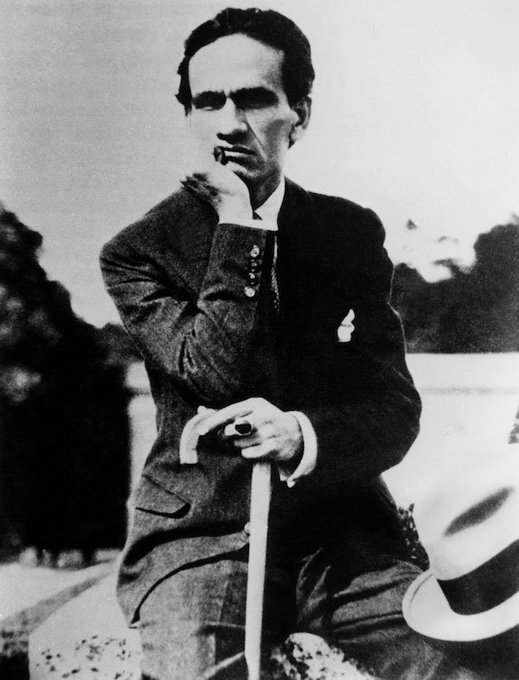
Vallejo’s AGAINST PROFESSIONAL SECRETS 

This is a wonderful collection of prose pieces and notes. There’s such whimsy coming round the edges of these aphoristic constructions.

Cuando un órgano ejerce su función con plenitud, no hay malicia posible en el cuerpo. En el momento en que el tenista lanza magistralmente su bola, le posee una inocencia totalmente animal.

Lo mismo ocurre con el cerebro. En el momento en que el filósofo sorprende una nueva verdad, es una bestia completa. Anatole France decía que el sentimiento religioso es la función de un órgano especial del cuerpo humano, hasta ahora desconocido. Podría también afirmarse que, en el momento preciso en que este órgano de la funciona con plenitud, el creyente es también un ser desprovisto a tal punto de malicia que se diría un perfecto animal.

(When an organ carries out its function fully, there is no possible malice in the body. At the moment a tennis player masterfully tosses the ball, he is possessed by animal innocence.

The same occurs within the brain. At the moment the philosopher discovers a new truth, he is a complete beast. Anatole France said that religious sentiment is the function of a special organ of the human body, yet to be discovered. One could also affirm that, at the precise moment that this organ of faith functions at its peak, the believer is also a being so devoid of malice that he could be called utterly animal.) 

I had a reading of these lines, but my booster shot for the Covid vaccine obliterated it, so that I can no longer understand what I had thought.

Vallejo is someone you want to follow as a disciple, what a scary authoritative presence. This book includes fragments from his notebooks, and just the single mention of Knut Hamsun compels me to put him at the top of the TBR. Also: “El arte según Marx: reflejo de la economía (Art according to Marx: reflection of the economy).” And “Poetas según Marx, que deben ser políticos militantes y conocerlo y vivirlo todo (Poets according to Marx, should be militant politicians who know it all and live it all).

Lately I’ve been thinking about the opening shot of SICARIO, where the federal troops creep into a view of suburban America. A story I once read in PLOUGHSHARES (I can’t seem to locate it) opens with a similar image, armed cops on the rooftop of a family home to stop a mass shooter. The same vibe is achieved in THE GHOST SOLDIERS by James Tate, a poetry collection that creates the impression that all these pieces take place in the same small town in the Midwest that is constantly disrupted by warfare, with bombs landing in cow pastures and tanks blowing away farm houses. I’m increasingly drawn to this conceit of massive, mechanized violence brought to bear on safe and idyllic places where such things aren’t supposed to happen, but of course the comfort of the latter rests on the former taking place elsewhere.

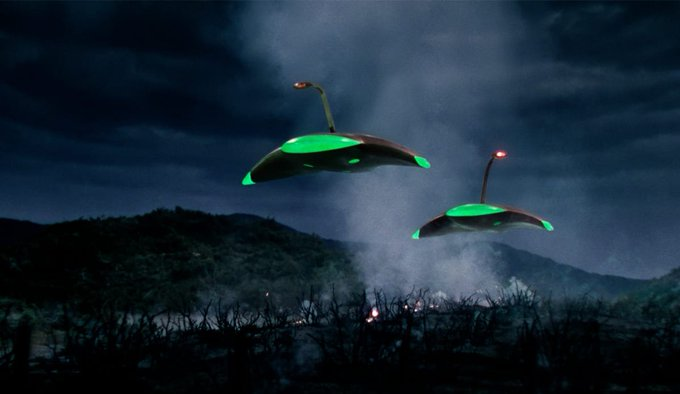
The first 30 pages of WAR OF THE WORLDS makes this point again, as ground zero for the Martian invasion is the peaceful northern London suburb of Barnet. A Sci-fi war bursts into a scene of bourgeois domestic bliss:

About six in the evening, as I sat at tea with my wife in the summerhouse talking vigorously about the battle that was lowering upon us, I heard a muffled detonation from the common, and immediately after a gust of firing. Close on the heels of that came a violent rattling crash, quite close to us, that shook the ground; and, starting out upon the lawn, I saw the tops of the trees about the Oriental College burst into smoky red flame, and the tower of the little church beside it slide down into ruin. The pinnacle of the mosque had vanished, and the roof line of the college itself looked as if a hundred-ton gun had been at work upon it. One of our chimneys cracked as if a shot had hit it, flew, and a piece of it came clattering down the tiles and made a heap of broken red fragments upon the flower bed by my study window.

I’m pretty sure the first time I read this book was shortly before 9/11, and perhaps the longer you wait before a reread, the more empowering it may feel. It goes by fast. I was moved to revisit it by the 83rd anniversary of Welles’s radio broadcast last Halloween weekend. And to my surprise the modern film and TV adaptations are pretty faithful to Wells’s original plot, but with faster pacing and other adornments.

Unfortunately I seemed to have entered a trough toward the end of November, and in the middle of producing this post, I have forgotten how to read and write.

Reflections of a Muad’Dib apologist

But see, amid the mimic rout,

   A crawling shape intrude!

A blood-red thing that writhes from out   

   The scenic solitude!

It writhes!—it writhes!—with mortal pangs   

The mimes become its food,

And seraphs sob at vermin fangs

   In human gore imbued.

Edgar Allan Poe, “The Conqueror Worm”

The new DUNE film made me happy, especially the floating lanterns, or glowglobes, with their bespoke design in the Caladan Castle. Aristocrats living in ultra modernist tombs was the DUNE I happened to want. The movie put all its money on the screen and it looked and sounded glorious. Luckily Snyder’s JUSTICE LEAGUE earlier this year put me in the mood for escapism.

I like the 1984 version of DUNE, with the qualification that the only watchable version for me is the 3-hour Spicediver fan edit. My earliest memory of any kind of media is the shot of the worm consuming the spice harvester, seen on TV. What DUNE 84 has going for it:

  • A bizarre mise en scene like futuristic rococo art. I especially loved the gilt picture frame entryway into the heighliner.
  • The music by Brian Eno and Toto is sick.
  • The Harkonnens are truly fucked up.

But I’m not tainted enough by nostalgia to prefer it over Villeneuve’s adaptation. DUNE 84 has a perfunctoriness to it, like the right elements of the book are presented in the right order, but without the connections and stakes made clear. DUNE 21 is not without its faults but it takes effort on my part to let them bother me. I suspect both suffered from producer interference and constraints, though to different degrees.

All the complaints I heard about DUNE going in turned out to be exaggerated. The fight choreography was excellent: it wasn’t THE RAID REDEMPTION but the concept of the shields and return to swordplay and phalanx warfare were kept in the foreground. Zendaya’s Dove commercial shots weren’t intrusive and in those sequences she is clearly a stand-in for the coming jihad of Muad’Dib, like a Lady Liberty, or whatever the draped woman in the Columbia logo is supposed to represent. The visuals were not bland for being monochromatic but in fact brought out the kind of tactile detail that you want from fantasy cinema. When was the last time Hollywood treated wet stones with such love?

The masses seem to be connecting to DUNE as a mid 20th century story that influenced much fantasy and SF properties after it, now adapted in a way that feels refreshing and not at all derivative, in part because there’s a rudimentary character to it all, the way the planetary environments aren’t extra in their alienness, the way folding space isn’t foregrounded in any flashy way, etc.

At the same time, seeing Rebecca Ferguson in a dark hooded cloak kept reminding me of THE SOUND OF MUSIC. Similar to Nolan movies there’s a throwback element to the roadshow spectacle movies of the 50s and 60s, specifically those turgid Roman epics (and DUNE 84 is reminiscent of THE GREATEST STORY EVER TOLD, namely in all those voiceovers). But DUNE 21 taps into the kind of epic storytelling the novel does: an impending threat whose details are only revealed slowly. DUNE needs a stately aspect to its tone; the book reads more like a popularized version of Aeschylus than the pulp tradition it comes from.

My favorite thing about the book, and maybe the principal element of its approach to epic storytelling, is the use of epigraphs. The aphorisms and the spiritual/philosophical/mystical vernaculars are fun on their own, as well as the question of who is writing these things and why. But they also telegraph what exactly is about to happen, the same way that the scene headings in Döblin or Brecht’s theater do. It’s not about suspense here but process. Who can forget “A million deaths were not enough for Yueh!” But before that is a quote from “Dictionary of Muad’Dib” where Yueh is “chiefly noted as betrayer of Duke Leto Atreides.” In other words, like a mythical epic poem, the precise sequence of events and the precise nature of the characters has been firmly established. The longer ones are like little stories.

Family life of the Royal Creche is difficult for many people to understand, but I shall try to give you a capsule view of it. My father had only one real friend, I think. That was Count Hasimir Fenring, the genetic-eunuch and one of the deadliest fighters in the Imperium. The Count, a dapper and ugly little man, brought a new slave-concubine to my father one day and I was dispatched by my mother to spy on the proceedings. All of us spied on my father as a matter of self-protection. One of the slave-concubines permitted my father under the Bene Gesserit-Guild agreement could not, of course, bear a Royal Successor, but the intrigues were constant and oppressive in their similarity. We became adept, my mother and sisters and I, at avoiding subtle instruments of death. It may seem a dreadful thing to say, but I’m not at all sure my father was innocent in all these attempts. A Royal Family is not like other families. Here was a new slave-concubine, then, red-haired like my father, willowy and graceful. She had a dancer’s muscles, and her training obviously had included neuro-enticement. My father looked at her for a long time as she postured unclothed before him. Finally he said: “She is too beautiful. We will save her as a gift.” You have no idea how much consternation this restraint created in the Royal Creche. Subtlety and self-control were, after all, the most deadly threats to us all.

—From “In My Father’s House” by the Princess Irulan

Peter O’Toole, first known man to have the Eyes of Ibad.

As for the “white savior” question, I’m the wrong person to ask. Muad’Dib is less like a space Cecil Rhodes to me and more like a space Napoleon, or Stalin. That is, given the political and economic situation presented in DUNE, the jihad represents social progress, excesses and all (like killing tens of billions of people). In my gleeful “tankie” misreading, the Muad’Dib Jihad is a good thing while the Butlerian Jihad was reactionary. Those who say the latter represents the overcoming of our slavish relationship to technology by the human spirit (including the director of DUNE 21) are appealing to humanism to paper over antagonistic class interests. The struggle against AI resulted in the conscious reversion to the feudal class mode of production, while productive relations got scrambled up, so that we have big aristocratic families with private armies that possess their own capitalist industries, treated as household management. The thing about feudalism is that technological and social development are slow as to be nearly static (whereas under capitalism, productive forces attain great dynamism), and so the Imperium reigns for ten thousand years, and behind the Emperor and the decayed planetary parliament of the Landsraad are the monopolists over space transport and the Bene Gesserit, who seem to fill a similar stabilizing role in politics as Taoist assassins did in the Tang Dynasty, to say nothing of their eugenicist plot to create a future ubermensch. The Kwizatz Haderach is a purely economic solution to the Imperium’s dependency on melange for transport (which only exists because of the ban on advanced computer science). Muad’Dib is the true solution, the destruction of clearly outdated organizational forms through political struggle, namely a holy war spreading across the universe like unquenchable fire. (Funny enough, the final result in the first book, marriage between House Atreides and House Corrino, is what could have resolved the political tension in the first place, and not the intermarriage of Atreides and Harkonnen that would serve the ends of the BG.) 

And the film makes clear that Muad’Dib is learning from what his father Duke Leto understood by his reference to “desert power,” a rather Maoist insight that the masses are the key link, not possession of land or wealth. It’s in that sense, the latent force within the Fremen’s peasant rebellion, that Arrakis is the richer planet. Say, maybe DUNE is just IT’S A WONDERFUL LIFE in space.

The MVP of the movie.