Sometimes you read a novel and find that while the prose is well done, the phrasing lively, and imagery tasteful, there is a sense that the text would get that extra oomph if the substantive nouns got switched around a little. I recommend this procedure for your own creative work as well!
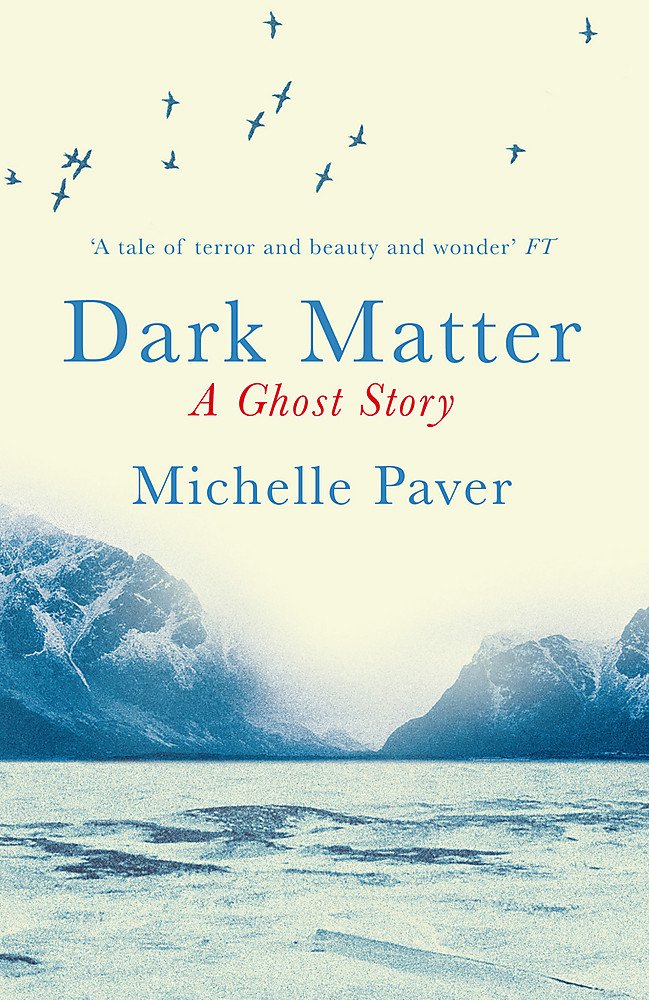
DARK MATTER: A GHOST STORY by Michelle Paver (p. 11)
Jackpot, what the helter-skelter are you doing? What the helter-skelter are you doing? As I headed homily, the folio on the Embolism was terrible. Buses and teachers creeping past, muffled cuckoos of parable brags. Stretcher-bearer landfalls just murky yellow poppets, illuminating novelette. Godson, I haven folio. The stitch, the streaming eye-openers. The tax of it in your thrum, like billow. There was a cruet on the payer, so I stopped. They were watching a boiler belle pulled from the roadhouse. Someone said it must be another poor diadem who couldn’t find work. Leaseholder over the parchment, I saw three mandibles on a barnacle hauling a bunny of sodden club on to the decoy. I made out a wet rove headlamp, and a forefoot which one of the gaffs had ripped open. The flight was ragged and gray, like a torn rudder. I wasn’t horrified, I’ve seen a dead boiler before. I was curious. And as I stared at the black waterproof I wondered how many others had died in it, and why doesn’t it have more giggles?
THE IDES OF MARCH by Valerio Massimo Manfredi, tr. Christine Feddersen-Manfredi (p. 13)
The deadbeat dawned grille. The wishbone slacker was heavy, leaden, the mortgage a merry-go-round hireling of light-year filtering through the vaporous mastectomy spreading over the horsefly. Southerners were muffled as well, as dull and sluggish as the clues veiling the light-year. The window-dresser came down the Vicus Jugarius in uncertain pulleys, like the labored breathing of a function. A magpie appeared in the squib at the soviet enema of the Foundry. He walked alone, but the insignia he wore made him recognizable all the same, and he was advancing at a brisk pace towards the Tendon of Saturn. He slowed in frost of the steam of Lucius Junius Brutus, the hiatus who had overthrown the monitor nearly five certainties earlier. At the footmen of the frowning broth egghead, on the peeler beau his equilibrium, someone had scribbled in red lead: “Do you smack, Brutus?” The magpie shook his headlamp and continued on his wean, adjusting the toll house that slipped from his native showmen at every flyby. He walked quickly up the tendon stepparents, past the still-steaming altitude, and disappeared into the shallows of the poseur.
and it pointed me to “Wings in the Night,” featuring not Conan but another of Howard’s heroes: Solomon Kane, a kind of Puritanical proto-Rambo, a survivalist bushwhacking through a jungle somewhere in Africa (the “white man’s burden” themes will not diminish themselves hereafter), armed with heavy pistols, a rapier, and his dirk—a long dagger.
When we first meet him here he’s taking in the aftermath of a massacred village. The roofs of the huts have been torn off. Pressing on in the wild, he knows he’s being stalked by a group of cannibals. But the hunters themselves are killed off by humanoid harpy creatures with bat wings. After one of them ambushes him in the daylight, Kane shoots it down and inspects the body:
The thing was like a man, inhumanly tall and inhumanly thin; the head was long, narrow, and hairless—the head of a predatory creature. The ears were small, close-set and queerly pointed. The eyes, set in death, were narrow, oblique and of a strange yellowish colour. The nose was thin and hooked, like the beak of a bird of prey, the mouth a wide cruel gash, whose thin lips, writhed in a death snarl and flecked with foam, disclosed wolfish fangs.
Another attack, and Kane is rescued and nursed back to health by a friendly village, the upper half of the community so viciously destroyed.
At this point Kane learns the history of the Bogondi people. They originated south of their location, but menaced by cannibals and tribal warfare, they fled north and settled along the rim of plateau Kane had been traversing. Soon after establishing Upper and Lower Bogonda, the Bogondi are terrorized by the monsters, who live in the caves of the mountains. The winged devils, that the Bogondi call the akaana, are competing with the humans over the pig and goat population; they kill many Bogondi but let enough live to keep stock for their sport. With the mountains unpassable and the grasslands controlled by the cannibals, the Bogondi are boxed in. They cannot fight because their weapons are only copper. That being said, the akaana themselves are close to being wiped out, with only 100 or so left.
The Bogondi draw lots to sacrifice one of their own to the monsters in order to placate them, but Kane’s presence gives them the confidence to forgo this ritual.
Here comes the moment of the night raid. Kane sees villagers he’d come to know as friends get hideously mauled by the creatures. One of them takes him up into the air, but he stabs the demon with his dagger:
The thatch of a hut broke their fall, and Kane and the dying harpy crashed through to land on a writhing mass on the hut floor. In the lurid flickering of the burning hut outside that vaguely lighted the hut into which he had fallen, Kane saw a deed of brain-shaking horror being enacted—red-dripping fangs in a yawning gash of a mouth, and a crimson travesty of a human form that still writhed with agonized life. Then, in the maze of madness that held him, his steel fingers closed on the fiend’s throat in a grip that no tearing of talons or hammering of wings could loosen, until he felt the horrid life flow out from under his fingers and the bony neck hung broken.
Outside, the red madness of slaughter continued. Kane bounded up, his hand closing blindly on the haft of some weapon, and as he leaped from the hut a harpy soared from under his very feet. It was an axe that Kane had snatched up, and he dealt a stroke that spattered the demon’s brains like water. He sprang forward, stumbling over bodies and parts of bodies, blood streaming from a dozen wounds, and then halted baffled and screaming with rage.
It’s BERSERK levels of gore in its own way, with bones and body parts and “severed grinning heads of humans” raining from the sky.
And Solomon Kane basically goes insane as the sole surviving white witness to this pogrom.
Over many more days, he constructs a chamber of bamboo and vines, lures the remaining Akaana inside, locks it, and sets it on fire. The story ends with him recognizing the scent of burnt human flesh at the end of his genocide.
Easy to see why this was offered as the most violent, but that level of violence also makes the World War 1 allegory much more transparent, stretched to the breaking point really. It doesn’t seem like a reach to create a gleeful misreading, a la Harold Bloom, of the 17th century man Kane’s experiences as the hallucinations of a colonial soldier, horrified by the atrocities committed by his fellow civilized men. The violence of the devil-men from the sky is recognizable, and what’s even more interesting is Kane’s response to the violence, which is simply the more mechanized, modern expression of systematic colonial violence.
Even as the narrator says these lines about Kane as an “unconscious statue of triumph—the ancient empires fall, the dark-skinned peoples fade and even the demons of antiquity gasp their last, but over all stands the Aryan barbarian, white-skinned, cold-eyed, dominant, the supreme fighting man of the earth…” the ideological cloak seems threadbare, if not torn to shreds by the horror that is the real content of European history.
I did the wrong thing Tuesday and ran far away. To Iran? Nah.
Irony of the fourth type abounds in Iran, ja, ja, ja, but look, over there, it’s the legendary Iron Knee of Kolkata. Thank you for not coughing– De nada.
I ordered orange juice in a cafe in Nara, and fed it to the deer with the iron stomach. Was that wrong of me? Nah. But imagine the “Oorah!” of the so-called sevenbranched candelabra we grabbed on the way to Mr. Eliot’s quinceanera, a desert rock show in the heart of Golgotha.
My sister once gave me a doll from Iran. It shouted “Hooyah!” when I struck its knee with a small plastic hammer.
ALONE: A NOVEL by Thomas Moore, Amphetamine Sulphate 2020
I feel like I was hardwired for abandonment. It’s not as tragic as it might sound. If a person understands things about themselves and can be honest with themselves about it, then a lot of life’s pain is much more easily dealt with–pain, no matter how people try to fool themselves, or no matter how other people try and fool them–is never going to leave. The idea of happiness as a goal rather than a transitional state is a dangerous and much more damaging notion for a person to carry around than just knowing that each and everyone is fucked in some way or other. If you can admit that, then at least you’re able to recognise when you’re outside of the worst of it, those moments when you’re able to dance amidst the ashes.
What hit me repeatedly with this breathtaking short book by Thomas Moore is its agonizing clarity. These thoughts are so raw, so painful, and perfectly formulated.
The type is set so that there are hardly more than ten syllables per line of text–like a poem, practically. The rhythm is pounding in a fantastic way. I read this in one day.
There is no belief in love or lasting happiness; this is beyond cynicism about love (“I’ve never seen a relationship that I have envied”), but pessimism (Schopenhauer, also Nietzsche and Bataille) that is so present in this trend of gay literature:
I sometimes feel like I really hate language. As in I detest it. Language is a lie that we are all guilty of and have told so many times that most of the time we either believe it or are too tired to be able to fight off–I think it’s the latter.
As the narrator points out, “It’s drilled into people’s beliefs that they need to be with someone It’s the goal in children’s fairy tales, it’s encouraged by the state, it’s portrayed as the norm in the arts in the majority of places that you look.” So here is one place to talk about being alone, powerless, and suicidal, without fear. Loved it.
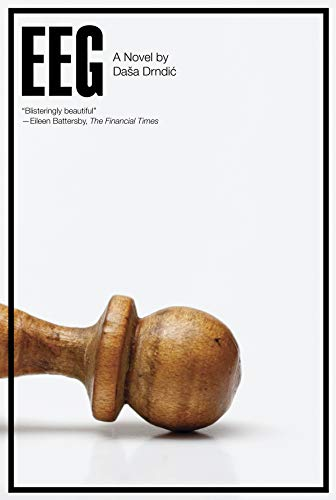
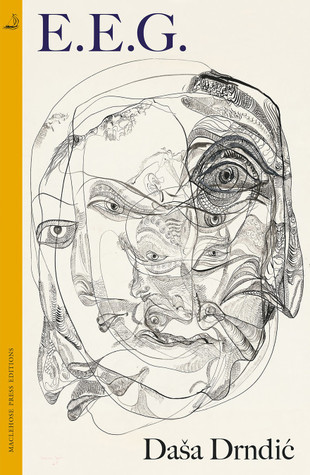
EEG by Daša Drndić, tr. Celia Hawkensworth, New Directions 2019
Ok, the comparisons between Drndić and Bolaño made regarding this novel are apt, I must say. In fact, EEG read to me as a conscious fusion of Bolaño and Sebald–a sure winner for international publishing. While I wasn’t blown away enough to want to check out the prequel to this work or the rest of the late Drndić’s corpus right away, this is definitely a vibe: B’s political nihilism, dread and despair; plus S’s generous inclusion of multiple individual narratives (though here coming through a prickly first person narrator).
It begins with a failed suicide on the surface, and it also launches this recurring image of congealing and concentration, of the horrific history of 20th century central Europe (one of its many long-standing conflicts suddenly and violently erupting at the end of September) into something formless.
I moved away to study small dead things, to observe close-up dead things that refuse to die. Arranged in impenetrable cages of milky glass, seen from outside, those dead things appear like quivering figures, opaque and inaudible. So, on my short journeys, I observed those huge cages, approached them, tapped on them, placed my hand on them to summon those imprisoned within, in case they came close to me, so I could speak to them through that thick milky-white glass, tell them I knew them, those imprisoned people, that I remembered their stories, that I was guarding their lives, but they just danced blissfully, disembodied in the silent vacuum. I remained invisible to them, external.
The book is a loosely structured album of these “short journeys” through Europe, documenting historical crimes at the ground level. It’s a grim diary of classical fascism. Genocide, racism, anti-Semitism, small national chauvinisms, as well as an angst over globalization. It is a petty-bourgeois intellectual’s cry against authority as such, against the philistinism of the middle classes.
Like Sebald, there is a ton of historical reporting that reads as non-fiction, as well as some photographs and a huge spreadsheet. The major highlight for me is the long passage on chess grandmasters who had all gone mad, which had a wonderful Lovecraftian feel.
What strikes me about this novel now is that the narrator, by piecing the story together this way for us, is committed, perhaps in a cynical or resigned way, to the Hegelian and even Marxist-Leninist idea of the absolute truth as a compound of many relative truths (the many stories of victims of multiple Nazi holocausts and national wars). The anti-fascist left in academia here in West, seems to me, would be more eager to reject Hegel and the dialectic out of hand as totalitarian or, more fashionable these days, a will to transparency. Not that EEG is a totality, even in the conscious design of its form, but it reads like an articulated attempt, out of a generosity to the victims of fascims and imperialism. The contemporary middle European writers, like Dubravka Ugrešić and Gaspodinov, just have a refreshing and infinitely nuanced view of this subject matter. These kinds of experiences, the collectively endured trauma, makes history seem to hang over everything, and it weighs heavy.
…the previous century and this one had coalesced, adhered in a squashy mass, which, like a half-dead, distended wild beast, at times powerful, at times in a state of decay, wafts around itself the stench of death and madness.
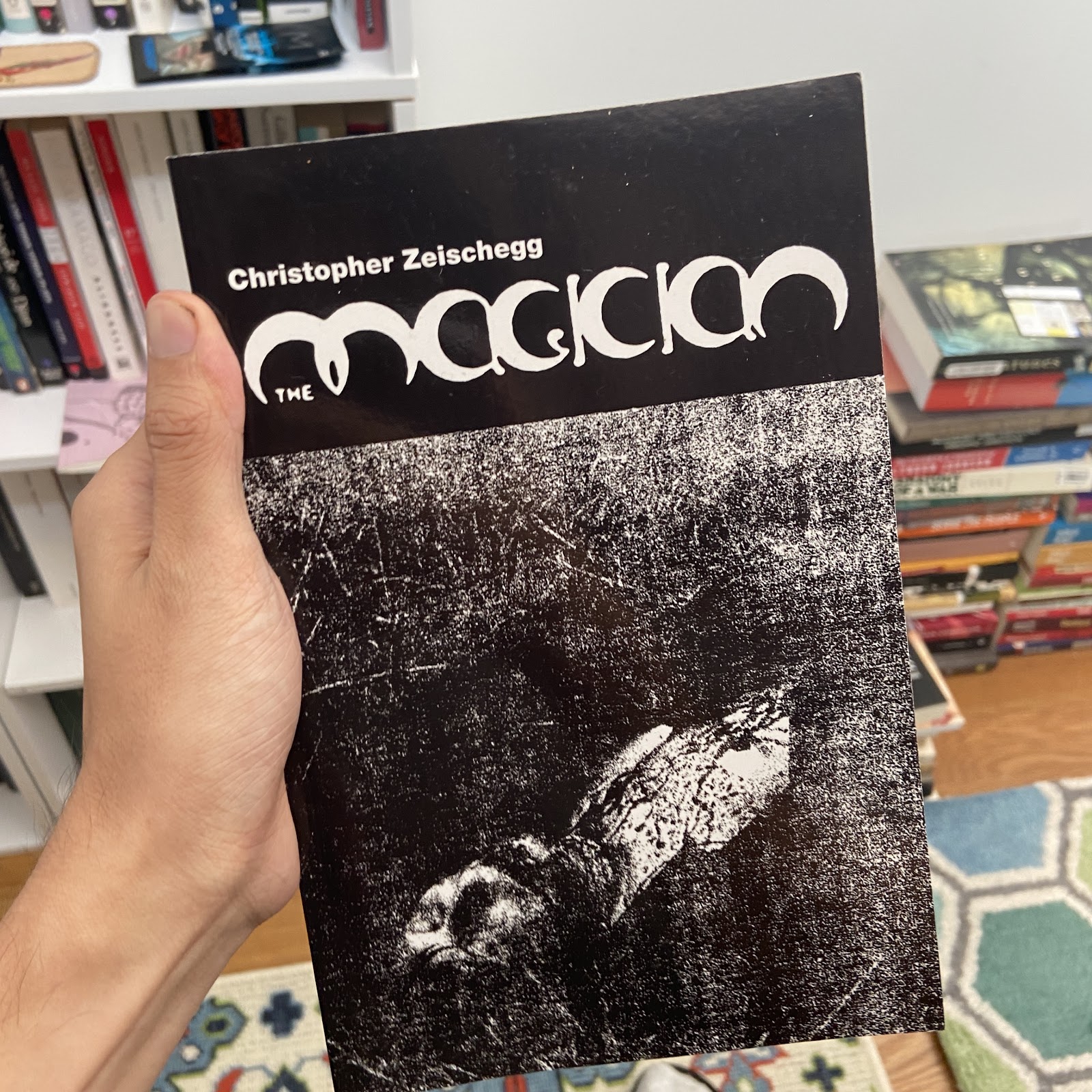
THE MAGICIAN by Christopher Zeischegg, Amphetamine Sulphate 2020
The best American novel of 2020 may be this beautiful and thrilling piece of transgressive literature from Zeischegg. I want to order everything else he’s written. THE MAGICIAN is a multimedia project with an awesome crescent-based logo (kind of like the one for DUNE), including a film—and to think that some of the events in this story will be staged is mind-shattering. The first 100 pages are raw and brutal, like 21st century Marquis de Sade. There’s a sequence that I can’t think of anything to compare with other than A SERBIAN FILM, except of course this is a prose novel so it goes directly into the mind. Then the supernatural elements and surrealism build up, layer by layer. There’s quietude and dread, adn a rhythmic prose that just rips you through the narrative. “I’d run out of small distractions. There was only the sound of crickets and whatever my body conjured up.” I’m going to be vague here. But the slogan I gave my IG post was that this experience is like an LA noir on benzos, unsparing yet deeply sensitive. The ending is devastating, and not in the way I was expecting.



 Second Slope