Confined escapism–pleasure reading in March

My immediate sense after finishing the Leonora Carrington collection produced by the Dorothy Project is that she has aged very well. Kelly Link, Angela Carter, Robert Aickman, and it seems the whole general tendency of fantastic or speculative or weird tales is toward this oneiric work that mixes the gothic with fairytales. The word for it now is fabulism. I still have this nagging feeling that SF as a whole has abandoned historical materialism in favor of thoroughly non-empirical imaginative writing. (Or what I’ve taken to be SF based to some extent on tendencies and contradictions among historical modes of production is no longer on the order of the day.) Fabulism as a concept may account for this. It also seems to create a continuity for fantastic fiction between canonical literature like Poe and Hawthorne to pulp magazines in the early and mid 20th century. The latter used to be an overhanging sin on fantasy that Jameson and Suvin used to speak of in the 70s and 80s.

And it’s not just the content Carrington established, but the style, which is plain and direct, completely transparent as it relates marvelous things. This is of course in line with the older gothic novels. Cesar Aira writes like this too. The writing is clear but it’s also loose, so that the events are hard to keep track of in your memory.

I’ve thought for a year now that Carrington is more ironical and darkly humorous than any of the above. I had that impression from her institutionalization memoir DOWN BELOW. The early pieces in this collection are terrific. Everyone loves to talk about “The Debutante,” with its face-ripping and then face-eating talking hyena, made more gruesome by the sultry narrator’s POV. But what really gets me this this moment, after the hyena has devoured the maid, leaving only her feet:

“I can’t eat any more. Her two feet are left over still, but if you have a little bag, I’ll eat them later in the day.”

“You’ll find a bag embroidered with fleurs-de-lis in the cupboard. Empty out the handkerchiefs you’ll find inside, and take it.” She did as I suggested. Then she said, “Turn round now and look how beautiful I am.”

The humor in these stories kills me, especially the ending of “The Happy Corpse.”

Many of the stories are translated from French and Spanish, and the prose there seems way more placid than the ones written in English, where a reflective tone and social observation come out. This is the opening of “White Rabbits”:

The time has come that I must tell the events which began in 40 Pest Street. The houses, which were reddish black, looked as if they had issued mysteriously from the fire of London. The house in front of my window, covered with an occasional wisp of creeper, was as black and empty looking as any plague-ridden residence subsequently licked by flames and smoke. This is not the way I had imagined New York.

The animals, the detailed designs of objects, the dark forests, the rotting meat, the rituals and magical correspondences, the tension between domestic comfort and wild freedom: all of these elements express unique insights about a woman’s position in Europe—”The Neutral Man” may well be a true anecdote, like Amy Hempel’s story about her motorcycle accident. I wouldn’t protest a re-centering of the Surrealism canon on Carrington’s writing and pictures.

#
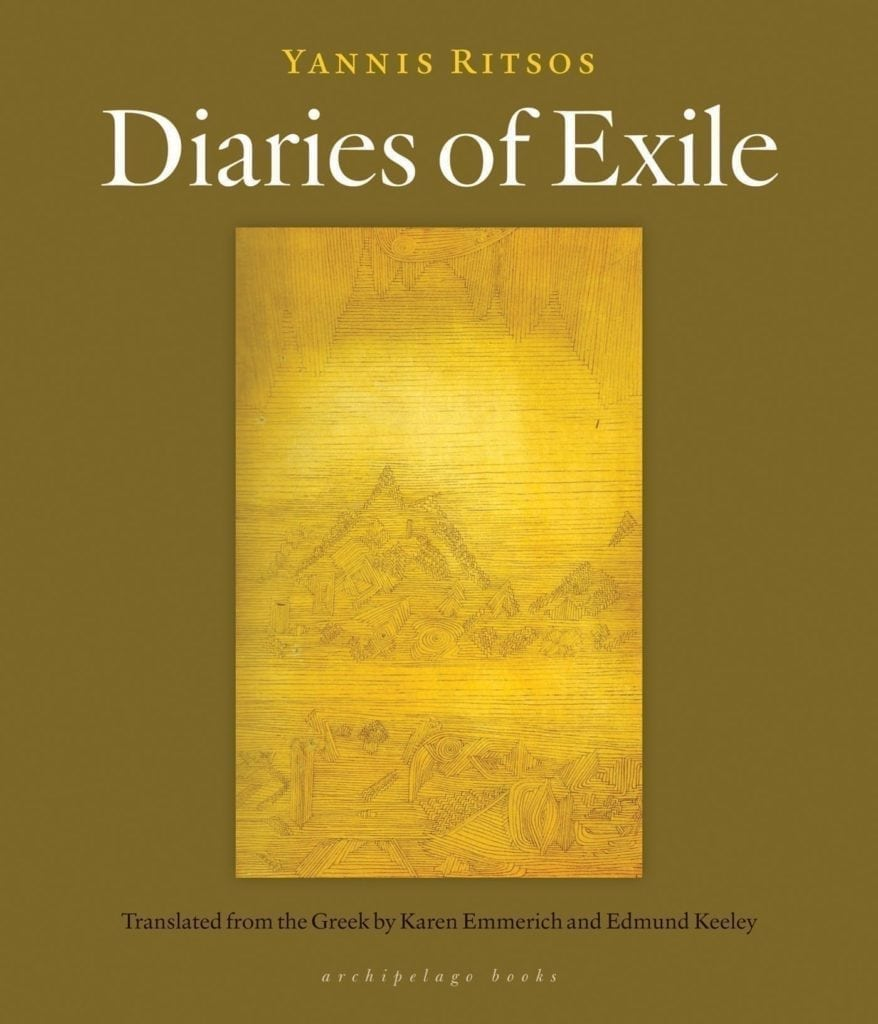
I’m struggling to talk about DIARIES OF EXILE by Yannis Ritsos. I picked it up because I wanted to read something about confinement, in light of the coronavirus situation. I was blown away by its simplicity and honesty. The poems, which comprise Ritsos’s prison diaries in verse, between 1948 and 1950, are blunt but never brutal. There is a pureness and sensitivity to the speaker, who finds a placid consolation in productive activity with other people, even if they never communicate.

I do mean simple, in its repetitive observations and images—cigarettes, cigarette packaging (a source of paper for writing) the change of the seasons in a barren place—and the sentence structures, sometimes laid out line by line. Yet they layer sophisticated ideas. The first two stanzas of “November 17” stand out to me both for this reason, the way it talks about the forms of wood, as an object of labor and as an entity of nature, and a rare bit of religious imagery.

The wind assumes its original position
the trees return to their old shape
no longer the wood of the bed-frame, the coat hanger, the wardrobe,
the wooden bowl on the villager’s round table
the wooden spoon that ladles out food
but now the tree with its branches and its shade
in the clouds and wind that strip the land of color
that dress with a certain nakedness free of forgetting and of memory
the houses, the bread, people and their works.

Things are simpler than we thought
so much so that we are sometimes startled; we stand
looking and smiling precisely there where we pressed our nails into our palm.

And then this stanza:

All this happened slowly, bit by bit. We didn’t notice.
Maybe tomorrow the old things will happen again. Nothing is certain.
But maybe out of all this will remain a tighter grasp of the hand
two eyes that gazed into two other eyes with no tilt of hesitation
a lighter that lit five cigarettes without preference;
and the number five wasn’t one, two, three, four, five,
but only a single number—five.

Of course all this doesn’t make a poem
and here I toss it onto the page like a useless stone on the stones
that will maybe someday help to build a house.

I will also remember the poem about the dog at the end of the first Diary.

The poems get sparser the further we go into Ritsos’s internment. On Christmas Day:

The window brings in the sky
in little squares.

Everything is tormented
like the old women gathering radishes.
Even the stones.

Was Christ really born in a season like this?

Plus, this passage from a letter to his sister, quoted in the translator’s introduction, may be the best writing advice I’ve ever heard:

the image is always a means and not an end in itself – we’ve said this before – you know it – you should avoid mere decoration – Don’t cover up your heart – when there’s no heart, there’s nothing at all – of course heart alone isn’t enough – but it shouldn’t be missing, either. Guard against the allure of the word, which always leads to verbosity – but don’t ever neglect that allure in the name of an emotion or of spontaneity.

#
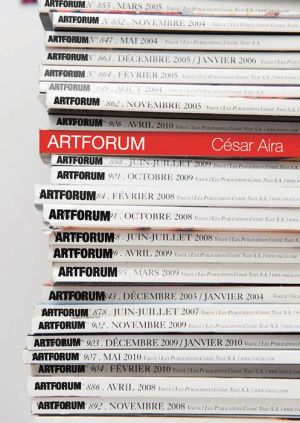
Nothing like one of Don Cesar’s short philosophical novels to clear your head. Like the last translation from New Directions, BIRTHDAY, ARTFORUM reads like a lightly fictionalized diary, about the author’s obsession with collecting back numbers of the magazine, scavenging at bookstores, trying to get an international subscription. He doesn’t seem that invested in the actual content beyond the reproductions of artistic dream states. What really attracts him are the magazine’s properties as an object, its square cut, its glossy pages etc.

Formally, the book is made of very short stories and sketches and ruminations. Some of them are dated; it’s possible Cesar wrote these pieces across 20 years and finally collected them into a very rich book, the funniest that I’ve read by him in a while.

A highlight is the first chapter, the only truly marvelous event in the plot, where an issue of Artforum sacrifices itself by getting wet to keep the other magazines on the table dry. “Can an object love a man? The entire history of animism was contained in that question.” All objects are carriers of information, and so books “fulfilled their condition as objects twice over by being specialized carriers of information; they were superobjects, because in their infinite variety and novelty they could supplant all other objects in imagination and desire.” I’d say my reading of Merce Rodoreda’s GARDEN BY THE SEA is supplanting my desire to be in a Spanish seaside villa rather than in self-quarantine in a Brooklyn apartment.

ARTFORUM is not directly about contemporary art but is about the experience of objects that aren’t useful but are enigmatic enough to appeal to us and call our attention—like broken clothespins. And then there’s the experience of waiting, its changing colors, its infinite plying.

I should write a story about what it was like to wait for it those many months, but it is impossible because the wait was made up of so many very tiny spiritual movements, so varied, that the story would never end.

Another small treat in this work is that Aira includes a moment of reflection on his mysterious writing process (I think the magazine articles are too credulous about this sometimes).

My work as a writer was a constant repetition of time’s surrender to waiting. I never could, and in fact never wanted to, write for more than one hour, and I spent the vast remainder of each day impatiently waiting for the next one. And within that hour the pattern of the day is repeated: I think of something and together with the thought comes its formulation. In a few seconds it’s written, and then I have to wait till I think of something else, something which doesn’t happen. I don’t want to dig more deeply into this, but I fear that within a few seconds that very thing is going to happen again.

This is quite theoretically oriented, similar to pages in THE LITERARY CONFERENCE, that business about “the velocity of thought and the thought itself,” which leads me to believe this is more “genuine.” Unless it’s another trick—that’s our Aira.

Another cheer for Don César

I regularly get preoccupied on Cesar Aira, go back through his interviews (especially the Spanish ones like this one for Lokunowo), dip through the New Directions translations (which I am compulsively collecting–I’m compelled to take in his whole translated body of work as it comes; the nature of his work seems to demand it).

Had a hard time getting into CONVERSATIONS, but today (Nov 23) I started a reread of GHOSTS, which I read way too fast and too distractedly the first time, because these opening pages are thrillingly gorgeous. Aira is linked with me right now to Magritte. I always liked Magritte, but sometimes I wonder if it’s kitsch. Only the paintings full of commodities, perhaps, but kitsch isn’t merely illustrative technique. Magritte was an ad illustrator for a living, and his surreal pictures have the same instant readability. So too with Aira and Gothic novels in general — opaque, materialist styles come from Modernism — no, the narrative is linguistically transparent, all the more to see the romantic, magical content.

In the long first paragraph, which feels very 19th century with its floor plan and set dressing and portraits of people coming and going on business, the actual first glimpse of the ghosts in the prime apartment building are slipped non-nonchalantly in a series of images.

A woman in violet was catching her breath on the stairs between the sixth and seventh floors. Others didn’t have to make an effort: they floated up and down, even through the concrete slabs. The owners were not bothered by the delay, partly because they didn’t have to make the last payment until they took possession, but also because they actually preferred to have a bit more time to organize the furnishings and fittings.

Another image, of two naked ghosts sitting on the TV dish, “a sharp metallic edge on which no bird would have dared to perch,” evokes a stillness that gets picked up with the young mortal workman balancing on a dumpster with an empty bucket.

The only unusual thing about him was that stillness, which is rare to see in a person at work, even for a brief spell. It was like stopping movement itself, but without really stopping it, because even in those instants of immobility he was earning wages. Similarly, a statue sculpted by a great master, still as it is, goes on increasing in value. It was a confirmation of the absurd lightness of everything.

Suppose that these elements, the workman in his pose with the bucket, the reflections on wage labor and the contemporary art market, are in fact dictated by chance as Aira claims with his flight forward method. Somehow we still get, at least here, a thematic progression. The class contradiction is taken up from here in the portrait of the architect Felix Tello. The narrator reflects on page 10 that Tello is caught between bourgeois and proletariat, and from his perspective they are almost two of a kind: neither hang on to their money, because they both need to seize whatever opportunities come their way — it actually makes  sense. This clarifies the class contradiction in one way, but the thought is also tethered to Aira’s dream world, a world of the id (defined against Tello’s ego), which is all expenditure, all ludic play, and no work.

And the bit that’s hard to forget, with the two proletarian ghosts. Naturally if there are ghosts in the story we want to know how they interact with matter. This passage answers with something whose plain cartoon otherness is just as easily mediated as that wonderful last construction, “the lowest string of a Japanese harp.” And the details of “naked” walls and paving.

A builder who happened to be passing by with a bucketful of rubble on the way to the skip stretched out his free hand and, without stopping, grasped the penis of one of the naked men and kept walking. The member stretched out to a length of two yards, then three, five, ten, all the way to the sidewalk. When he let it go, it slapped back into place with a noise whose weird harmonics went on echoing off the unplastered concrete walls and the stairs without marble paving, up and down the empty elevator shafts, like the lowest string of a Japanese harp.

Every Aira book lays bare the common device. We have a narrative that imitates a 19th century family chronicle; indeed, what we really have a version of the bourgeois interior that is the fuel for fine art. Laying it bare means creating this comical situation where it is still being produced (and the producers are still present).

Some jottings on Don César

THE LITTLE BUDDHIST MONK / THE PROOF
César Aira, tr. Nick Caistor
New Directions, 2017

Exhaustion. In his interviews, Aira seems to take seriously an idea from Ortega y Gasset, that literature is like a mountain, and its practitioners are mining it. Which makes literary art a finite resource that can be exhausted. And that’s why his books are so lean, not just because he likes to be elegant, or respect his readers’ time, or that his Louis Aragon or dada-like fantastic narratives are hard to sustain for long, but simply that this mode of production is on its way out.

It’s edgy to elegize for the novel, but believing or pretending to believe that art is dead is the right position to be in for creating. And besides, it had a beginning; surely it has an end. Literature could have died in its sleep a generation ago, and  now carries on in an afterlife, much like liberalism.

Infantile disorder. The tonal whiplash and narrative switchbacks in Aira’s work remind me of the way kids tell stories, a storytelling that’s hardcore diachronic: and then, and then, and then. Just as it’s said somewhere that Picasso once visited an exhibit of art by children, and remarked that it took him years to learn how to draw like that. This return to a more naive space is in keeping with surrealism (between automatic writing and OuLiPo’s input-based creation) as well as Utopian SF or fantasy (Olaf Stapledon).

The commitment to high modernism remains, but there’s no more desire for grand, solemn mega novels that strain to capture the totality of bourgeois or monopoly capitalism. The Joyces and Musils and Prousts and Manns that amount to secular religions.

Absolute Formalism. Aira’s books are so overwhelmingly about themselves, about their own aboutness in the way the formalists wanted them to be. Their content is a projection of their form, of the elements selected to build the story. It’s most obvious in VARAMO, while MIRACLE CURES OF DR. AIRA presents a mystified version of the creative process. As with Kafka, there’s a risk of turning his stories back to realism by reading them as social parables. On the other hand, the weirdness of Aira’s books, as I read them, are about renewing our own perceptions of literary theory.

Which is why I felt that THE LITERARY CONFERENCE is a jab or at least an elbow nudge against Carlos Fuentes. The giant blue silkworms that lumber down the hills and attack the city, are they not like that writer’s mega novels and others like his? The threat is overcome by the narrator’s device that was a prop for one of his plays — a retreat or regression to fairy tale logic. (Fuentes giving the Nobel to Aira in one his stories is no less of a backhanded compliment.)

How to apply the word novel vs. novella is really inconsistent these days. Novellas were more easily distinguishable in the 19th century institution of the triple-decker novel that allowed library systems to loan out the same work to three people. But now most novels aren’t that long, besides the few middle-brow prestige pieces that come out in the US each year. Novels can be any length these days, and Aira’s output then addresses, not formalism, but the redefining of the novel form itself. Perhaps they aren’t novels at all.

Revolutionary break. I’ve never totally loved an Aira book right away, except for EPISODE IN THE LIFE OF A LANDSCAPE PAINTER and HOW I BECAME A NUN. Other than those two, I finish them thinking it’s second-tier Aira and wait for them to grow on me over the weeks till I know it’s a new favorite. THE PROOF’s own narrative switchback into a genre of surreal ultra-violence has tyrannical reign over both that story and the whole book. But that’s also appropriate.

Two young women named Mao and Lenin hold up a supermarket in the name of love, as the Love Brigade. It’s amusing to read this under Cold War liberal programming: revolutionary situations as a terroristic surge led by hopeless Utopian romantics. But then again, was Marxism not a product of Romanticism, if only as a rebellion against it? Forget thesis-antithesis-synthesis. Real dialectics means appearance-reality-appearance again.

Aira never respects the reality principle, but even then the very end of THE PROOF goes beyond unreal. As the store catches fire, we read about one woman whose body melts until she’s like a Modigliani painting on crack. It appears this mundane “revolutionary” act (all the world’s a supermarket in globalization) has torn the fabric of reality apart and anything is possible, is aesthetically legitimate.

Which is why Aira’s work I think speaks so earnestly to our historical moment. It’s a different tack from Roberto Bolaño, who usually stays close to realism in order to show us why such a commitment is no longer truly possible. The liberal consensus in the last couple of decades has become more authoritarian as per the needs of the ruling class. In our own country, NFL workers taking a knee during the anthem is unacceptable, let alone taking to the streets in a serious stance against white power and its servants in the police force. That’s just one example of the hard constraints on political imagination (insert the obligatory quote of capitalist realism and imagining the end of the world here). Thinking also of the appalling repression on J20, and the situation in Argentina today.

I won’t say that Aira’s is the authentic realism for today. Just that his way of producing stories do the urgent work of presenting any and all alternatives to what we have. It’s hard to see exactly how his work upholds the historical perspective of the proletariat. But that may be precisely it: such a historical perspective has been lost in the wake of the end-of-history 90s (9/11 not being a wake up call for the global metropolis but the trigger for denial), as well as the disembodiment and amnesia that makes up the spectacle, the culture of late capitalism.

Around the same time I was flying through Aira’s translated ouvre, I read an incredible insight in Jameson’s POLITICAL UNCONSCIOUS. It may well have been what permitted me to start writing fiction again. What he said made me realize that it wasn’t realism that bothered me. Realism is noble, difficult to do, and, if the Marxists are right, the plebian weapon of choice against aristocratic form. What I couldn’t stand in today’s literature was the reification of realism. So there’s a new notion of what is realistic, aside from the reality principle and character psychology: that which simply keeps the historical dialectic going in its own representations. Those books are to be prized, especially as our own literary darlings seem hellbent, more often than not, on stopping it.