Someone set us up the bomb–translated literature in July

ALL FIRES THE FIRE
Julio Cortázar, translated by Suzanne Jill Levine
New Directions 2020

All eight stories in this collection are masterful. I bought the new New Directions paperback with its own spine number and everything, but it’s a reprint of a Penguin-Randohouse edition from the 50s or 60s. I’m forever indebted to Cortázar for the Axolotl story, which taught me about the placement of details and how they transfer the tension around a narrative. The pieces here have depth and control, and spacious paragraphing. And the endings are so perfect.

THe first two, about a days-long traffic jam bringing about new social relations, and an accelerated Garcia Marquez fable where a family household conceals death and illness from Mama for her health’s sake, were terrific. But I have to say what stood out was the title story and the one before it, “Instructions for John Howell.” The latter is a single paragraph describing how a theatergoer gets roped into the performance during intermission, an avant-garde gesture that turns into a prolonged mind game that turns into a possibly genuine intrigue.

But the experimentalism at work in “All Fires the Fire” is indeed pyrotechnical; and these long running paragraphs call attention to themselves here because two completely different scenarios, one in ancient Rome and the other in a modern apartment, begin to run together. In the first story, a proconsul gets revenge on his wife by sending a gladiator she desires to his death; in the other, a rake of a boyfriend has a phone call with the woman he’s cheating on. The narrator speaks fatalistically, of a “cruel and monotonous succession of events,” or “unavoidable continuation of action.”

There is also someone on the phone line calling out numbers. 

On the line there’s a crackling of mixed communications, someone dictating figures, suddenly a silence still darker than that darkness the telephone pours into the eye of his ear.

This third strand is like a peak into the story’s underlying code or algorithm. This is truly classical hermeneutics, where the Greek and Hebrew letters of the holy texts can be switched around, or converted into significant numbers.

The minimal collage on the ND cover is a great illustration of what the story is doing. The continuity is the all-consuming eternal fire that makes up the Heraclitean universe. 
FOUR BY FOUR
Sara Mesa, translated by Katie Whittemore
Open Letter 2020

“You do know, you dear thing,” says the narrator in THE TURN OF THE SCREW by Henry James, “only you haven’t my dreadful boldness of mind, and you keep back, out of timidity and modesty and delicacy, even the impression that, in the past, when you had, without my aid, to flounder about in silence, most of all made you miserable.”

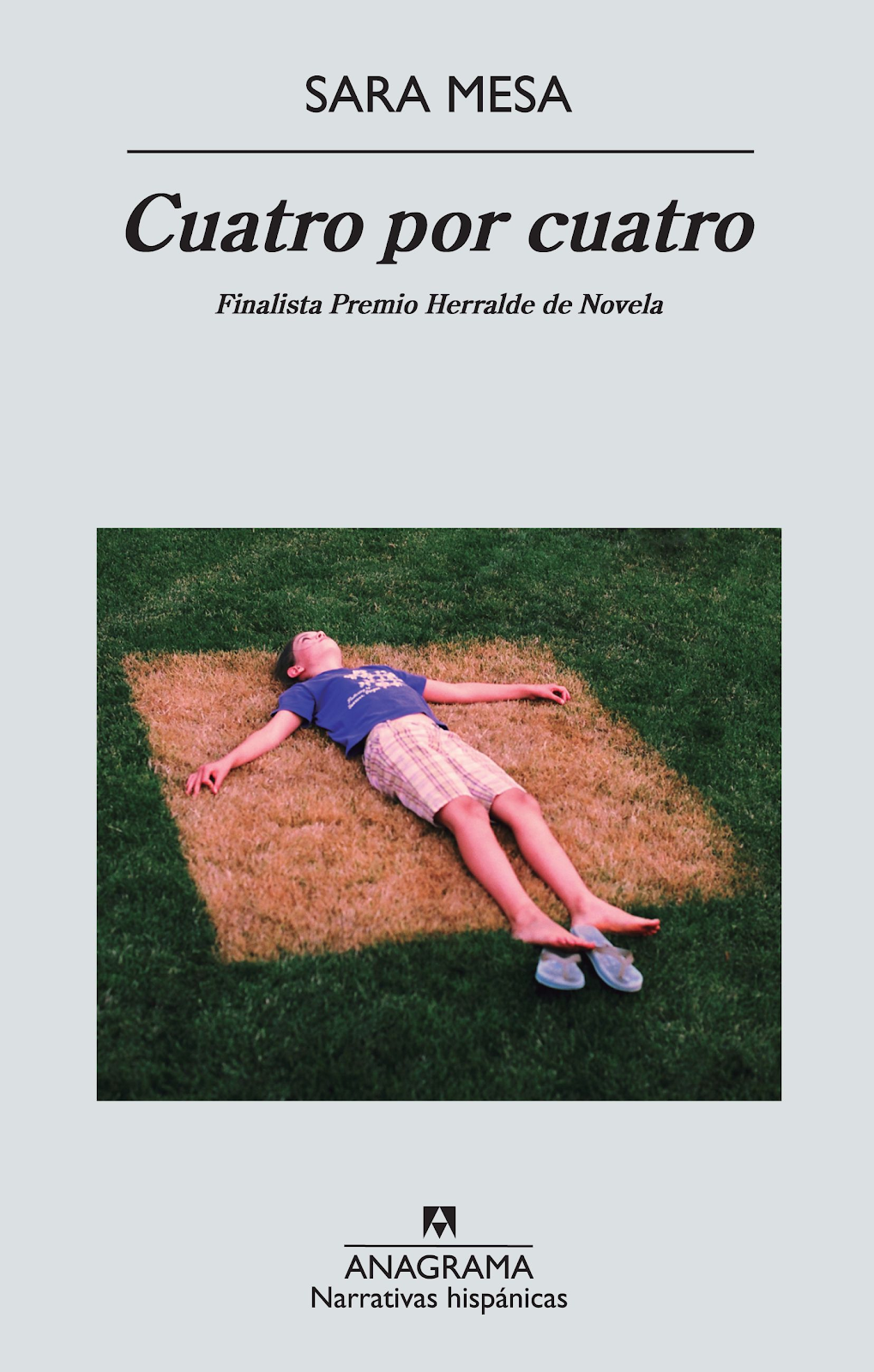
Sara Mesa’s FOUR BY FOUR is in the same gothic feel as that text, steeped in sexual anxiety and implication about children in danger. We’re in a surreal boarding school for well off children, in the English style, yet appearing as if out of nowhere in Spain. Some of the children are here on scholarship, and their parents in fact work as custodians. A mystery is afoot and it seems like the administrators and faculty are hiding something. It unfolds like a Hardy Boys mystery as interpreted by Luis Bunuel.

These are simple sentences but what keeps it from going down too easily is how spaced out and elliptical the narration can become. There are two main parts, one anchored around the students, and the other in the form of an impostor substitute teacher’s diary, a hilariously unreliable narrator, whose recurrent blackouts bring to mind the madness of a Poe story or maybe an extremely hapless Philip Marlowe. Coverups, power games, institutional depravity, and owls taking flight at dusk. There’s also a political dimension, a transparent but creative allegory for “totalitarianism,” of security versus freedom. If you’ve checked out Foucault or Agamben these will be very familiar ideas. This is the postmodern analysis of power, which is divided into two forces or “techniques”: the political technique, where the state integrates natural life into its operations and reproduction, “biopolitics” and so on; and the technology of the self, through which you bind your identity and consciousness with an external power. Mesa’s story makes this all more concrete, and shows how in this framework resistance and revolution are impossible. I keep coming back to Zygmunt Bauman’s point about the “liquid modern society” that prevents the struggle for freedom by convincing the people that they are already free. 

There’s also a link between controlling the lives of students and grooming them to be sexual servants that has not left my mind once established.

At one point, the substitute talks in his diary about writing, and the thought links all this authoritarianism with “autofiction” as a kind of behaviorism; a mechanical reporting of every outside impact on the writer’s consciousness; who the writer is is almost irrelevant.

I protected myself with indifference and avoided facing hardship and failure. I began to keep a diary because I didn’t have to make anything up. A simple log, a methodical, factual record. If I see rain falling outside my window, that’s what I write. The only decision I have to make is whether to be concise or to describe the rain in detail. I can note how it changes over time, how heavy it falls, who gets wet and who doesn’t. Or, I can simply write: it’s raining. That’s it. I write about what happens to me, why I think it happens, how I feel about it, what people tell me, how I respond. If something doesn’t interest me, I don’t write about it. Or I write a summary, strip it of meaning. I never have the urge to make anything up or change my story. I wouldn’t be capable. My creativity has dried up, or maybe I destroyed it. Who knows.
ORNAMENTAL
Juan Cárdenas, translated by Lizzie Davis
Coffee House Press 2020

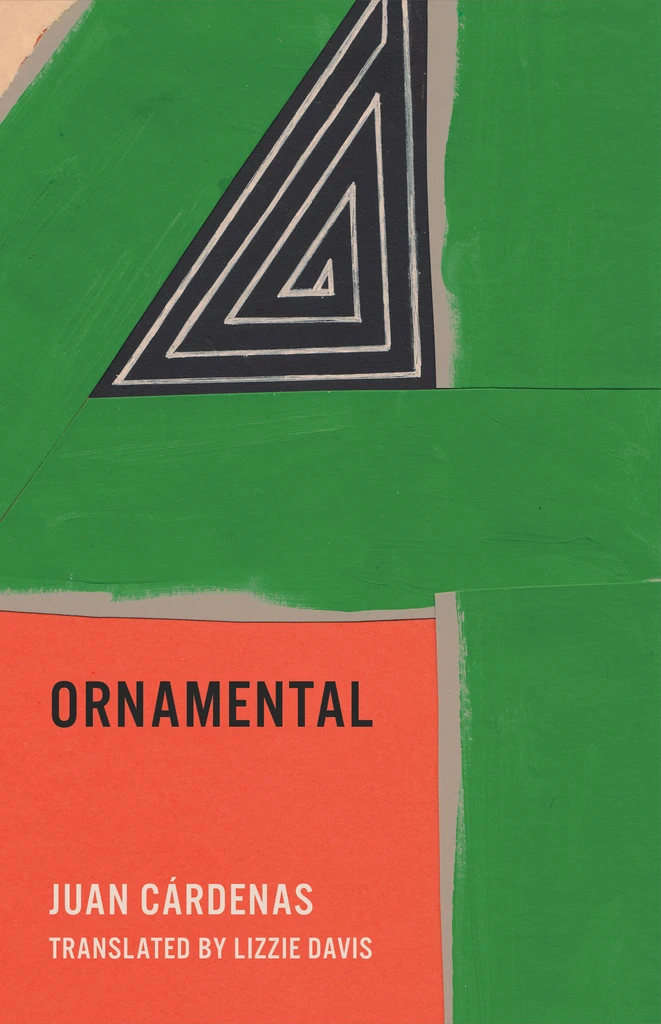
The worlds of art and pharmaceuticals collide in this short book, which makes perfect sense. Which other two industries are more saturated with the blood money of capitalism, the public face of this mixing being the decadent high life of coked out artists and connoisseurs. At the core is a brief triangle between a doctor, his wife the artist, and subject number 4 of the trials of a drug he’s developing. This is a pill for total wellness without side effects, civilization without barbarism—-and it only works for women. Whether it’s brain chemistry or philosophy and culture, postmodernism is an all-in drive toward solipsism; if the world is only full of good sensations then it is only full of good, period. This is a quick, interesting read, and the doctor, while an asshole, is more clever than, say, Houellebecq’s protagonists.

The doctor’s wife, the celebrated and tasteful artist, to me stands in for the aesthetic postmodernism Cardenas is making fun of here. Her pieces, vaguely described, are “perfect little nothings,” as Gwendolyn Brooks would say, just ornaments, or embellishments that don’t contain much meaning by themselves. But she justifies herself in interviews with the deliberate superficiality of pomo theory.

What matters with anamorphosis is the distortion itself and not the hidden form. Perhaps, as my wife likes to say, we have to completely renounce our urge to interpret.

Similar with Mesa, this is a very disagreeable, decadent world. But there is little capacity to resist or change it. The best the petty bourgeoisie can think to do here is go out into the jungle and live the libertarian fantasy of complete self reliance “off the grid.” Dreams, dead end mysteries, spider monkeys; all in all a good time.
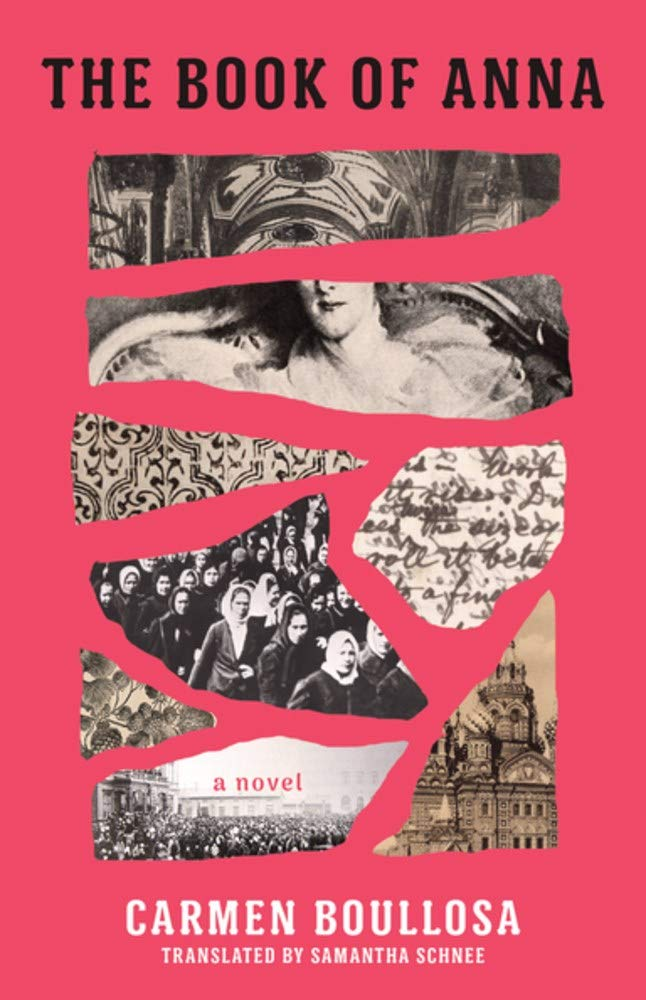
THE BOOK OF ANNA

Carmen Boullosa, translated by Samantha Schnee

Coffee House Press 2020

This novel from Mexico has such an enticing metafictional concept. The cast of Tolstoy’s great novel walk around St. Petersburg among the flesh and blood “real” or “historical” people. The effects of Anna’s scandal and suicide reach through the next generation, and it all coincides with the beginning of the first Russian revolution in 1905. The plot centers on Anna’s effects: a portrait, about which both Anna’s children, Sergei and Anya, have complicated feelings about; and a manuscript only given brief mention in Tolstoy.

To get the disappointing elements out of the way first. I found the plot to be really straightforward (a literal plot with anarchist bombs), a way to negate the entire metafictional conceit. The actual Book of Anna itself, an opium-induced fairy tale, was also better as a mystery—as with the Mesa text, the allegories were just a tad too transparent for me. In an academic way the novel wants to explore the “minor” aspects of great things (whether a great book or world historical events) the servants of the Karenin household, or the anarchist and narodnik tendencies in Russian revolutionary politics (about to wilfully marginalize themselves, since the 1905 revolution was a bourgeois democratic one, and the anarchists didn’t want to participate in it). There is nothing about the mainstream of Russian Social-Democracy or the Menshevik-Bolshevik split, and while Anna’s character and love life are explored, the discussions of class and philosophy in Tolstoy’s work are not acknowledged here. As a result, the presentation of ANNA KARENINA in this book seems one-sided and individualistic; Anna’s adultery has an entire context of a rapidly modernizing Russia, but this novel focuses on individual sexual love detached from these dimensions. (What I’m saying is this text is so determined to remove scientific socialism, as if it had been taking too much space, or as if the feminist concerns with this material will shine all the brighter; but I think the result is more impoverished.) Revisionist takes on classic literature are fine, but I get a little irked by the kind of framework that says Tolstoy failed to consider X, as these claims are almost always incorrect and made in bad faith, and seem to elide the truer purpose of fiction to lend cogency, immediacy and vividness to ideas regardless of their correctness. There is however a hidden link to V. I. Lenin: of the three Alexandras in the text (including Kollontai, who appeared in CARS ON FIRE) one of them is the sister of one of the Karenins’ servants, who happens to be named Vladimir. Her sister dies in the Bloody Sunday massacre, which in turn radicalizes him. A similar story happened to the young Lenin, whose older brother Alexander was executed for plotting to kill the tzar.

The parts of the book that were really for me were these ruminations on fictional characters given a real “ontological status,” switching ink and paper for blood and viscera.

It’s not easy to pin down dates in Sergei’s life. In 1873, when Tolstoy first wrote about him—Anna Karenina’s son appears early in the novel—and began to publish his story in the Russian Messenger, Sergei was eight years old. An eight-year-old newborn. He’s eight years old again when the first edition of the complete novel is published in 1878, but a few pages later, when the dramatic events of the novel take place, he’s two years older. So, for our purposes, he has three birthdates: 1873, when Tolstoy created him; 1865, when he was born in the novel; and 1878, when he appears in print for all posterity. For the monolingual English reader, Sergei arrives on this earth in 1886, the year the first English translation appeared; from his own point of view he was born in ‘78 (though for our purposes, he was already ten years old by then).

Nevermind how this materially happens, or how Russian society feels about it; we learned from Nabokov that being a character and being aware of it, of having been written by an author, is the most existentially dreadful thing ever. Here, it is a kind of sultry 19th century angst. Or is it that Tolstoy’s characters may as well be real, and possess a vitality literature can never achieve again?
TIME
Etel Adnan, translated by Sarah Riggs
Nightboat 2019

This collection won the BTBA for poetry, and it’s the first Adnan I’ve read. This book takes the postcard as a serious medium or poetic form, and you feel the spatial and temporal distance as well as the pining between good friends. The lines are printed here without Adnan’s correspondent or whatever the images on the postcards were. It’s tantalizing to know there was other material in this project, and you have to wonder how much meaning is lost on top of translating French verse. The lines feel super concentrated and aphoristic. These are just four separate lines from throughout the book.

if we write, it’s that we can’t sing, if we sleep, it’s that we can’t live

those who cannot leave discover the geography of the body.

and the sea is treacherous marble

The day is not made of light, but of will

Where is joy then? Chained to me, an horizon,

Objects are children of their own shadows

The collection is made of longer sequences, and I definitely loved the first one the most, perhaps because it felt the most evocative.

don’t leave the Mediterranean
without telling her that you loved her:
her daughters and her sons went
North, a day of rain, or a day
of war

as for me, I belong to the stones
thrown for lack of helicopters,
to the women locked up,
to the political prisoners;
sometimes I regret my love of
splendor

but our solar mother star,
and the lunar father, in their way,
have entrusted us with useless
objects from a forgotten century
No double bagging needed

Image

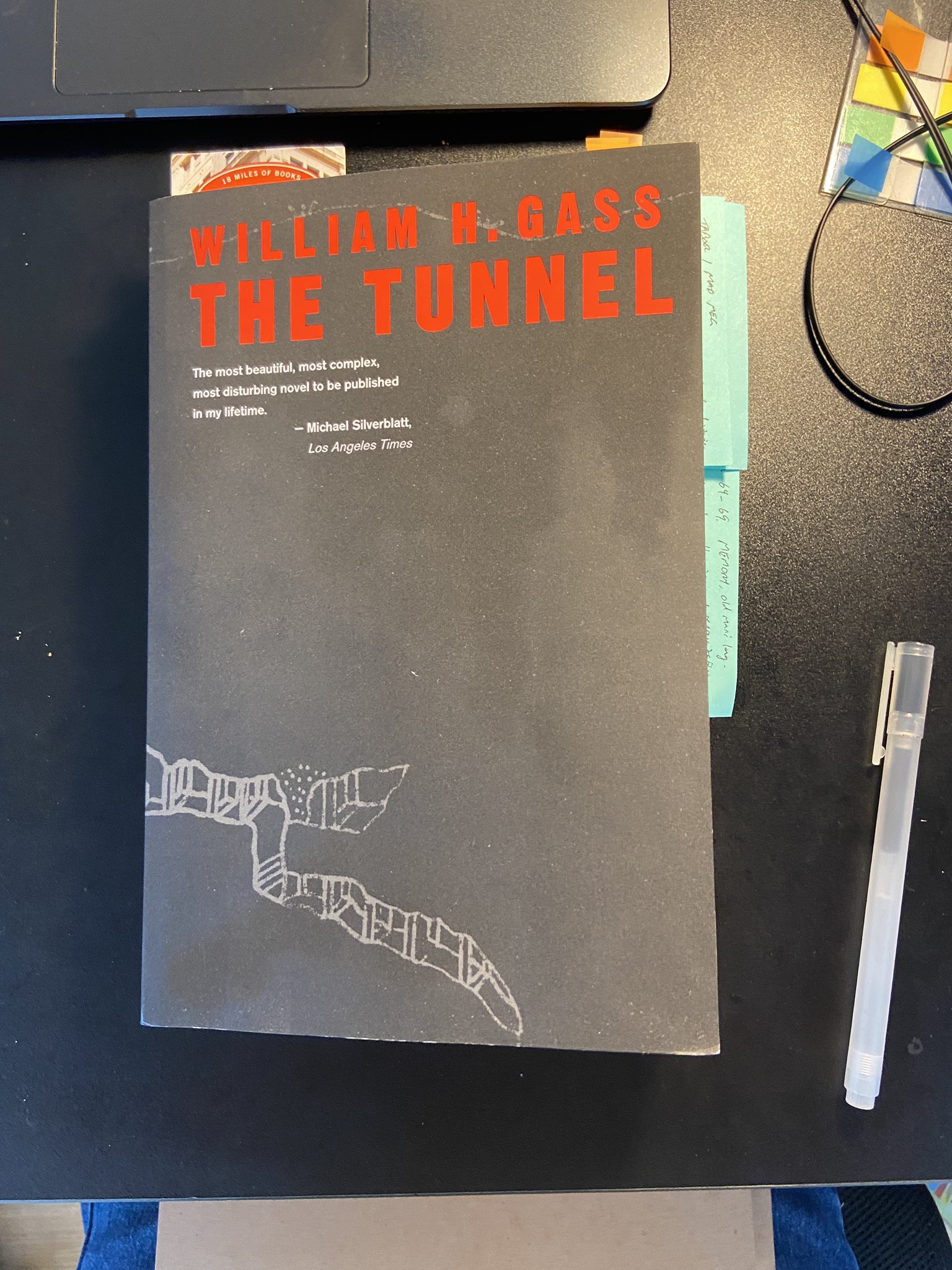
Oooofff, how I put off writing this post on THE TUNNEL by William H. Gass.

So much so that I’m two thirds of the way through at time of writing. After this I will have read all of Gass’s fiction except OMENSETTER. This is by far his greatest, most enjoyable, most consistent and sustained writing, I mean really his magnum opus, where he gave himself so much freedom and yet also displays the most control.

This was the first Gass I’ve read in a long while—in fact I haven’t read much of him since he died—and this great novel has been so recharging; I want to go back to the rest of his corpus.

After the first hundred pages or so it lets up, both the cruelty of the content (as far as representing the Holocaust is concerned) and all that restless play with typography and fragments. Then for long stretches it’s very accessible writing, easier than Henry James and Faulkner for sure.

A labor of love for three decades, THE TUNNEL came out in the early 90s, along with so many other great works of late modernism by Evan Dara, Sebald, Saramago—but I would actually single out INFINITE JEST. For Gass is doing something similar in the figures of his asshole history professor Kohler and his contemptible colleague as DFW does in his own big book: a collection of impressions and pastiches of philosophy, concepts from the bourgeois canon given “novelistic” concreteness. Except DFW was a follower of Wittgenstein and analytical positivism (the branch of Western learning Planmantee in Gass’s work is lampooning); whereas Gass sticks to Continental philosophy—much better!

How to describe? You may be familiar with TRISTRAM SHANDY by Laurence Sterne, where the author tries to write his autobiography but has inked hundreds of pages before even getting to his birth; how can he possibly catch up to the present while stuffing the manuscript full of knowledge and digressions and ravings? Similarly, William Kohler in THE TUNNEL was beginning to write the introduction to his new book, but can’t write in that rigorous academic idiom. Instead he produces these pages of sprawling, nasty, spiteful language, his hatred of everyone he knows, the human race, his fringe and off-putting interest in the history of facscism and Nazi genocide. He’s literally digging a tunnel, since there’s nothing left for him to do but withdraw. His relationship with his wife Martha is dead in the water; he’s accused of assaulting a student that he calls “Betty Boop.” He has traumatic memories of a window exploding in front of his alcoholic mother during a Midwestern storm, and of his unwashed foreskin (a hilarious sequence). He’s hiding his tunnel project from his wife, as well as the pages of this deranged book within the pages of his scholarly work, Guilt and Innocence in Hitler’s Germany. Kohler is a shallow, crass, unrelentingly cruel asshole with a ridiculously wide field of references in the humanities.

And thanks to Gass’s prose, Kohler has a poetic utterance that every so often hits Ashbery levels—but there is none of Ashbery’s warmth here; this is the voice of a dad turning around in the driver’s seat to yell at his children to shut the fuck up.

Is this novel doing anything more? A kind of transposition into Gass’s balls-out style of aesthetic philosophy and epistemology as it’s been hacked out by philosophers from the ancients up to the Germans, with lines from Rilke and a bunch of doggerel and dirty limericks stitched in? Does that intellectual meatiness need to come with graphic details of bathroom business plus Kohler’s depraved and bitter inner life, his hatred of women, and the material of the history he studies? That does seem to be the point: you just enjoy the writing so much you don’t mind that it keeps going. I never understood the people in the writing program who thought TRISTRAM SHANDY needed to be cut down. How do you edit Sterne or Gass?

And the writing can be dense as tungsten–but in THE TUNNEL, never abstract and ersatz as I’ve felt it can be in the essays sometimes. There are just really complicated, scholarly ideas that are conveyed in the “novelist way,” a flow of images and material processes. Here’s an early paragraph from his Preface to IN THE HEART OF THE HEART OF THE COUNTRY.

Literature once held families together better than quarreling. It carved a common ancestry simply from vibrating air, peopling an often empty and forgotten past with gods, demons, worthy enemies and proper heroes, until it became largely responsible for that pride we sometimes still take in being Athenian or Basque, a follower or fan. Think of the myths we’ve wrapped around Lincoln, that figure we have made a fiction in order to make him mortal. Think of the satisfaction there is in supporting a winning team of any kind. It’s no small gift, this sense of worth which reaches us ahead of any action of our own, like hair at birth, and makes brilliant enterprises possible.

There’s a lot in these 115 words, no? Daunted by unpacking all of it, you want to throw your hands up and say Just check out Walter Benjamin’s “The Storyteller,” check out the end of Marx’s 1857 “Introduction”… But we can see he’s talking about the consolidating and binding role of “literature” (more properly the epic?) in premodern times. The orality of narrative (“simply from vibrating air”). From the primitive community to sentimental nationalism. And yet also a necessary ground to make “brilliant enterprises” possible; so literature is not simply a luxury, though even if it were, lovely language is an affordable luxury as far as they go.

What’s up with this William Kohler? There are many hysterical male narrators like him in American literature of course, from Heller and Bellow and Nabokov—plus the suburban nihilism of Richard Yates. Gass supplements all of that with his philosophy; he converts classical German idealism into lovely writing that I could almost read endlessly. And Kohler strikes me very much as a Nietzschean.

Only Kohler isn’t a philosopher of the future, as much as his history book purports to go beyond ethics, beyond “guilt and innocence.” No, he’s a pudgy middle-aged reactionary asshole humanities professor who attacks his students, and he is aware of being part of the herd. He shares that contempt for self-satisfied liberal cosmopolitanism that makes up the politics and culture of modernity, the celebration of mediocrity and wimpiness that the German identified with Christianity and the democratic bourgeoisie.  This para captures it:

But the streets are full of people being obnoxious in the cause of peace. I remembered the storm troopers and the meaningful discipline of their violence. Just like Lire, their banners spoke of the public weal while their boots settled private scores. I find the weaknesses of the present—its pedestrian vices, its paltry passions, its press-agent posturing—embarrassing, as though I were witnessing a poorly performed play; and I have, in effect, left the theater. Although much of the hoopla is inescapable, I nevertheless have, as the sillies sort of say, turned in, turned out, dropped off, gone quite away into the peaceful silence of my page, the slow cold work of my cellar, the sweet reenactment of my bitter former days. (411)

So Kohler can’t be a critic or a future philosopher the way FN describes it in BEYOND GOOD AND EVIL. (This passage comes just before Kohler’s colleague Governali has a life-altering trip on LSD; the humor in this novel killed me at times!) Not even invested enough in the world to critique it, he can just be indecent and withdraw into his tunnel project. And why the tunnel? Ultimately the same reason why so much great writing has so much cruelty baked in.

With my tunnel I have committed the ultimate inactive act. After all, what is a useless hole? I can honestly say I have accomplished Nothing. (Ulysses answered Polyphemus with a similar riddle.) Such doughnut-shaped deeds have amassed this pile of paper, determined my present detachment from my work, developed my unimpinging personality—’unim-,’ yes—endlessly rehearsed these unheard lectures, projected my antiutopian visions only a darkly boarded black screen, formed there my disheveling plans. I’ve done nothing except fill her drawers with dirt. When she finds out, what then? (468)

This is partially what leads Kohler toward the PdP, the Party of Disappointed People. There’s much more to say here. I thought instead I might zero in on just one page (of a great deal of small type) that holds Kohler’s deeper take on bourgeois philosophy, specifically the materialist-idealist antithesis. These thoughts come about around a third of the way into the book, amongst cartoonish visions of tourists in hell, and a discussion with Kohler’s colleague Herschel (the conventional Hegelian amongst the history department).

By hiding our basic urges, leanings, dispositions, sometimes inside their opposite like a tramp in a tux, we make them look—feel—sinful, as Freud saw, when, of course, they aren’t in the least. And the concrete corrupts; particular cases always make their general principles look ridiculous. Even the laws of nature have to express themselves in crudities and outrage, in bee stings and earthquakes. That fan there, for instance—there’s not a thing it does that doesn’t exemplify the highest and most important principles of physics; yet look at it: how does it distinguish and ennoble them? 

Here universals, general principles, can only find expression within crude particularities. To bring in the concrete at all seems to “disgrace” or deflate the ideal. This is one way (a bougie asthete’s way) to explore that fundamental question in philosophy of the relation between thought and being.

Is there a wall or a window between the world and our sensations from and ideas about it? The line of classical idealism, from Bishop Berkeley to Hume and Kant disputes any such direct connection with independently existing matter, or the things in themselves. Hume, the full agnostic, outlawed the question entirely, whereas Kant said the thing in itself was unknowable. Any positing of an external world, of which our ideas are more or less accurate mental reflections, that is, the materialist line, was for these thinkers an illegal passage, or a positing of an external world that constituted metaphysics. Though perhaps one reason is that these bourgeois thinkers, in their pining for rational purity, found concreteness too intolerable; they wanted to get out of the world.

I’ll Marxist hat for a second and point out that in the historical materialist perspective, the more progressive classes (as the bourgeoisie was at a certain epoch of capitalism’s history) are the ones more in touch with reality in their philosophy (are more materialist).

If the materialist line that bridges the world and the ideas together is too “narrow” (as it seems to students who have imbibed so much idealist and counterintuitive metaphysics), Kholher problematizes the interaction between matter and sense through the imagery of war.

In a war, then, there is nothing to argue about: how can Body and Mind trade blows, for instance? Only, I should say, if they can find mercenaries to do the trading, and a common field for the fight. But the sword beats only upon the shield, and body thrusts itself only against another body, reason wrestles reasons not angels, feelings collide with feelings not cars, sensations interfere with other sensations—the spirit is as crazed as a plate—so that any passion which would cloud perception must find a percept willing to make itself a mist, and any part of Spirit that would trip the tongue or heat the heart will have to enlist an organ or a nerve to carry out its wishes. The Marxist believes that the mind is another organ of the body, whereas the Idealist believes the weapons fire the other way; but, in fact, the real catastrophe which their quarrel is designed to cover up is the irreconcilable divisions that cut us, not into pieces as a cake might be, but into heteronymous kinds.

Words and language introduces a wrinkle of course. It’s one thing to knock on a wooden table, and feel confident that an actually existing table has excited your nervous system and given you the sense impressions of the feel and sight and even smell of the wooden table. But words, unities of sound images and concepts, are the only way we can exchange complex ideas about our relation to the world, and of course words don’t immediately connect with the world, or as Wallace Stevens would say, there is no communion with the world.

Like many thinkers before him, Kohler believes he can transcend this ancient quarrel. Neither idealism nor materialism, but the abyss.

The One and the Many can occupy the same camp because every Many is made of Ones; but between Mind and Matter, and who knows how many other oppositions, there is no sweet little worm-shaped serpent—a pineal gland—there is no mark of recognition like a circumcision; there is only the abyss.

One mystery to crack here is the nature of the connection between all this philosophy talk and Kholer’s fascism. At a larger scale you pose that to a 20th century Europe that fell into reaction. We like to think this pile of bourgeois culture is valuable in some sense. So why was it also the earliest source of reaction (Mariategui pointed out that the first expressions of fascism in Europe came from the literary arts rather than politics). Gass put more answers out there for us in the mid 90s than perhaps anyone could have expected. 

Readers have thrown bookstores into turmoil by ordering the same 10 bestselling anti-racist manuals; do you suppose they would turn to a 650-page screed by a dickhead professor composed by a white male author for insight? Philosophy, politics, and art all swirl about in Gass’s corpus, but central all along is also the question of why we read what we read at all.

Short stories are very good for you

I’m always drawn to a book of poems when I heard it has a great sestina. And Joyelle McSweeney’s experimental lament TOXICON AND ARACHNE delivers. The poems, including a cycle of sonnets, deal with bodily toxins as well as suffering and environmental destruction. Then the book finishes with poems about the death of the poet’s infant daughter.

Her work has a driving style that is driven by sound, similar to Michael Laly, while also engaging with the established lyrical forms and the proper literary field of allusions. The pieces are also topical.

The joystick’d boys sink arrows into the ozone.

If we can’t have bees we’ll have drones.

Sometimes a line is re-mixed by ear:

like fruit loops the beak of a toucan
or fish hooks the mutilated pelican

One of the two exceptional sestinas in this collection is about the disappeared Mexican students.

McSweeney’s poems also have an element of decay and decomposition, or a sense of leaving things to nature/chance/entropy, in the form of evocative pseudo-typos that almost approach flarf: “rainment,” “doggrowl,” “Like a dog returns to her thesis,” “urne-buriall.”

These poems go right into the muck at the same time as they evoke classical forms. The grief flows through, careful and multidimensional, and yet delivered in a jaunty rush of language. Achingly beautiful collection from this year.

I want to look so young it would be foolish to think about having kids after all, I have my whole life ahead of me! I could get an MFA!

I attend the MFA thesis reading as a faculty member (of course) and cheer on our small brigade. Afterwards I want to text my friend to come to the graveyard with me so she can watch my back while I press my face in the mud in front of my baby’s grave.

Stephen Dixon is a writer I’ve inexplicably delayed getting around to even though his work is right up my alley. The title story is outstanding: an attempted suicide on the 14th floor of a NY apartment building triggers 14 story lines, the paragraphs all running together whereas an author would typically use space breaks, with the characters ignorant of all the connections. And we delightfully note that this book holds 13 stories, and considering that sometimes a building will renumber the 13th floor to 14…

Ther other standout in the collection is the Pushcart-winning “Milk is Very Good For You,” a piece of erotica narrated by Richard Richardson, in which all the dirty words are systematically misspelled, and the hedonistic escapades of mom and dad and the babysitter are interrupted by the children’s wailing for more milk. Disturbingly pure.

His writing is clear and tight, transparent not only in terms of narrative but for all these underlying algorithms and chain stories–for situations that in some cases are truly horrible and morbid.

Another collection of urban stories, by a cosmopolitan author from Chile. Bolaño is too obvious a name to drop here, but I do think Ramón Ríos is interested in failed, disaffected people in similar ways. She is plugged into the political crises that are very specific to her generation of Chileans, after what Bolaño’s experienced. Both are masters of the story in which nothing happens yet everything culminates and vibrates with significance; you have to wonder how these pieces are holding themselves together. Most of them are very short, only the middle three stories are plied out. On the surface the action is simple, but the scenes are weighed down with memory.

As he descends the stairs, he’s met with the occupations his father used to threaten him with, like a line-up of ghosts: this-beggar reading tarot cards on a bench in the square. This-numbskull selling water bottles on the corner of Atlantic and Nostrand. This-busybody reading a book, sprawled out on the sidewalk, covered with that blanket that this-guy, this-animal, stepped on yesterday as he made his way home from work on East 11th. This-guy stumbling, feeling the city’s pavement under his back. Dirty streets scorching in the sun.

Ramón Ríos chooses amazing details that just plant you in a particular time and place, like upper Manhattan in the early 90s, in “The Object.” There’s a tension between realistic and fantastic modes of narrating the same content. That story moves from a tense and tirade-heavy event with Gordon Lish at Book Culture (the 80’s realism plus the cult of the sentence vibe) out of the bookstore to outside—”we can breathe.” Then we’re leaving Manhattan on a bus, the prose gets more fabulous and “magical realist”: 

Outside, space has twisted into folds, a spiral where our very breathing grants it those multiple universes. The city fades away with every block: the city of shortage, poverty, excess, the centripetal force of fantasy, the void where bombs and fish rain down.

“Invocation” is an ambitious and fascinating two-column story that runs like a libidinal interview between two artists with a past. (The only other two-channel prose piece I can think of is the one in DICTEE by Theresa Cha.) This long story has the best and worst elements of the book. There’s a generous quotation of and reference to critical theorists which I don’t like to come across in this way in fiction, though it is pretty seamless as far as that goes. At the same time there is amazing imagery and transformations in the narration—like if Djuna Barnes were in this trend of feminist theory-driven fiction. The entire “Obituaries” sequence is amazing, capped off by the punk rock lamentation “Dead Men Don’t Rape.” I also loved “Extermination,” which complements Sturgeon’s “It” and the swamp thing mythos, while also working as an allegory that happily and wonderfully marries politics and artmaking.

Any Welt that I’m welcome to

Fingering:
Arms disarmed and explaining themselves
—Brenda Shaughnessy

That was quite a hiatus. I ended up putting most of my energy in the April/May to finishing my thesis for my masters program, which centered on Jameson’s ideas about allegory—and “national allegory”—and Althusser. I’ve talked about the connection here before. Then immediately after, the George Floyd protests and urban rebellions directed my activities elsewhere (including writing activities).

I read a lot of great literature in this period, including Baldwin, O’Connor, Anne Carson, and a full catch up is beyond me, but I can share notes on a few texts recently finished. I am also eager to blog through THE TUNNEL by William H. Gass. I haven’t dug into this great writer on this platform yet, and after another two years of graduate (over)education I think I have more of the tools needed to crack into the concepts that manifest themselves “behind” the dazzling and terrible prose style.

For the lightning round of this post I’ll start with the SF.

I gotta admit, this is the first Delany fiction that I actually finished. It helped that this a nice novella that basically reimagines Goethe’s WILHELM MEISTER’S APPRENTICESHIP, transposing the bildungsroman formula onto a planetary opera with metafictional anagrams and time manipulation. I found this early 60s work enjoyable and compelling in ways that the post-DHALGREN novels I’ve attempted (STARS IN MY POCKET and TRITON) were not.

Delany also mentions Theodore Sturgeon in EMPIRE STAR. A Sturgeon story is also talked about at length in Bolano’s SAVAGE DETECTIVES. Sturgeon has commanded so much respect–I liked the tributes to him in this book from Bradbury and Wolfe. I’ve been an intense admirer ever since I read those brilliant opening lines of MORE THAN HUMAN.

I rooted around through this first volume of the collected stories, from North Atlantic Books. Most of these are short newspaper syndicate and pulpy stories, pretty hacky, but well written. It turns out Sturgeon doesn’t hit his stride till 1940, and I love his account of bashing out “Brianna’s Hands” in one of those urgent situations that distract a writer from assigned work–I know the feeling well, and there’s a parallel dynamic with reading books too, perhaps. That story is dark and twisted, in a kind of timeless setting, like Shirley Jackson or some of Robert Aichman. Brianna is a woman with no consciousness or volition except in her hands, which literally drag her body around the house. There is a gothic pulp formula here, but all it does is support really fucked up situations and a great style.

Then there’s “It,” which is a solid monster thriller, also apparently written in a white heat of inspiration on the writer’s honeymoon. But it’s an important work–the elements for Swamp Thing, Incredible Hulk, and other giants without emotion, or a surplus of only one emotion, in comics.

An honorable mention is “Helix the Cat,” which goes on for a little while, but is a diverting exercise in rationalizing the idea of the immortal soul (with a lot of mechanics introduced).

What opens up Sturgeon’s work is not only a new market for those weird tales that can surpass the rigid conventions and cheap O. Henry twists of the newspaper story, and allow him to stretch out his prose style beyond hard boiled narrators and 30s dialog, but also these kind of basic philosophical concerns about perception and being in the world: A moldy mud golem that investigates and analyzes things (quite literally, to grisly effect); it has perception and interests, without any feeling. “Helix” has some early discussions about the sense perception of “souls” too. (I’m afraid this will be an obsession of mine for a little while as I’m going through classical subjective idealism, like Berkeley and Avenarius and all that; it will also be very useful for Gass!)

Just as useful will be this hard SF Cartesian fable from hell, available for free

I remember being terrified by this episode of LOST IN SPACE, which my dad taped off the Sci-Fi channel in the 90s. 

Consciousness, the realm of the thought, the mind, that’s the thing that creates our mental images of the world, our ideas and feelings and reflections, what would we be without it? Well, what if consciousness and self-awareness is just a vestigial object, an evolutionary glitch, a burden on our capabilities to survive, an energy sink. Maybe we’d be better off without it, and maybe the “intelligent” life that exists out there is far more likely to be without it. The aliens of this novel can do higher logic and mathematics as instantaneous reflexes, but without any thought for themselves. They operate in a vessel giving off insane electromagnetic fields that completely disturb the human astronauts, like convincing you to the core that you are in fact dead. It’s a very classical idealist notion, that you are only your perceptions, that the world you experience is something modeled from sensory inputs, the permeable membrane between self and matter. The novel explores other aspects of consciousness in a fun way: half of the narrator’s brain is cybernetic, leading to trouble with relationships, and a generally isolated kind of life.

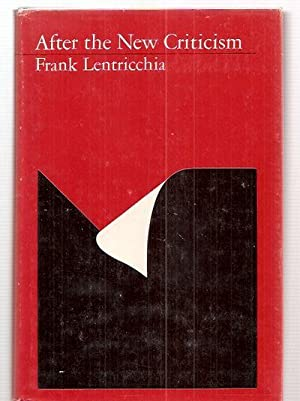
This is an amazing book. Frank Lentricchia in the 80s produced a solid, astoundingly well-written survey of American literary theory in the second half of the 20th century. He portrays this sequence—so convincingly—as a series of formalist polemics against the New Criticism, from Frye to existentialism to the American phenomenologists to the structuralists and post structuralists. Harold Bloom along with Hirsch and others get individual chapters, and even Bloom is so busy countering the NC’s attack on Romanticism that the multicultural interventions and the canon wars must have struck him as an attack on the rear. Here is Lentricchia on Heidegger’s language of earth and world:

The work of art “sets up” a world, but it “sets forth” the earth: “The work lets the earth be an earth” is the way Heidegger phrases it. What he means by this is not that the work is realistic in its portrayal of nature, but something far more familiar to readers of neo-Kantian aesthetics. In “The Origin of the Work of Art” earth is a reference to the aesthetic medium: the sculptor’s stone, the painter’s pigment, the poet’s language, the architect’s rock and wood. The aesthetic handling of medium is in brilliant contrast to the handling of medium as equipment: “Because it is determined by usefulness and serviceability, equipment takes into its service that of which it consists: the matter. In fabricating equipment-e.g. an axe-stone is used, and used up. It disappears into usefulness …. By contrast the temple-work, in setting up a world, does not cause the material to disappear, but rather it causes it to come forth for the very first time and to come into the Open of the work’s world.”

So we have the familiar formalist distinction of utilitarian and aesthetic values, of a medium which must remain unobtrusive if it is to be useful, if it is to mediate, and of a medium cherished for its own sake, set forth in its irreducible sensuous reality, as good in itself, thrusting itself upon our attention.

The whole book holds to this level of solidity, of careful argumentation and quotation. The type and design of the book is so nice too. One of those rare experiences of a theoretical text that is also just really delightful to read.

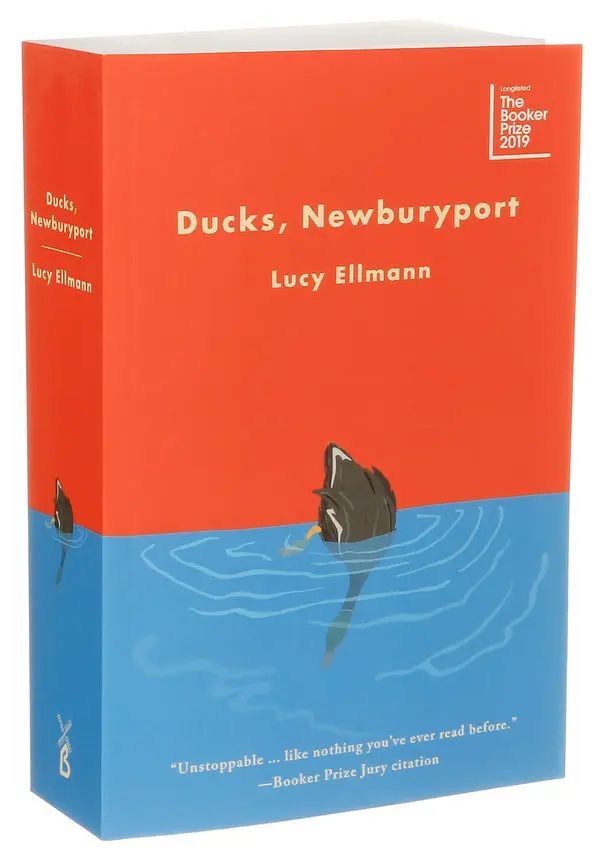
Somewhere along my insane drive to finish school I also finished up the new novel by Ellmann. I heard a lot of excitement about it toward the end of last year (plus it took home the Goldsmiths prize). Among the more core vanguard crowd of readers it might be getting a slight backlash now. I admired what this book was doing. It’s not at that supreme level of innovative fiction, but it draws on that tradition, on Stein, Lessing, Richardson, Young. It’s not that experimental or demanding, despite the form. I don’t think it’s a “river book” in the “stream of consciousness” sense (though Ohio’s rivers are important), but a spiral book, both a mental downward spiral and a compulsive circling of recurring thoughts around some absent center with no end in sight…till one reaches the unthinkable.

Basically, the form of the book is a single sentence that expresses the inner monologue of a white middle aged suburban housewife making baked goods for some extra income. She has a loving second husband and a few kids. The monologue is broken up with the lyrical story of a mountain lioness in the greater area who embarks on a quest to find her lost cubs–this is actually the A plot. There is something of a writing constraint. The Oulipo had an exercise called “Starter Text,” where every sentence of a work has to begin the same way. George Perec’s “I Remember” is the classic example, and there’s also le Tellier’s book A THOUSAND PEARLS where every sentence starts with “I’m thinking about…” DUCKS, NEWBURYPORT is driven by “the fact that.”

That idiomatic phrase is meant to point to the significance of something. But when it’s used as the main connecting points for wall-to-wall language, containing almost everything the middle classes have been worried about in the pre-Covid society, then the problem becomes the pure lack of significance or the ability to draw out significance in this flattened landscape of thought (Ellmann runs a risk in making historical tragedies seem trivial when they poke out among a collage of pop lyrics and clickbait article titles, though perhaps that is the point made about our daily lives now). Sometimes the “fact” is definitely an opinion, or a memory, or a question–”the fact that why do I remember that Amish woodshop and not my mother…” As a result a lot of the language is generic in that classically novelistic way (the fact that a single man in possession of a large fortune must be in want of a wife).

And the details of her life and history come through, her concerns with her eldest daughter, her ex-husband, the daily chores, skeevy neighbors, financial worries, family history, US politics, etc. There’s still plenty of plot, maybe even too much. I admit I found the ending disappointing for this reason, though I liked the story with the lioness very much.