See ya later, doppelgänger! October summed up

First things first.

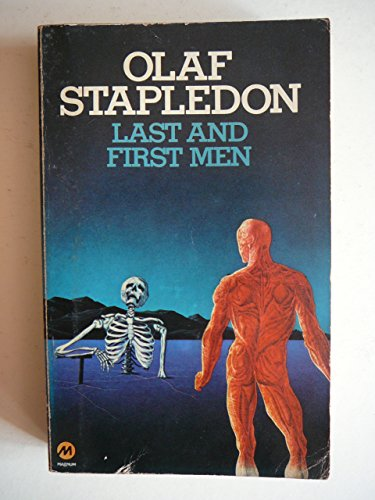
I had a new story published in Passages North at the beginning of the month, inspired by Olaf Stapledon but really more in the manner of A. E. Van Vogt. Neat! I read it out loud at the open mic in the cafe where I wrote it. There were so many stand-up comics doing sets at the show that even I got heckled. Laugh-a-minute. I put cinnamon in my coffee every day till I saw DUNE in theaters.

More reads: Anne Carson’s SHORT TALKS | Paul Curran’s LEFT HAND| Thomas Mann’s MAGIC MOUNTAIN (whew!) | Stevens’s PARTS OF A WORLD | Ashbery’s CAN YOU HEAR, BIRD | 

And a press copy of my most anticipated novel of the year, for two years in a row: WARNING TO THE CROCODILES by Antonio Lobo Antunes, translated by Karen C. Sherwood Solentino, from Dalkey Archive.
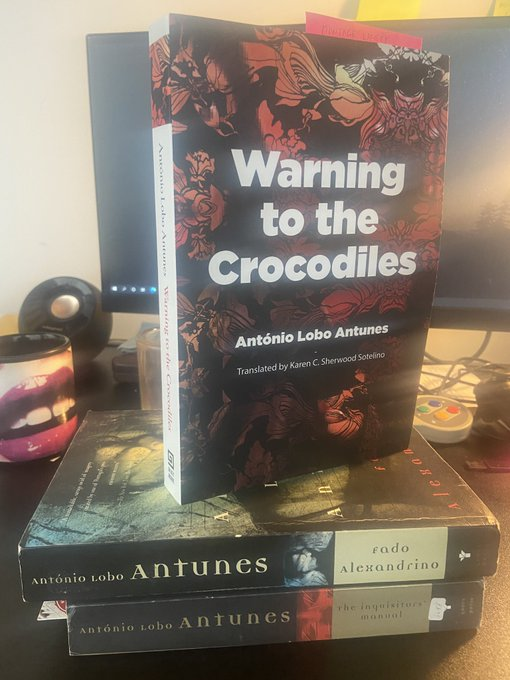
If you’re at all interested in translated literature then I urge you not to sleep on this great Portuguese novel from 1999. Lobo Antunes is a living grandmaster of literary modernism, and even all my personal hype did not prepare me to realize that this translation is very important, as this work is a summation of the tendencies in his 90s output, in the same way FADO ALEXANDRINO (perhaps his masterpiece) works as a summation of the 80s. A review to come, probably next year. As for the cover, I like the palette, and when you look past the fractal floral pattern and see that it is masking a strange image with pixelated faces, which is suggestive and fits as a depiction of the Lobo Antunes literary experience, with its ultra-subjective haziness. But my reflexive tastes definitely prefer the monochrome with red accent minimalism of Dalkey’s typical covers. Perhaps uniform covers are on their way out more generally.

Now for my trip to Norway via Fosse.

#
During the day I wrote the opening of Septology. I just started with my laptop on my stomach in bed. I write easily. Something comes to me when I sit down to write. I have never had writer’s block. […] What I experience when I write has as great an impact, if not greater, than what I experience in life. To write is to dream while awake, to place oneself in a controlled dreamlike state where one advances by listening.

Jon Fosse, interview in MUSIC AND LITERATURE

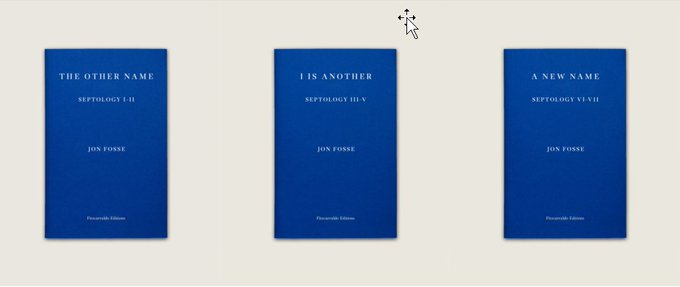
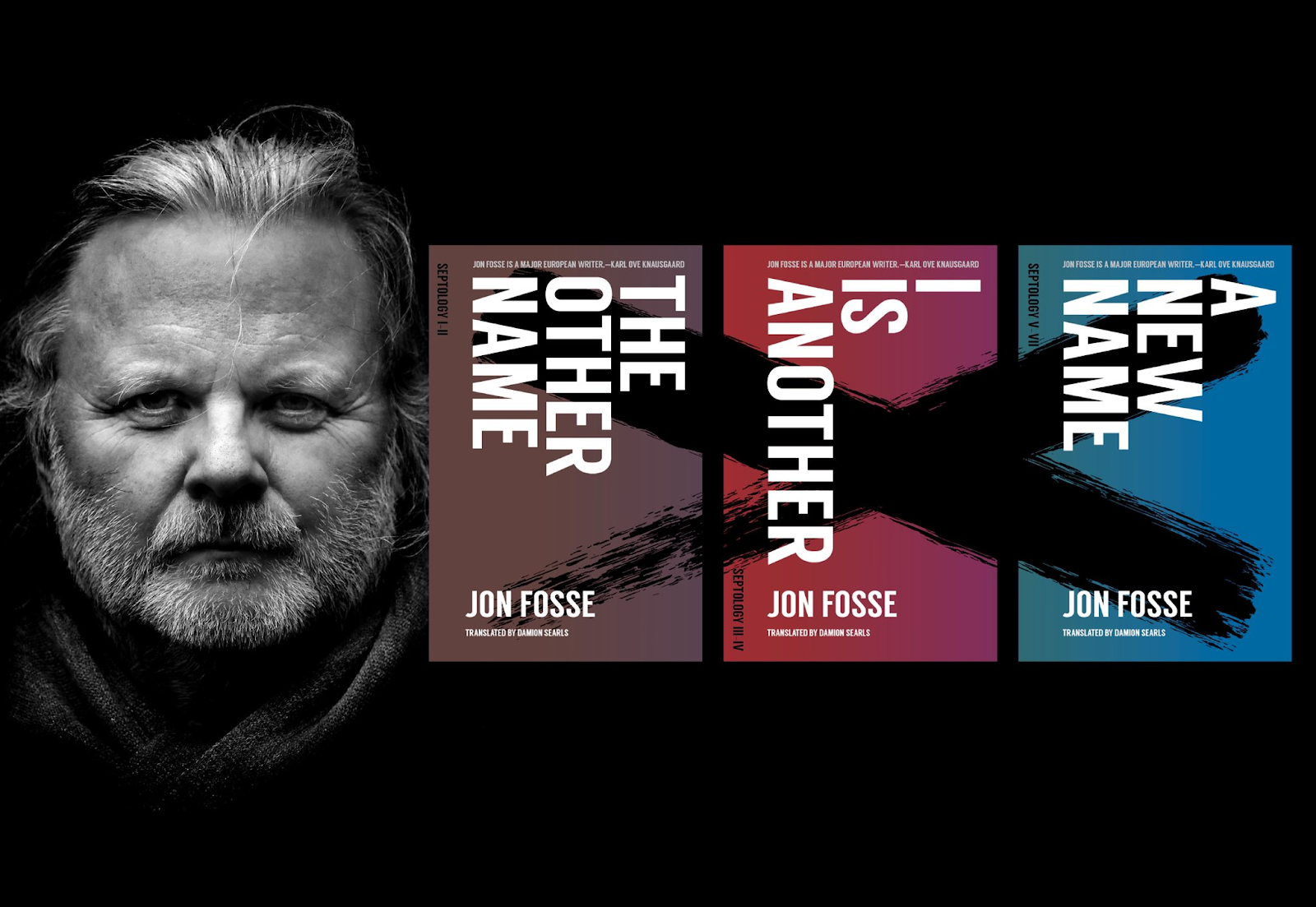
SEPTOLOGY follows a painter named Asle, seemingly from one day to the next. Every morning he imagines or “sees himself” looking at his latest picture, made of a purple and brown line that cross diagonally; and every night he ends the day with his rosary, reciting the Lord’s Prayer in latin, slowly, till it comes one or two words at a time as he inhales and exhales. Which encapsulates nicely the extreme down-tempo nature of this literary experience. Each day begins and ends the same way, with slight variations on what crosses Asle’s mind when he contemplates his picture, will he sell it, will he gift it to his neighbor Åsleik’s sister named Guro but is called Sister, will he stow it away in his crawl space, will he give up painting all together? And in his closing prayer sometimes he wonders if he really believes. “…then I say Ave Maria and that usually helps, I think and sitting there in my car I take my rosary out from under my pullover and I think now do I really believe in this, no, not really, I think…” (Part V) 

I fell in love with this bleak and beautiful fictional world, a world of habits, routines, grieving (for his late wife Ales), and the peculiar human sight made possible in complete darkness, which is how Asle prefers to look at his pictures to make sure they’re truly good and finished. But that’s not all. When we follow Asle heading into the town of Bjørgvin in the first book, he finds his double passed out on the snow: another Asle, also a painter. This Asle is an alcoholic, while our narrator Asle has gone sober; the narrator was devoted to Ales and it was love at first sight, while the double is twice-divorced with distant children; the double has a dog while the narrator doesn’t (though he’d like one); the double’s life is considerably more fucked up, and he spends much of the story recovering in a clinic after the narrator drops him off. Everyone takes the doppelgangers in stride (and there’s another doubling in Åsleik’s sister and a local woman of the same name who bumps into the narrator a few times). The biggest point of tension in the first book is who will take care of the dog Bragi. I found all of this to be profoundly beautiful.

Most of the novel’s space is taken up with the narrator’s almost clairvoyant visions of his life, childhood, a sexual attack by The Bald Man, attending Art School, falling in love with Asle, sneaking cigarettes in those slate roof boat houses that dot the west Norwegian coast. It read to me like he was seeing pictures in his mind not unlike what he paints, and we are reading the “language of pictures,” in the narrator’s phrase, especially since he seems to experience them as compulsive images that wash over whatever he’s doing in the present moment the same way his ideas for paintings do. “I have all these pictures inside me, yes, so many pictures that they’re a kind of agony, yes, it hurts me when they keep popping up again and again, like visions almost” (Part II?). The phrase “I see myself” that heads every part, mantra-like, so perfectly condenses Fosse’s procedures, a narrative act that arrests narrative time in the same moment of its expression.

SEPTOLOGY’s landscape is overwhelmingly darkened snow: the narration so telescoped on individual acts and objects, the pace so languid, the tone so even and gentle, it puts not a movie but a black box play in the mind’s eye. Fosse is a highly mature child of Beckett and Bernhard, but not so caustic as either, taking the former’s absurdism and the latter’s music.
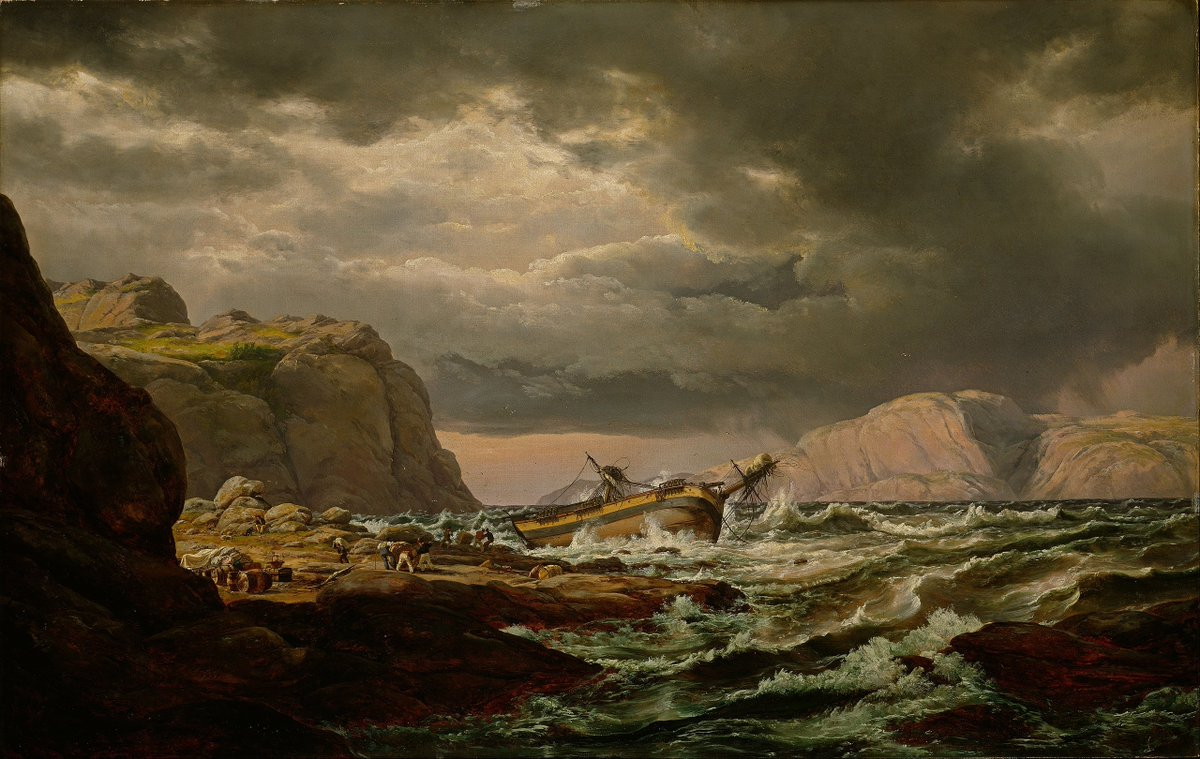
and I grip the edge of the table tight and then I look at Bragi standing there and looking at me with his dog’s eyes and I think that dogs understand so much but they can’t say anything about it, or else they can say it with their dog’s eyes, and in that way they’re like good art, because art can’t say anything either, not really, it can only say something else while keeping silent about what it actually wants to say, that’s what art is like and faith and dogs’ silent understanding too, it’s like they’re all the same, no now I’m getting in over my head with these thoughts, I think, because I’ve never been a thinker, and the only language I’ve so to speak mastered is the language of pictures, I think and I look at Bragi and maybe he’s hungry or thirsty… (Part V)

The last book really threw me in for a loop. First of all, it seems several weeks have elapsed before the beginning of Part VI. I’d thought the seven parts naturally lent themselves to a week (they’re collected in three volumes, just like LORD OF THE RINGS’s seven books, incidentally). But that’s not all, Asle’s schedule changes, as he spends most of this section at night staring out his window at some landmark in the darkness over the Sygne Sea. Asle seems to have been a gifted painter from the beginning. He’s so talented he can start Art School without finishing high school, and after that the Art School runs out of things to teach him. There’s no resistance to his artistic upbringing. It’s God’s grace. I loved the intense mixture of modes in this gentle transformation of the story at the very end.
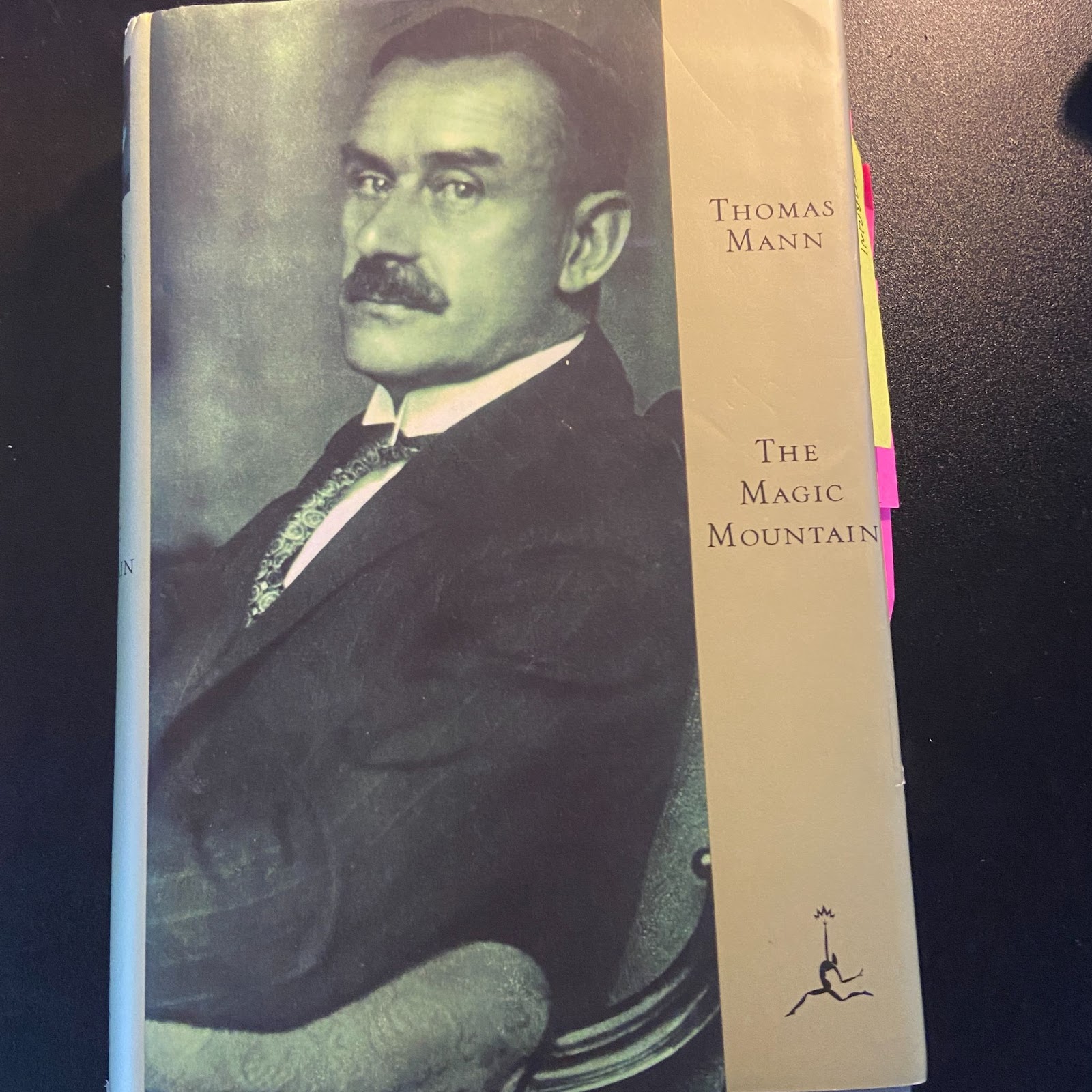
Mann’s MAGIC MOUNTAIN was three months of delectable reading. I may have enough to say about it to make a proper essay, though the didactic allegory and the ironized bildungsroman conceit Mann employed so masterfully here have been rendered transparent by scholars already. The experience itself is like climbing a mountain by stages, first unrolling slowly until around the sixth of the big chapters, things develop faster, the narrator starts summarizing more, the tone gets funnier and more deranged as we go along, and before you know it you’ve careened over the finish line in a runaway toboggan. 

I read a hard copy of the Lowe-Porter translation, pictured above, but also ended up reading large stretches of it electronically through the more recent John E. Woods translation. This was interesting if irresponsible. They are quite different, with Woods overall being very smooth to read, as I expected after his DOKTOR FAUSTUS, while Lowe-Porter goes for an antiquated pastiche with lots of idioms and untranslated French. Which approach is more faithful to the German I can’t say; the two translations read to me as trying to get to Mann’s sense of humor in different ways. In the first chapter, Hans Castorp laughs his head off at a particular word used by his cousin and asylum resident Joaquim. In Mann, the word is “Seelenzergliederung” which means psychoanalysis, but literally can mean soul dissection. Lowe-Porter translates this to “psychoanalysis” which in the scene made me laugh, while in Woods it’s “psychic dissection.” Is Wood’s more literalized choice a way to make the concept as bewildering as it might be to Castorp’s perspective?

It’s probably because I’m still high from finishing it, but the very best comparison sentence for me is the very last one. 

Lowe-Porter:

Out of this universal feast of death, out of this extremity of fever, kindling the rain-washed evening sky to a fiery glow, may it be that Love one day shall mount?

And Woods:

And out of this worldwide festival of death, this ugly rutting fever that inflames the rainy evening sky all around—will love someday rise up out of this, too?

I originally went to Lowe-Porter because, being a hopeless aesthete, I’d previously found Woods suspiciously accessible, but I prefer the Woods formulation here. The fever is more concrete with its “ugly rutting,” and while “feast of death” and “kindling the rain-washed evening sky” have an old macabre ring, “festival” and “inflames” seem more precise. And Woods adds some structural redundancy with the repeated prepositional phrase “out of this” while Lowe-Porter’s sentences are much of the time extremely heavy on either the front or the back end in terms of what you have to keep in mind about the subject while reading through these long sentences. Putting the main verb mount at the very end felt awkward, no doubt because of my modern American ears.

So if I had to recommend the best translation on the market, I don’t know, I’d probably say go with Woods then Lowe-Porter on a possible reread.

Next read: a trip with Mr. Lowry to Mexico, on All Saints’ Day, and something about a dead dog?

Notes & fragments: method of choice for the obsessive storyteller

THE LIFE AND OPINIONS OF TRISTRAM SHANDY, GENTLEMAN
Laurence Sterne
Modern Library, 2004

THE INVENTED PART
Rodrigo Fresán, tr. Will Vanderhyden
Open Letter, 2017

ALL FOR NOTHING
Walter Kempowski, tr. Anthea Bell
NYRB Classics, 2018

Chapter 10 of Volume 4 of TRISTRAM SHANDY declares itself the “chapter upon chapters.” And the chapters in this book are really short, sometimes just a line, and in one case cut out, with the pagination jumping ahead (and even this has a pointed joke behind it, having to do with a Christian taboo against odd numbers on the recto page). Rather than chapter breaks, they practically function a lot like space breaks in contemporary fiction.

Breaking for a new chapter is described as an instinctual impulse.

— A sudden impulse comes across me — drop the curtain, Shandy — I drop it — Strike a line here across the paper, Tristram — I strike it — and hey for a new chapter! (222)

The only rule for the serious writer, according to Tristram, is to obey these sudden impulses. Any other rules should be destroyed, burned to keep the author warm. “[I]s a man to follow rules — or rules to follow him?” (Ibid.)

But this chapter is for his opinions on chapters, not his writing process.

Is it not ten times better than to set out dogmatically with a sententious parade of wisdom, and telling the world a story of a roasted horse — that chapters relieve the mind — that they assist — or impose on the imagination — and that in a work of this dramatic cast they are as necessary as the shifting of scenes — with fifty other cold conceits, enough to extinguish the fire which roasted him. (223)

There you have it, lots of short chapters make the book easier to read. When you have something serious, like a roasted horse story (another term for shaggy dog story), chapters help organize the drama, while also affording room for “cold conceits” — ideas, concepts, and themes — which cool down the intensity of the narrative events.

And TRISTRAM SHANDY is an amazing book, in which all the forms of writing available to the landed gentry, and indeed to the aristocracy, like the sermon, are churning together. Closer to rhetoric than style, every short chapter is a dwelling on a moment, usually the pettiest moments in terms of literal plot, like walking down a staircase, that are comically protracted in the narration. But that dwelling is shaped by belles lettres, backed by a classical elite education system.

That’s why the end of this chapter has Tristram bullying us with his knowledge of classical literature, including criticism, with a long footnote in french. All to tell us to read and understand things, like Avicenna, who wrote books “de omni scribili” which is a pun on de omni scibili, of everything knowable; the former means “of everything scribbled,” and that’s a good description of this novel and the fragmentary, discursive form of creative writing we’re talking about.

Avicenna is famous for reading Aristotle’s METAPHYSICS 4o times, and memorizing it, without ever understanding it. There’s also an anecdote about Licetus, who was born as a five-inch fetus.

*

In a section of THE INVENTED PART called “Many Fêtes, or Study For a Group Portrait With Broken Decalogues,” Fresán bundles together notes marked off by a typographical dagger, that have to do with Fitzgerald writing TENDER IS THE NIGHT, biographical business with Hemingway, the Murphys, and even some material on Dickens.

He starts with a note about the biji.

† “Have you read all these books?” she asks.

† The biji (筆記) is a genre of classic Chinese literature. “Biji” can be translated, roughly yet more or less faithfully, as “notebook.” And a biji can contain curious anecdotes, nearly blind quotations, random musings, philosophical speculations, private theories regarding intimate matters, criticism of other works, and anything that its owner and author deems appropriate. Do samurais interrupt the conversation of their katanas to write down something that occurs to them in the precise instant of blood and steel? (303)

This is basically the wikipedia article with some embellishments, and it’s a good description of Walter Benjamin’s ARCADES PROJECT as well as “books of commonplaces,” and even the poetics of the social media feed.

The bijis here are notes toward a new novel by the protagonist (who has dispersed himself into the universe after breaking into the Hadron Collider) that will be his ultimate statement on his parents, who are kind of a mystery, caught in a photograph by Man Ray, and the meaning of Fitzgerald’s problematic novel in their lives.

And he arranges and unarranges these pages, telling and deluding himself that he’s revisiting the biji genre, so he doesn’t have to admit that they are, in reality, just the windblown tatters of fallen standards and the still-smoking ruins of something that he wanted to build but that came crashing down. The broken pieces of a temple he believed in or needed to believe in. The shrapnel from an explosion extracted, piece-by-piece, from the wounded but surviving body of something, of someone. The loose phrases of that thing  — trying to swim underwater and hold his breath — he wanted to write so badly, but couldn’t, a while back now, sometime during the great droughts that marked the Crack dynasty.  (304)

A similar kind of rhetorical “dwelling” on the subject is at work here, but less oral in its nature than Sterne. These are post apocalyptic fragments, a familiar image from modernism. (As a side note, the middle segment of an earlier section, “The Place Where the Sea Ends so the Forest Can Begin,” has no paragraph breaks, but it has two narrating voices, or the same voice speaking from different space-time positions, which are distinguished by the normal font and a typewriter font. This also makes things easier to read!)

† “Writer’s aren’t people exactly.” — Francis Scott Fitzgerald, The Last Tycoon.

† Exactly, Scott. Writers are people who, inexactly, always prefer to look away, toward another part — the invented part. (Ibid.)

The dagger: used for a footnote after the asterisk is taken. Here it suggests a text made entirely out of secondary footnotes. Each fragment is suggesting a totality that is unseen, does not exist, namely the unmade book.

Is this feasible, a self-contained piece of writing that nevertheless structurally posits a larger work? Like studying a painter’s palette that was used for an unseen, unknown masterpiece? Can one think of lyrical essay writing, or “creative nonfiction” if you prefer (I don’t), in this way?

These notes also serve as the framing concepts of the entire, large, seemingly formless novel, but dislocated from the “edge” of the work and concentrated in the midway point, a very fun mashing of spatial models.

Maurice Blanchot used a typographical mark in his fragments — in an unconscious way they feel appropriate for notes, for enumerations, for listing. And also, the novel opens by bringing the visual character of punctuation to our attention, where the question mark has

the shape of a fish or meat hook. A sharp and pointy curve that skewers both the reader and the read. Pulling them, dragging them up from the clear and calm bottom to the cloudy and restless surface. Or sending him flying through the air to land just inside the beach of the parentheses. (11)

Just like in Adorno’s infamous essay, punctuation and typography have this hieroglyphic quality. Of all the marks, it’s the em-dash that beguiles Adorno the most. The interruptive line seems to materially embody the dialectic of continuity and rupture between sentences and thoughts. There is a fascinating contradiction in the function of the dash (and think of all of the dashes of different lengths and characteristics in Sterne, taking the directionality of language to the extreme) as well as the clean space break. The gap that is created is also a link, through association or implication or any other kind of relationship, imprecisely evoked. Nevertheless, in the “constellation,” which is yet another way to talk about fragments and bijis, the lines drawn between the nodes of actual material are actually the greater presence in the work.

What about the dagger? Does it look more like a cross, or more like something else?

Lastly, the evocation of the biji is a different self-justification than Sterne’s deceptively frivolous reasoning. Does modernism revolt against tradition? In one sense it does: Adorno talked about seeking out that which was taboo in mainstream, familiar art. Duchamp’s fountain is a ur-text. But also, extreme modern art can be defended in a more legalistic way, by looking up precedents, usually in the ancient world. Here we appeal not to militant futurism but an alternative temporality, a different set of repeating forms.

*

Finally, ALL FOR NOTHING does not read like a sheaf of notes, but rather a stereotypical realist novel that got crammed with space breaks. Early on, it focuses on an odd aristocratic family in a mansion in Prussia in the last days of the Third Reich, while a string of visitors comes to call, including a Nazi violinist.

Peter was asked if he had ever danced. ‘Come here!’ said Fraulein Strietzel, showing her bad teeth, and she grabbed the boy and gave him his orders: left, two, three; right, two, three. The boy took hold of her, very clumsily, and felt himself pressed close to her body, which was flat as a board with some protuberances, quite different from his mother’s soft, warm body.

*

But it really was very odd in the drawing room, and then the air suddenly went out of the whole thing, like a balloon deflating, and they sat down by the fireside again. The gramaphone was turned off.

*

Peter said he could go get his microscope. What about looking at flies’ legs under it? But no one pursued that idea any further. (41)

These are still intervals in the action, but they’re very tiny. And using white space in this way has its own subtle effects. Within these vignettes, even at their most continuous, it’s like the characters are drained of any conventional interiority. The narration can get away with more free indirect discourse and dialogue summary. There is a disconcerting sense of time being finite, a revolt against the stability of representation and the subject, without any gimmicks — unless using lots of space breaks is a gimmick.

There is a wide range of possible degrees to which these sections can assert their autonomy, halting the motion of the plot or narrative in order to meditate on their content, as well as the extent of the structuring role they play in the whole text. As worked over as the narrative may be, the vignettes combined with all the song lyrics and lines of verse give the impression of a historical scrapbook, similar to other works by Kempowski.

I used the word “affords” earlier, which is a concept from design. Specific forms “afford” specific qualities, and these affordances are determined by the material (cotton affords both fluffiness, or breathable fabric). With David Markson on one end and Bolaño or Pynchon on the other, the fragment can have a minimalist or a maximalist employment. Fragments may be convenient (rejection of coherency as a standard), but at the same time they indulge curiosity. As mainstream forms lose their conviction, these lines of influence are always available.

AFFORDANCES OF THE FRAGMENT:

  • Ease of reading, looks tidy on the page.
  • Autonomy, resisting closure, but also linked to the rest through good placement.
  • Flexibility, used by maximalist and minimalist writers alike.
  • Malleability, as opposed to the “durability” of conventional realist fiction.
  • A more collectivist ideology, against bourgeois individualism and possession.
  • “Epistemophilia,” the love for knowledge, exploring what we can know, rather than seeking representation or transcription of reality.
  • Lightness, digression, experimental, yet compact with rich thinking; indulging one’s obsessions.

PS: I took the affordance concept from

FORMS: WHOLE, RHYTHM, HIERARCHY, AND NETWORK
Caroline Levine
Princeton UP, 2017