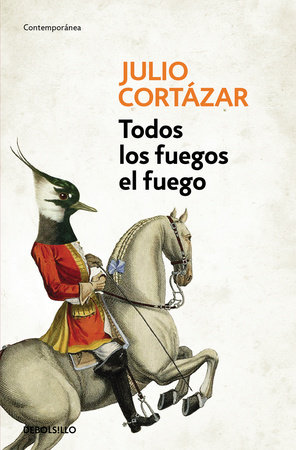
ALL FIRES THE FIRE
Julio Cortázar, translated by Suzanne Jill Levine
New Directions 2020
All eight stories in this collection are masterful. I bought the new New Directions paperback with its own spine number and everything, but it’s a reprint of a Penguin-Randohouse edition from the 50s or 60s. I’m forever indebted to Cortázar for the Axolotl story, which taught me about the placement of details and how they transfer the tension around a narrative. The pieces here have depth and control, and spacious paragraphing. And the endings are so perfect.
THe first two, about a days-long traffic jam bringing about new social relations, and an accelerated Garcia Marquez fable where a family household conceals death and illness from Mama for her health’s sake, were terrific. But I have to say what stood out was the title story and the one before it, “Instructions for John Howell.” The latter is a single paragraph describing how a theatergoer gets roped into the performance during intermission, an avant-garde gesture that turns into a prolonged mind game that turns into a possibly genuine intrigue.
But the experimentalism at work in “All Fires the Fire” is indeed pyrotechnical; and these long running paragraphs call attention to themselves here because two completely different scenarios, one in ancient Rome and the other in a modern apartment, begin to run together. In the first story, a proconsul gets revenge on his wife by sending a gladiator she desires to his death; in the other, a rake of a boyfriend has a phone call with the woman he’s cheating on. The narrator speaks fatalistically, of a “cruel and monotonous succession of events,” or “unavoidable continuation of action.”
There is also someone on the phone line calling out numbers.
On the line there’s a crackling of mixed communications, someone dictating figures, suddenly a silence still darker than that darkness the telephone pours into the eye of his ear.
This third strand is like a peak into the story’s underlying code or algorithm. This is truly classical hermeneutics, where the Greek and Hebrew letters of the holy texts can be switched around, or converted into significant numbers.
The minimal collage on the ND cover is a great illustration of what the story is doing. The continuity is the all-consuming eternal fire that makes up the Heraclitean universe.
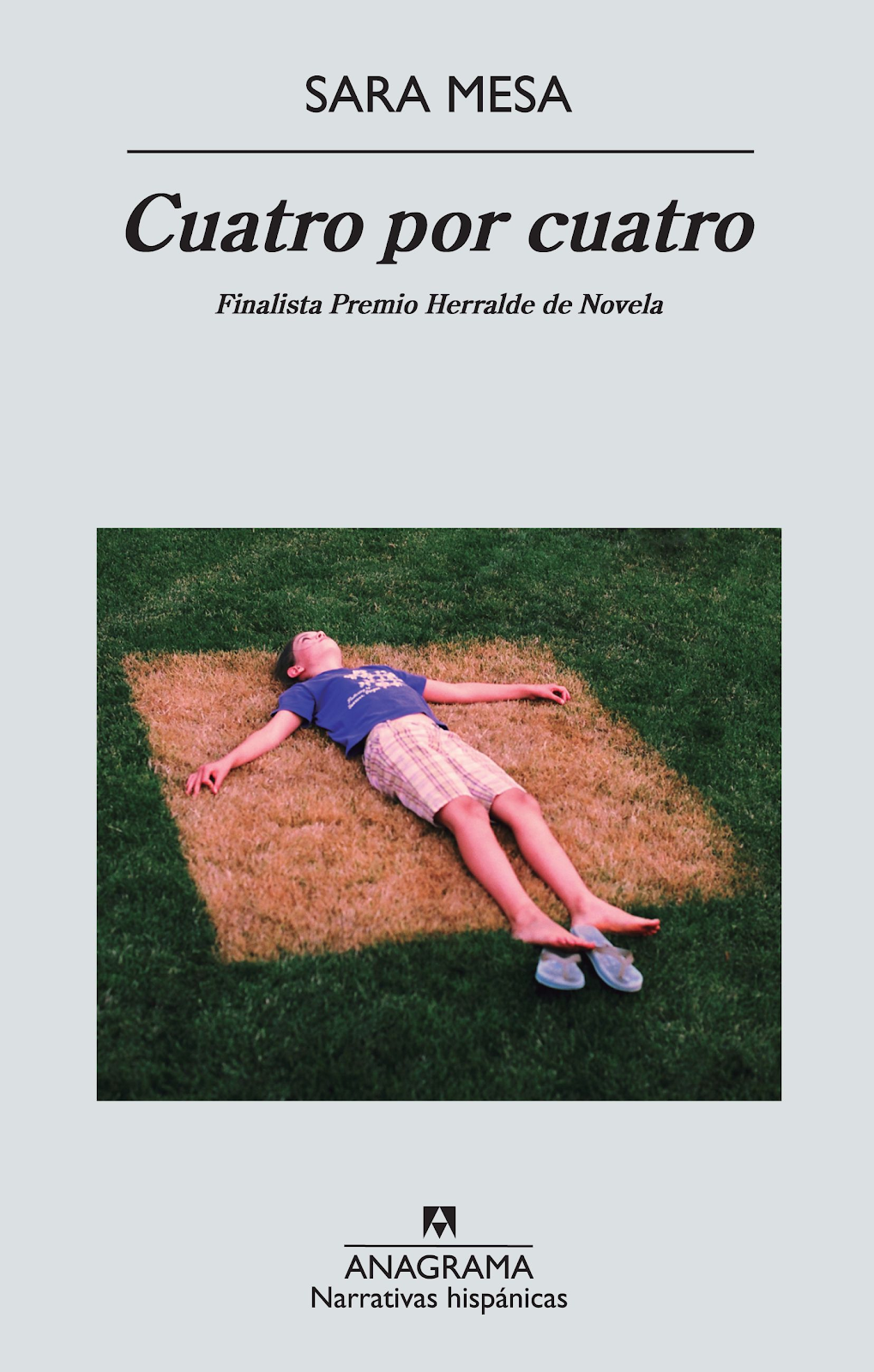
FOUR BY FOUR
Sara Mesa, translated by Katie Whittemore
Open Letter 2020
“You do know, you dear thing,” says the narrator in THE TURN OF THE SCREW by Henry James, “only you haven’t my dreadful boldness of mind, and you keep back, out of timidity and modesty and delicacy, even the impression that, in the past, when you had, without my aid, to flounder about in silence, most of all made you miserable.”
Sara Mesa’s FOUR BY FOUR is in the same gothic feel as that text, steeped in sexual anxiety and implication about children in danger. We’re in a surreal boarding school for well off children, in the English style, yet appearing as if out of nowhere in Spain. Some of the children are here on scholarship, and their parents in fact work as custodians. A mystery is afoot and it seems like the administrators and faculty are hiding something. It unfolds like a Hardy Boys mystery as interpreted by Luis Bunuel.
These are simple sentences but what keeps it from going down too easily is how spaced out and elliptical the narration can become. There are two main parts, one anchored around the students, and the other in the form of an impostor substitute teacher’s diary, a hilariously unreliable narrator, whose recurrent blackouts bring to mind the madness of a Poe story or maybe an extremely hapless Philip Marlowe. Coverups, power games, institutional depravity, and owls taking flight at dusk. There’s also a political dimension, a transparent but creative allegory for “totalitarianism,” of security versus freedom. If you’ve checked out Foucault or Agamben these will be very familiar ideas. This is the postmodern analysis of power, which is divided into two forces or “techniques”: the political technique, where the state integrates natural life into its operations and reproduction, “biopolitics” and so on; and the technology of the self, through which you bind your identity and consciousness with an external power. Mesa’s story makes this all more concrete, and shows how in this framework resistance and revolution are impossible. I keep coming back to Zygmunt Bauman’s point about the “liquid modern society” that prevents the struggle for freedom by convincing the people that they are already free.
There’s also a link between controlling the lives of students and grooming them to be sexual servants that has not left my mind once established.
At one point, the substitute talks in his diary about writing, and the thought links all this authoritarianism with “autofiction” as a kind of behaviorism; a mechanical reporting of every outside impact on the writer’s consciousness; who the writer is is almost irrelevant.
I protected myself with indifference and avoided facing hardship and failure. I began to keep a diary because I didn’t have to make anything up. A simple log, a methodical, factual record. If I see rain falling outside my window, that’s what I write. The only decision I have to make is whether to be concise or to describe the rain in detail. I can note how it changes over time, how heavy it falls, who gets wet and who doesn’t. Or, I can simply write: it’s raining. That’s it. I write about what happens to me, why I think it happens, how I feel about it, what people tell me, how I respond. If something doesn’t interest me, I don’t write about it. Or I write a summary, strip it of meaning. I never have the urge to make anything up or change my story. I wouldn’t be capable. My creativity has dried up, or maybe I destroyed it. Who knows.
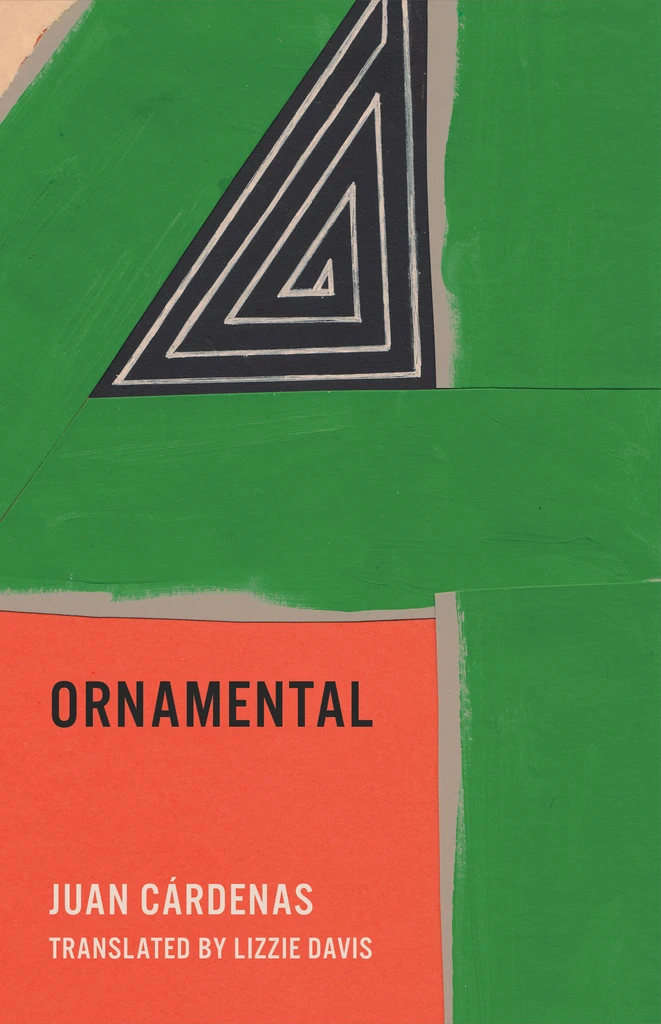
ORNAMENTAL
Juan Cárdenas, translated by Lizzie Davis
Coffee House Press 2020
The worlds of art and pharmaceuticals collide in this short book, which makes perfect sense. Which other two industries are more saturated with the blood money of capitalism, the public face of this mixing being the decadent high life of coked out artists and connoisseurs. At the core is a brief triangle between a doctor, his wife the artist, and subject number 4 of the trials of a drug he’s developing. This is a pill for total wellness without side effects, civilization without barbarism—-and it only works for women. Whether it’s brain chemistry or philosophy and culture, postmodernism is an all-in drive toward solipsism; if the world is only full of good sensations then it is only full of good, period. This is a quick, interesting read, and the doctor, while an asshole, is more clever than, say, Houellebecq’s protagonists.
The doctor’s wife, the celebrated and tasteful artist, to me stands in for the aesthetic postmodernism Cardenas is making fun of here. Her pieces, vaguely described, are “perfect little nothings,” as Gwendolyn Brooks would say, just ornaments, or embellishments that don’t contain much meaning by themselves. But she justifies herself in interviews with the deliberate superficiality of pomo theory.
What matters with anamorphosis is the distortion itself and not the hidden form. Perhaps, as my wife likes to say, we have to completely renounce our urge to interpret.
Similar with Mesa, this is a very disagreeable, decadent world. But there is little capacity to resist or change it. The best the petty bourgeoisie can think to do here is go out into the jungle and live the libertarian fantasy of complete self reliance “off the grid.” Dreams, dead end mysteries, spider monkeys; all in all a good time.
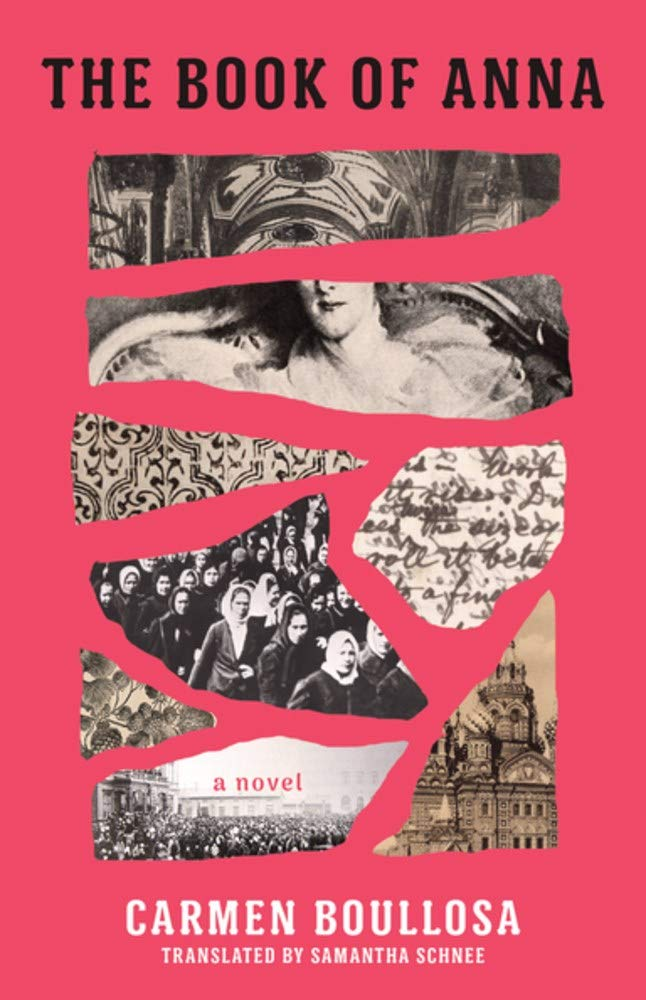
THE BOOK OF ANNA
Carmen Boullosa, translated by Samantha Schnee
Coffee House Press 2020
This novel from Mexico has such an enticing metafictional concept. The cast of Tolstoy’s great novel walk around St. Petersburg among the flesh and blood “real” or “historical” people. The effects of Anna’s scandal and suicide reach through the next generation, and it all coincides with the beginning of the first Russian revolution in 1905. The plot centers on Anna’s effects: a portrait, about which both Anna’s children, Sergei and Anya, have complicated feelings about; and a manuscript only given brief mention in Tolstoy.
To get the disappointing elements out of the way first. I found the plot to be really straightforward (a literal plot with anarchist bombs), a way to negate the entire metafictional conceit. The actual Book of Anna itself, an opium-induced fairy tale, was also better as a mystery—as with the Mesa text, the allegories were just a tad too transparent for me. In an academic way the novel wants to explore the “minor” aspects of great things (whether a great book or world historical events) the servants of the Karenin household, or the anarchist and narodnik tendencies in Russian revolutionary politics (about to wilfully marginalize themselves, since the 1905 revolution was a bourgeois democratic one, and the anarchists didn’t want to participate in it). There is nothing about the mainstream of Russian Social-Democracy or the Menshevik-Bolshevik split, and while Anna’s character and love life are explored, the discussions of class and philosophy in Tolstoy’s work are not acknowledged here. As a result, the presentation of ANNA KARENINA in this book seems one-sided and individualistic; Anna’s adultery has an entire context of a rapidly modernizing Russia, but this novel focuses on individual sexual love detached from these dimensions. (What I’m saying is this text is so determined to remove scientific socialism, as if it had been taking too much space, or as if the feminist concerns with this material will shine all the brighter; but I think the result is more impoverished.) Revisionist takes on classic literature are fine, but I get a little irked by the kind of framework that says Tolstoy failed to consider X, as these claims are almost always incorrect and made in bad faith, and seem to elide the truer purpose of fiction to lend cogency, immediacy and vividness to ideas regardless of their correctness. There is however a hidden link to V. I. Lenin: of the three Alexandras in the text (including Kollontai, who appeared in CARS ON FIRE) one of them is the sister of one of the Karenins’ servants, who happens to be named Vladimir. Her sister dies in the Bloody Sunday massacre, which in turn radicalizes him. A similar story happened to the young Lenin, whose older brother Alexander was executed for plotting to kill the tzar.
The parts of the book that were really for me were these ruminations on fictional characters given a real “ontological status,” switching ink and paper for blood and viscera.
It’s not easy to pin down dates in Sergei’s life. In 1873, when Tolstoy first wrote about him—Anna Karenina’s son appears early in the novel—and began to publish his story in the Russian Messenger, Sergei was eight years old. An eight-year-old newborn. He’s eight years old again when the first edition of the complete novel is published in 1878, but a few pages later, when the dramatic events of the novel take place, he’s two years older. So, for our purposes, he has three birthdates: 1873, when Tolstoy created him; 1865, when he was born in the novel; and 1878, when he appears in print for all posterity. For the monolingual English reader, Sergei arrives on this earth in 1886, the year the first English translation appeared; from his own point of view he was born in ‘78 (though for our purposes, he was already ten years old by then).
Nevermind how this materially happens, or how Russian society feels about it; we learned from Nabokov that being a character and being aware of it, of having been written by an author, is the most existentially dreadful thing ever. Here, it is a kind of sultry 19th century angst. Or is it that Tolstoy’s characters may as well be real, and possess a vitality literature can never achieve again?
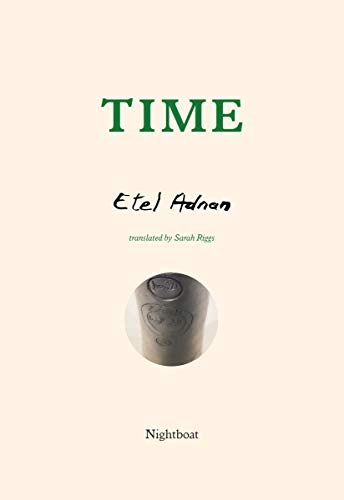
TIME
Etel Adnan, translated by Sarah Riggs
Nightboat 2019
This collection won the BTBA for poetry, and it’s the first Adnan I’ve read. This book takes the postcard as a serious medium or poetic form, and you feel the spatial and temporal distance as well as the pining between good friends. The lines are printed here without Adnan’s correspondent or whatever the images on the postcards were. It’s tantalizing to know there was other material in this project, and you have to wonder how much meaning is lost on top of translating French verse. The lines feel super concentrated and aphoristic. These are just four separate lines from throughout the book.
if we write, it’s that we can’t sing, if we sleep, it’s that we can’t live
those who cannot leave discover the geography of the body.
and the sea is treacherous marble
The day is not made of light, but of will
Where is joy then? Chained to me, an horizon,
Objects are children of their own shadows
The collection is made of longer sequences, and I definitely loved the first one the most, perhaps because it felt the most evocative.
don’t leave the Mediterranean
without telling her that you loved her:
her daughters and her sons went
North, a day of rain, or a day
of war
as for me, I belong to the stones
thrown for lack of helicopters,
to the women locked up,
to the political prisoners;
sometimes I regret my love of
splendor
but our solar mother star,
and the lunar father, in their way,
have entrusted us with useless
objects from a forgotten century
 Second Slope