First up, I’ll mention a short story of mine called “A Brief History of Materialism,” now up at Issue 3 of SPILLOVER MAGAZINE.
I’m very grateful that my last two publications ran on significant holidays, namely 4/20 and 5/1.
In truth, I haven’t written a jot of creative fiction in quite some time, what with all these book reviews and newsletter editions in May (and taking a break from the latter to catch up on the former). “Materialism” had actually been written quite some time ago…
The beginning of summer also included a special visit to the Cooper Hewitt Museum. They were exhibiting W. E. B. Du Bois’s statistical graphics designed for the 1900 world’s fair in Paris. Some of the plots were digital reproductions, but others were THE original deal, watercolor on aging cardboard. The blue pigment in the bullseye graph truly packs a punch.
If there was one main takeaway from this data for me, it was that America was still largely agricultural even at the beginning of the 1900s.
But honestly? The biggest impression on this trip might have come from the building itself. The Carnegie Mansion is simply an amazing structure to be in. It was designed for the industrial magnate’s family at the end of the 19th century, and built in the style of contemporaneous country houses in England; I guess it would be the kind of place in which Virginia Woolf would have been hanging out.
In the last seven years of apartment-hopping in New York and Brooklyn, I was moved by what it was like to dwell within a building that is solid, not shitty. Upon entering the imposing manor across the avenue from Central Park, you go up a few steps into an elevated foyer area. The parquet floor and the immaculate detailing of the sconce-work, as well as the tiling of the greenhouse area, left indelible impressions in my dreams, in which I wandered an expansive structure.
And there’s a couple more of these review pieces where that came from up the pipeline…
Seriously: translated literature has been going nuts in the last ten months. I am greedily trying to cover as much of it as I can. It’s not every season one faces two different translations of Proust and Wittgenstein coming to market at the same time.
I feel the need to very briefly discuss two biggie-budget movies that are raking in box office returns. Nolan’s OPPENHEIMER and Rajamouli’s RRR from last year have some striking similarities.
Both are 3-hour epics, and both are structured around a motif of Fire and Water.
RRR is a buddy flick about two guys who are diametrical opposites in many respects. Ram is cultivated, suave, on a secret mission, and a precision fighter. Like fire, he burns a straight path to his target. Bheem is from a tribal background, is loyal, sensitive, great with kids, and relies on sheer brawler power and his power–lifter physique. Ram cares about politics; Bheem cares about people. A revolution succeeds only when both are in play.
RRR plasters the fire-and-water idea everywhere in a thoughtful way: fire on the oil slick, water becoming steam, firelight glistening in droplets of water flung from a spear taking flight. The title cards that masala films typically have for the stars’ intros are transformed here into THE FIRE and THE WATER. Will opposites negate each other? Or can they transform into something new and higher—in the figure of two men piggybacking through a prison escape sequence like a six-limbed battle mech?
OPPENHEIMER begins with raindrops on a puddle. Young C. Murphy scrutinizes the propagating ripples. This film treats the theoretical physicist-cum-weapons project director as a kind of prophet—someone receiving intense visions of extremely concentrated knowledge. Such “premonitions” include views of horrendously massive nuclear fireballs triggering “atmospheric ignition.” We view the Burning of the Earth from space, a global wall of fire crossing the continents and oceans with the coming night; the shot with Göransson’s musical score actually feels beautiful and serene.
Cilian Murphy, whose face carried this picture, is in a sense envisioning the two types of apocalypse (“no more water, but fire next time”). Water and Fire in western cultures are two possible means of purification. The end of the world? Perhaps, but not if you’re a Marxist. But it’s certainly the end of his world, the end of a time when science, and in particular the new, seemingly probabilistic world of quantum mechanics, was attuned to nature.
Haven’t seen BARBIE yet, unfortunately. Though it looks like Gerwig has secured her spot as the successor to Nolan’s old position in the Warner Bros. stable. I did play with Barbie dolls, at my cousins’ house or on play dates with girl classmates, and I thought nothing of it in youth. It was the sort of thing that, once I’d grown out of it, I never reflected back on my relationship to it or what it means for pop culture. It just never interested my core.
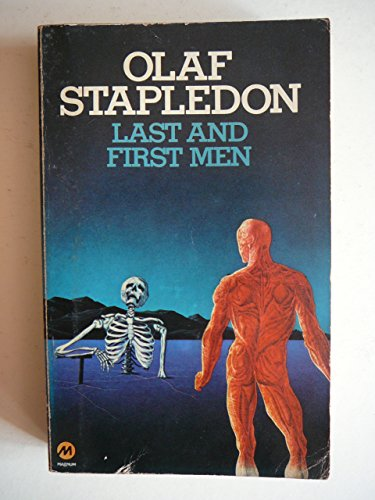
I had a new story published in Passages North at the beginning of the month, inspired by Olaf Stapledon but really more in the manner of A. E. Van Vogt. Neat! I read it out loud at the open mic in the cafe where I wrote it. There were so many stand-up comics doing sets at the show that even I got heckled. Laugh-a-minute. I put cinnamon in my coffee every day till I saw DUNE in theaters.
More reads: Anne Carson’s SHORT TALKS | Paul Curran’s LEFT HAND| Thomas Mann’s MAGIC MOUNTAIN (whew!) | Stevens’s PARTS OF A WORLD | Ashbery’s CAN YOU HEAR, BIRD |
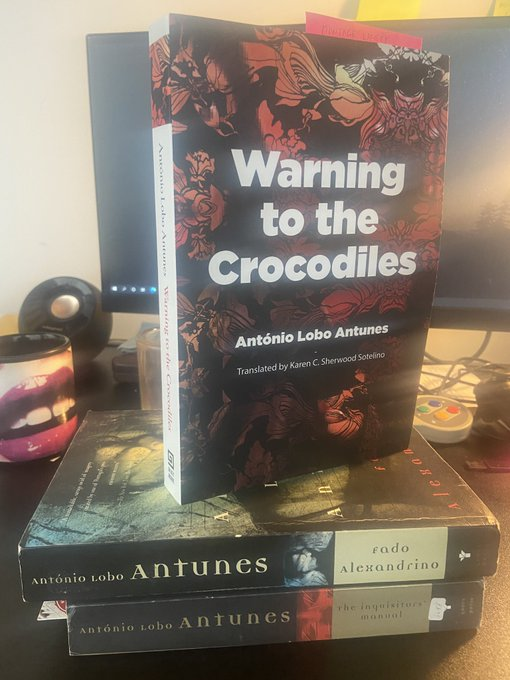
And a press copy of my most anticipated novel of the year, for two years in a row: WARNING TO THE CROCODILES by Antonio Lobo Antunes, translated by Karen C. Sherwood Solentino, from Dalkey Archive.
If you’re at all interested in translated literature then I urge you not to sleep on this great Portuguese novel from 1999. Lobo Antunes is a living grandmaster of literary modernism, and even all my personal hype did not prepare me to realize that this translation is very important, as this work is a summation of the tendencies in his 90s output, in the same way FADO ALEXANDRINO (perhaps his masterpiece) works as a summation of the 80s. A review to come, probably next year. As for the cover, I like the palette, and when you look past the fractal floral pattern and see that it is masking a strange image with pixelated faces, which is suggestive and fits as a depiction of the Lobo Antunes literary experience, with its ultra-subjective haziness. But my reflexive tastes definitely prefer the monochrome with red accent minimalism of Dalkey’s typical covers. Perhaps uniform covers are on their way out more generally.
Now for my trip to Norway via Fosse.
#
During the day I wrote the opening of Septology. I just started with my laptop on my stomach in bed. I write easily. Something comes to me when I sit down to write. I have never had writer’s block. […] What I experience when I write has as great an impact, if not greater, than what I experience in life. To write is to dream while awake, to place oneself in a controlled dreamlike state where one advances by listening.
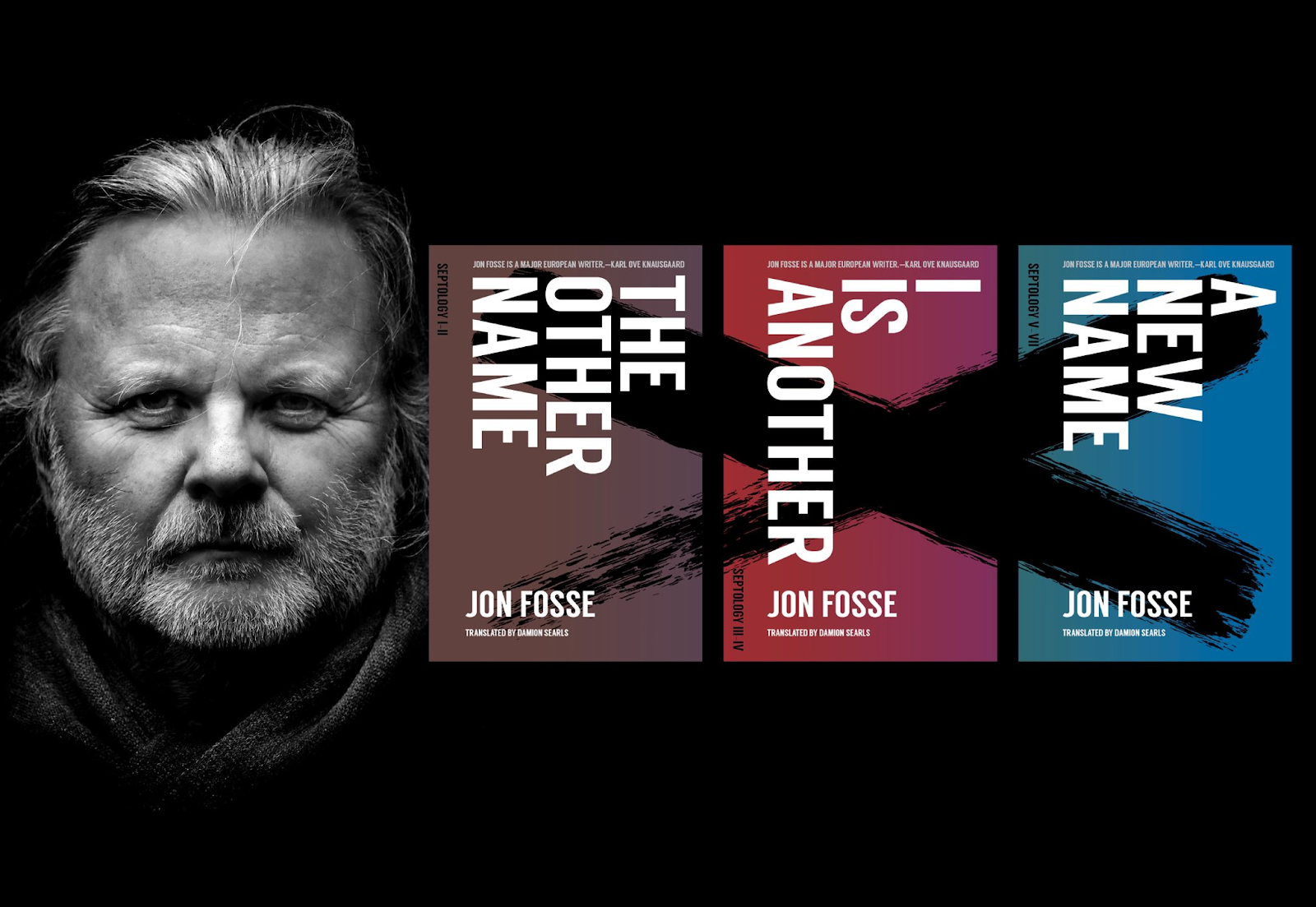
SEPTOLOGY follows a painter named Asle, seemingly from one day to the next. Every morning he imagines or “sees himself” looking at his latest picture, made of a purple and brown line that cross diagonally; and every night he ends the day with his rosary, reciting the Lord’s Prayer in latin, slowly, till it comes one or two words at a time as he inhales and exhales. Which encapsulates nicely the extreme down-tempo nature of this literary experience. Each day begins and ends the same way, with slight variations on what crosses Asle’s mind when he contemplates his picture, will he sell it, will he gift it to his neighbor Åsleik’s sister named Guro but is called Sister, will he stow it away in his crawl space, will he give up painting all together? And in his closing prayer sometimes he wonders if he really believes. “…then I say Ave Maria and that usually helps, I think and sitting there in my car I take my rosary out from under my pullover and I think now do I really believe in this, no, not really, I think…” (Part V)
I fell in love with this bleak and beautiful fictional world, a world of habits, routines, grieving (for his late wife Ales), and the peculiar human sight made possible in complete darkness, which is how Asle prefers to look at his pictures to make sure they’re truly good and finished. But that’s not all. When we follow Asle heading into the town of Bjørgvin in the first book, he finds his double passed out on the snow: another Asle, also a painter. This Asle is an alcoholic, while our narrator Asle has gone sober; the narrator was devoted to Ales and it was love at first sight, while the double is twice-divorced with distant children; the double has a dog while the narrator doesn’t (though he’d like one); the double’s life is considerably more fucked up, and he spends much of the story recovering in a clinic after the narrator drops him off. Everyone takes the doppelgangers in stride (and there’s another doubling in Åsleik’s sister and a local woman of the same name who bumps into the narrator a few times). The biggest point of tension in the first book is who will take care of the dog Bragi. I found all of this to be profoundly beautiful.
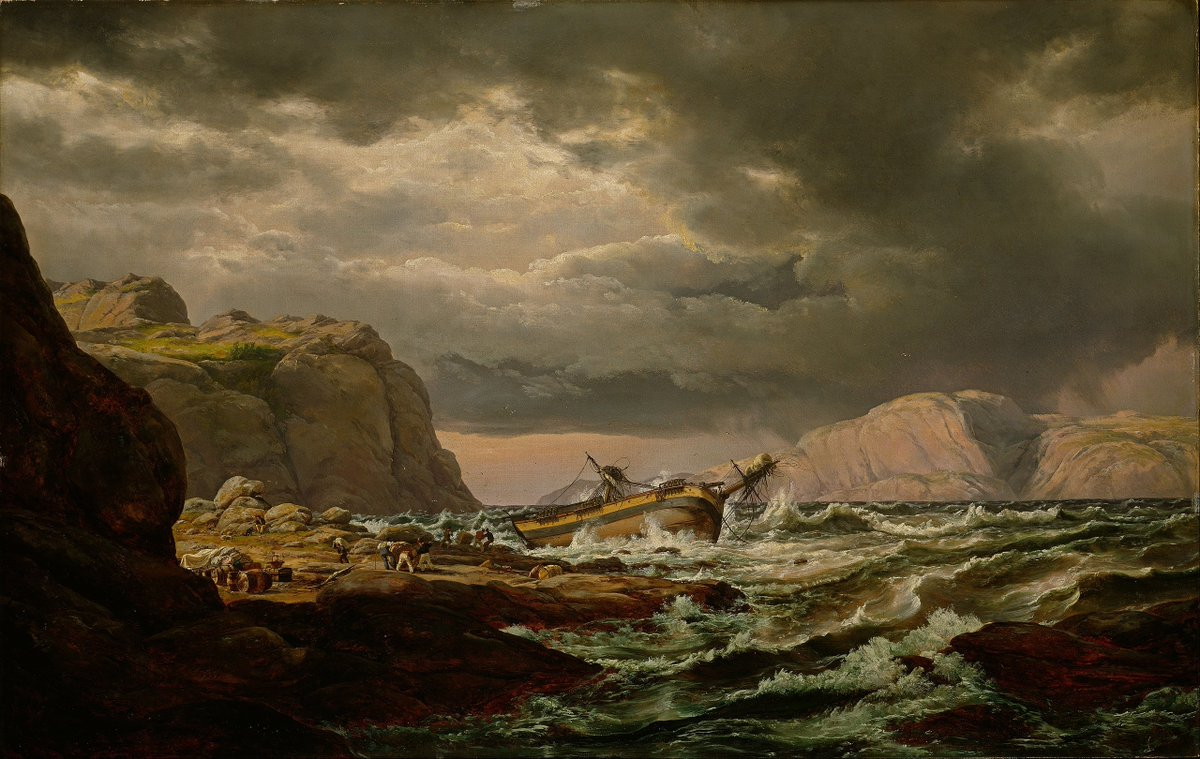
Most of the novel’s space is taken up with the narrator’s almost clairvoyant visions of his life, childhood, a sexual attack by The Bald Man, attending Art School, falling in love with Asle, sneaking cigarettes in those slate roof boat houses that dot the west Norwegian coast. It read to me like he was seeing pictures in his mind not unlike what he paints, and we are reading the “language of pictures,” in the narrator’s phrase, especially since he seems to experience them as compulsive images that wash over whatever he’s doing in the present moment the same way his ideas for paintings do. “I have all these pictures inside me, yes, so many pictures that they’re a kind of agony, yes, it hurts me when they keep popping up again and again, like visions almost” (Part II?). The phrase “I see myself” that heads every part, mantra-like, so perfectly condenses Fosse’s procedures, a narrative act that arrests narrative time in the same moment of its expression.
SEPTOLOGY’s landscape is overwhelmingly darkened snow: the narration so telescoped on individual acts and objects, the pace so languid, the tone so even and gentle, it puts not a movie but a black box play in the mind’s eye. Fosse is a highly mature child of Beckett and Bernhard, but not so caustic as either, taking the former’s absurdism and the latter’s music.
and I grip the edge of the table tight and then I look at Bragi standing there and looking at me with his dog’s eyes and I think that dogs understand so much but they can’t say anything about it, or else they can say it with their dog’s eyes, and in that way they’re like good art, because art can’t say anything either, not really, it can only say something else while keeping silent about what it actually wants to say, that’s what art is like and faith and dogs’ silent understanding too, it’s like they’re all the same, no now I’m getting in over my head with these thoughts, I think, because I’ve never been a thinker, and the only language I’ve so to speak mastered is the language of pictures, I think and I look at Bragi and maybe he’s hungry or thirsty… (Part V)
The last book really threw me in for a loop. First of all, it seems several weeks have elapsed before the beginning of Part VI. I’d thought the seven parts naturally lent themselves to a week (they’re collected in three volumes, just like LORD OF THE RINGS’s seven books, incidentally). But that’s not all, Asle’s schedule changes, as he spends most of this section at night staring out his window at some landmark in the darkness over the Sygne Sea. Asle seems to have been a gifted painter from the beginning. He’s so talented he can start Art School without finishing high school, and after that the Art School runs out of things to teach him. There’s no resistance to his artistic upbringing. It’s God’s grace. I loved the intense mixture of modes in this gentle transformation of the story at the very end.
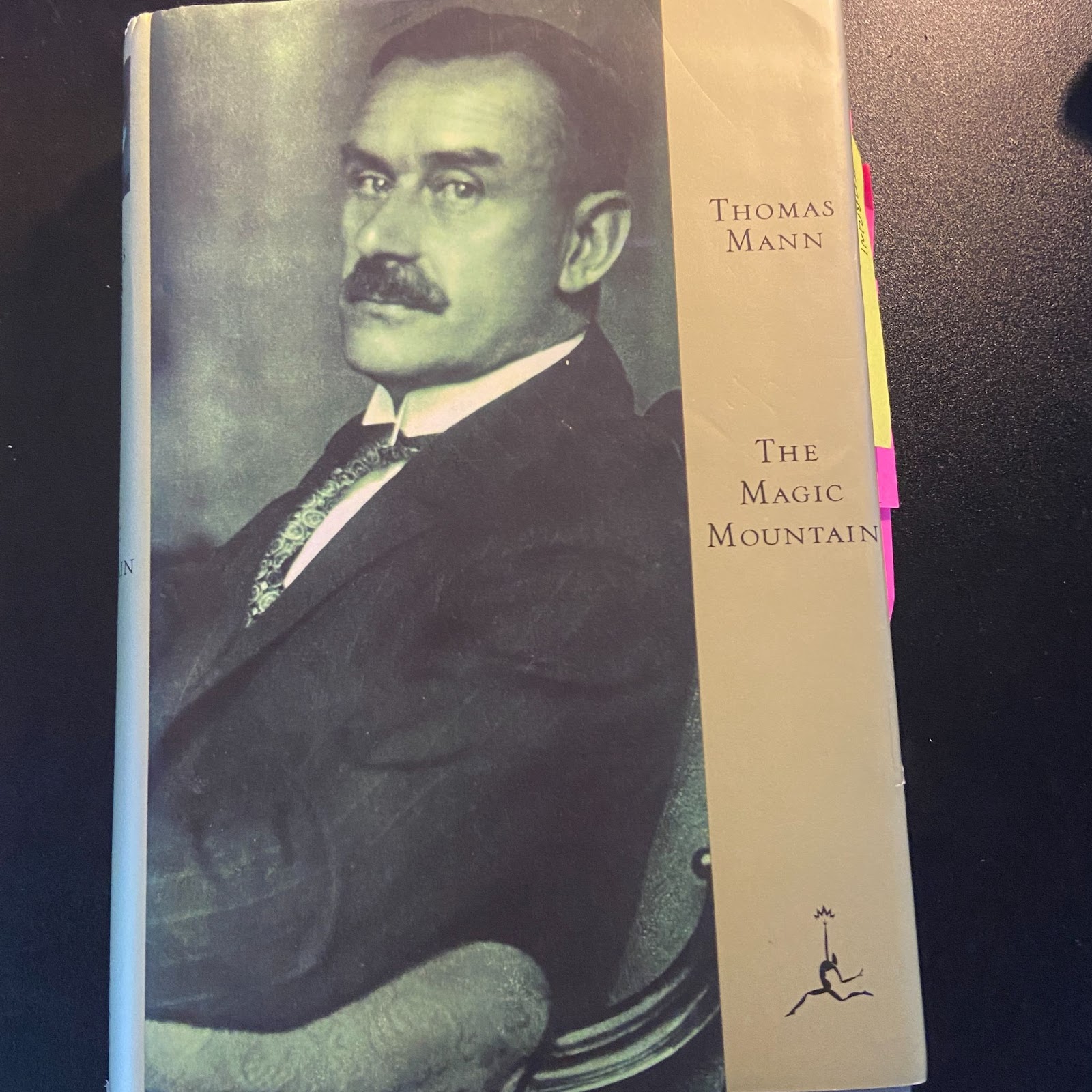
Mann’s MAGIC MOUNTAIN was three months of delectable reading. I may have enough to say about it to make a proper essay, though the didactic allegory and the ironized bildungsroman conceit Mann employed so masterfully here have been rendered transparent by scholars already. The experience itself is like climbing a mountain by stages, first unrolling slowly until around the sixth of the big chapters, things develop faster, the narrator starts summarizing more, the tone gets funnier and more deranged as we go along, and before you know it you’ve careened over the finish line in a runaway toboggan.
I read a hard copy of the Lowe-Porter translation, pictured above, but also ended up reading large stretches of it electronically through the more recent John E. Woods translation. This was interesting if irresponsible. They are quite different, with Woods overall being very smooth to read, as I expected after his DOKTOR FAUSTUS, while Lowe-Porter goes for an antiquated pastiche with lots of idioms and untranslated French. Which approach is more faithful to the German I can’t say; the two translations read to me as trying to get to Mann’s sense of humor in different ways. In the first chapter, Hans Castorp laughs his head off at a particular word used by his cousin and asylum resident Joaquim. In Mann, the word is “Seelenzergliederung” which means psychoanalysis, but literally can mean soul dissection. Lowe-Porter translates this to “psychoanalysis” which in the scene made me laugh, while in Woods it’s “psychic dissection.” Is Wood’s more literalized choice a way to make the concept as bewildering as it might be to Castorp’s perspective?
It’s probably because I’m still high from finishing it, but the very best comparison sentence for me is the very last one.
Lowe-Porter:
Out of this universal feast of death, out of this extremity of fever, kindling the rain-washed evening sky to a fiery glow, may it be that Love one day shall mount?
And Woods:
And out of this worldwide festival of death, this ugly rutting fever that inflames the rainy evening sky all around—will love someday rise up out of this, too?
I originally went to Lowe-Porter because, being a hopeless aesthete, I’d previously found Woods suspiciously accessible, but I prefer the Woods formulation here. The fever is more concrete with its “ugly rutting,” and while “feast of death” and “kindling the rain-washed evening sky” have an old macabre ring, “festival” and “inflames” seem more precise. And Woods adds some structural redundancy with the repeated prepositional phrase “out of this” while Lowe-Porter’s sentences are much of the time extremely heavy on either the front or the back end in terms of what you have to keep in mind about the subject while reading through these long sentences. Putting the main verb mount at the very end felt awkward, no doubt because of my modern American ears.
So if I had to recommend the best translation on the market, I don’t know, I’d probably say go with Woods then Lowe-Porter on a possible reread.
Next read: a trip with Mr. Lowry to Mexico, on All Saints’ Day, and something about a dead dog?




 Second Slope