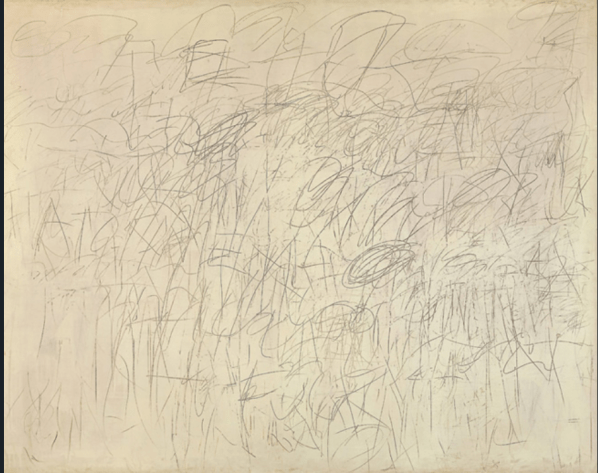
- Image found here
Twombly’s work has fascinated me since I first saw PROTEUS around a year ago.
More recently, I looked at reproductions of pages from a handmade book. On those pages he made blossoms of watercolor strokes, with crayon lines and acrylic paint added as well. Each page had one color dominating: blue/purple, gray, and red. The compositions were so small and compact, the lines and strokes so delicate, that it struck me as a useful way to approach short fiction and short nonfiction, since the practice of painting has consistently given more inspiration and advice than any fiction writing manual.
I showed them to my boyfriend, a painter, and a perspicacious spectator. (We spent one night raving over Malevich’s RED SQUARE. ) He said that these pages were used as a palette. So the dark circles drawn in crayon is his way of testing out the line, and what it will look like. And there’s something unique and appealing about the the crayon’s line over the grain of paper or canvas — if it weren’t for its infantile association.
I was thinking, bingo! essays are tryouts, as the tired argument goes, and here even the testing of lines can result in a meaningful work. Of course writers don’t work with lines beyond the rigid lines of print and our lines of argument. And analogies that provide a shock of insight at first should never be taken too far. But Twombly had a deep and nuanced stance toward aesthetics and history from which he produced, and something like that for me needs to guide how I structure my writing.
Other things I learned from my boyfriend: many of Twombly’s works on paper are cropped; an arbitrary and abrupt framing, another sympathetic vibe. Also a nearly overwhelming sense of compactness, the packing of elements and the seemingly endless layers. And an intriguing bit of intuition: he got a sense of frustration from Twombly, that he was constantly holding himself back in order to be accepted, that he could have been even more extreme.
John Berger, in PORTRAITS, also links Twombly to the practice of writing, which leads to an amazing passage. Twombly’s paintings elaborate the relationship between a writer and her language.
A writer continually struggles for clarity against the language he’s using, or, more accurately, against the common usage of that language. He doesn’t see language with the readability and clarity of something printed out. He sees it, rather, as a terrain full of illegibilities, hidden paths, impasses, surprises, and obscurities. Its map is not a dictionary but the whole of literature and perhaps everything ever said. Its obscurities, its lost senses, its self-effacements come about for many reasons – because of the way words modify each other, write themselves over each other, cancel one another out, because the unsaid always counts for as much, or more, as the said, and because language can never cover what it signifies. Language is always an abbreviation.
With this modern sense of literary writing on a practice against habitual speech, thought, and perception in mind, Twombly expresses the problems of writing while remaining “silent.” Quite the achievement.
Twombly to me conveys the sheer sense of historicity itself, minus any content (except for the pieces explicitly about Greek myths and the Iliad). They do look like surfaces people write on, walls and chalkboards, which become palimpsests of inscriptions and graffiti and hieroglyphs. The older elements are hidden, faded, almost lurking, and suggest something more alien — revenants from the enchanted realm of the epic.
The material world itself is a palimpsest in this way, as suggested in CASSANDRA by Wolf, the temples built over temples. And that novel also posits an older, lost world, a matriarchal utopia that was overthrown by the patriarchy. This vision is a response to another theme in that book’s essay portions: the reality of nuclear weapons. Somewhere between the Classical world and the end times, there are artists who face both directions like Janus. Upholding such a perspective, without liquidating one or the other, is closer to a modernism that unifies theory and practice.
 Second Slope