Great movies and not-so-great books // April summation

Watch the skies!

Sometimes it be like that.

I’ve been giving up on novels at an above-average rate lately, tho it could be that my threshold for putting down a work of fiction is lowering. 

It’s clear to me how well I’ve avoided writing about books here that I find unsatisfying. Talking about these experiences doesn’t come as easily.

But on the other side are two positive things on the movie-going front. Really, going from EVERYTHING EVERYWHERE ALL AT ONCE by Daniel Kwan and Daniel Scheinert to MEMORIA by Apichatpong Weeresethekul was as hard a shift from maximalism to minimalism you could make within current narrative cinema.

It’s funny that a few posts back I had talked about quantum mechanics being surrealistic in its implications. Then in March mainstream audiences get nailed by a high-concept martial arts comedy whose conceit—fundamental it seems to a lot of Daniels’ work—is essentially a quasi-scientific rationalization for surrealism. Rather than subjective freedom of the imagination or the mysterious unconscious, this kind of goofiness is placed on an objective basis, with all matter being in a superposition of forms, and so on. However, the practical result is the same, for as Michelle Yeoh’s character says, you can imagine whatever nonsense you want and somewhere it is inevitably real. The absurdism may be too much for some audiences, and everyone will have a threshold at a different gag, but as someone who grew up on Stephen Chow I enjoyed this absurd hyperpop romp as produced by the Russo Bros. Stupid gags that are well thought out are the supreme form of comedy. The emotional core in the family drama was smartly written, especially at the beginning. The resolution was naive but one can appreciate the gesture against apathy and disappearing into the bagel/anus singularity, wrapped in a sci-fi concept that contains the noise of the multiverse as a reflection of the noise of the modern world. I can’t really think of anything else from the twenty-first century quite like it, except MINDGAME. And I have definitely never felt a crowd rocked so hard by a film in my life.

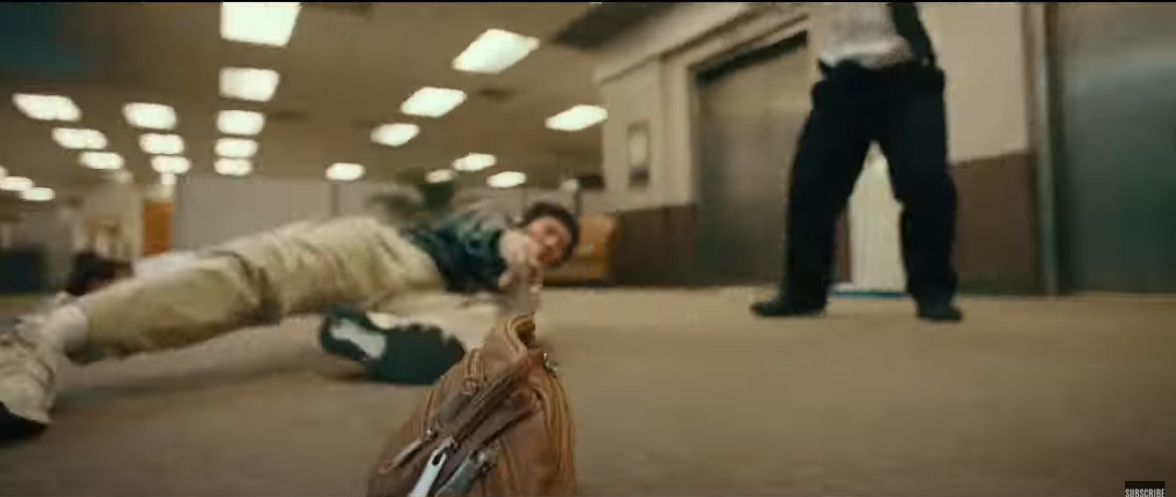
The fight scenes were fun to watch. There seemed to be a little bit of undercranking or a sped up quality to it, and there were things like the shot locked to the fanny pack rolling along the floor, reminiscent of Hong Kong movies. That’s the kind of over-the-top you want.
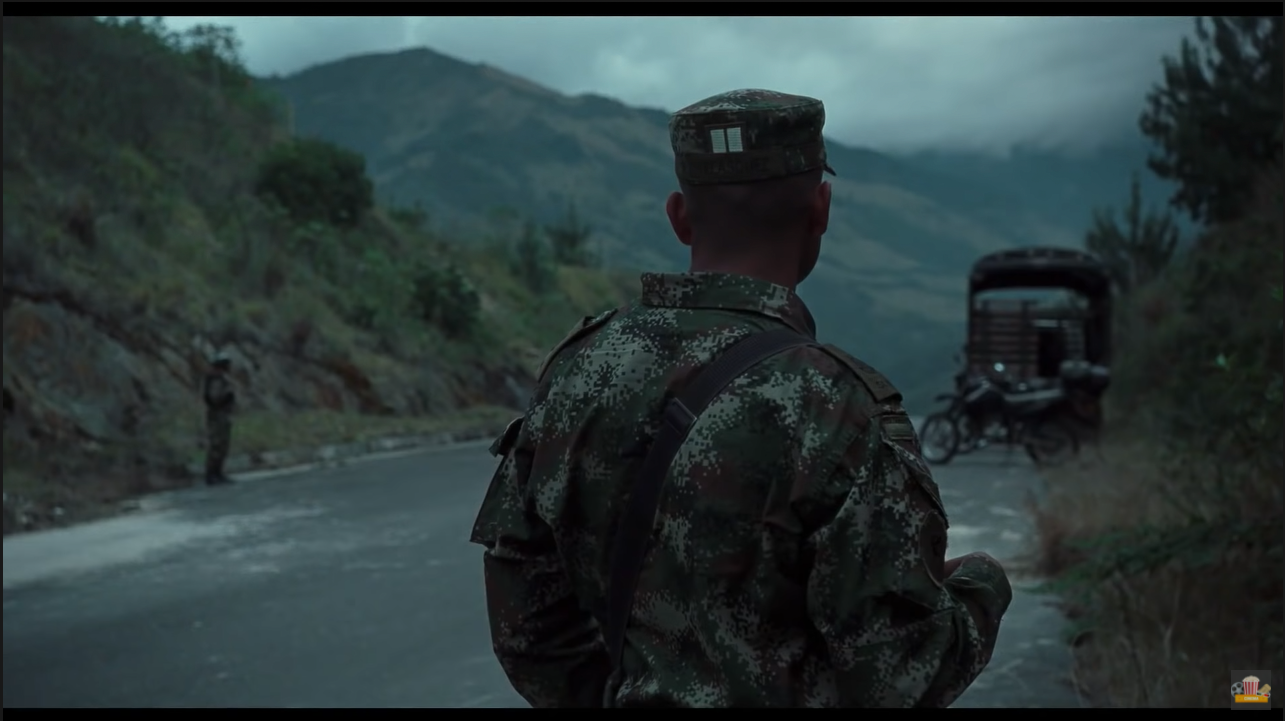
MEMORIA only sinks further beneath my skin with every passing day. On the one hand this was Weeresethekul’s epic breakout with international star Tilda Swinton in the lead, and dialog in English and Spanish. On the other hand, I found this to be the most starkly minimal film from the director yet. (I felt the length with this one, unlike with UNCLE BOONMEE or CEMETERY OF SPLENDOUR, though the running time is longer; the house was packed but the audience seemed to have a brutal time of it, unwilling to even shift in their seats, and when it ended we left in a pall of silence and existential dread.) UNCLE BOONMEE in comparison shares a lot about the characters’ subjectivities and their relationships to the setting. But we have to infer everything and anything about Swinton’s character Jessica, an expat living in Medellín, Colombia, visiting her sister in Bogotá who is recovering in the hospital at the national university. Of course the point is that Jessica is in a strange land, and with a sense of place denied, it’s as if her background and such becomes lost as well.
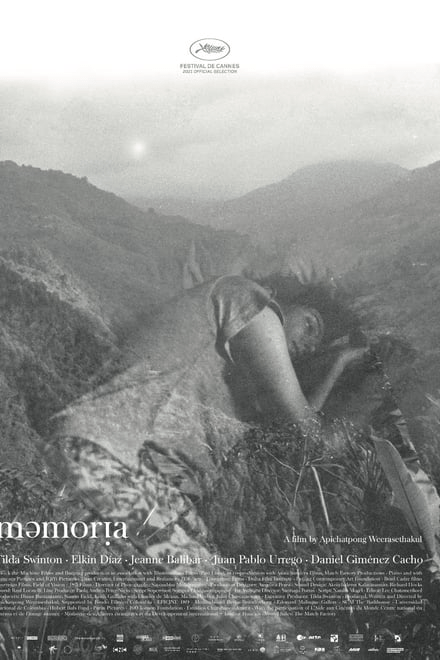
On a biographical note, I used to experience the same thing Jessica does in MEMORIA’s opening scene that kicks off her quest, namely exploding head syndrome, a sudden loud bang “heard” while falling asleep or waking up, not a real sound in the air but in the mind. This occurred to me semi-frequently when I was younger, up to the end of my teenage years. The “sound,” or the mental image of a sound, for me, was sometimes a dry thud similar to the sound effect in the movie, but it was more often a tinnitus-inducing schwing of a blade, or the pop of an electrical signal. Does Jessica’s bang really exist, as a memory or a premonition? Is it the same thing that’s setting off all the car alarms outside in the morning? 

The best point for restricting this film to the theatrical experience is the use of sound, the climax of the film is essentially a grand formal experiment where sounds from other worlds fill the present moment, and then the soundtrack to the reality of the world eerily drops away. In one scene Jessica walks into a music session, a sequence done in three shots: her approach in the hallway, her watching the performance, and a reverse shot of the musicians. There’s time to dwell on hearing without seeing, then seeing and hearing, and the interactions of the performers were great. I distinctly remember a moment between the pianist and guitarist. The piece itself was a cool and worldly jazz fusion tune, very well chosen, the driving 6/8 time echoing Jessica’s odyssey.

I won’t spoil anything, for this is a decisively rare film to see, but there is a solution to the cause of the sound. After so many decades of art narratives sustaining ambiguity, perhaps explaining the mysteries of the world has become a bold step. With A.W. ‘s work in general, it seems that the story, in the moment of its experience, jerks suddenly into the realm of speculative fiction, but in retrospect you can see the atmosphere of science fiction enveloping all of his art.

E. H. Carr is a big name in my reading solely as the author of a monumental, multi-volume history of the Soviet Union up to 1930, with the initial trilogy of volumes on the Bolshevik Revolution being his headlining achievement. I’ve only gotten through a volume and a half—each book is around 600 pages of small print—but Carr’s excellence as a writer is certainly felt. 

But if you listen to the national security punditry, Carr is also important in the space of international relations theory, and his book THE TWENTY YEARS’ CRISIS is considered a founding text for the twentieth century realist school in bourgeois political science. In its immediate context, the book was an argument for appeasement as the realistic policy choice (this was in 1939). While this is early on in Carr’s intellectual career and his grasp of Marxism remains superficial, his strengths as a prose stylist are well established. He delivers his argument in punchy lines such as: “the fact that utopian dishes prepared during these years at Geneva proved unpalatable to most of the principal governments concerned was a symptom of the growing divorce between theory and practice.” But underneath the rational presentation is a rather eclectic approach to diplomacy and the relations of forces at play in geopolitics.

The book’s ultimate result is a general description of the imperialist struggle of the great powers over spheres of influence. And this rough picture is colored by a bourgeois liberal perspective that is rather platitudinous. The theory of international relations is a simple spectrum between the poles of Utopianism and Realism, between argumentation based on the “common feeling of rights” and argumentation based on the “mechanical adjustment to changes” in geopolitical relations of forces. This balance is expressed concretely in the policy choices of Force or Appeasement. The fundamental problem of handling political change in the international sphere is that of a “compromise between power and morality.” Utopianism ignores power, Realism ignores morality. It becomes clear we’re in the liberal space of politics, since the ideal is nonviolent change (revolution is just as “immoral” as repression in the name of the status quo) and harmonization of class interests within each nation as well as a harmony of nations. But Carr’s critique of utopianism underscores how some overarching world system, either juridical or legislative, will never get off the ground as an adequate solution to the violent wars that keep erupting between competing monopoly blocs. These schemes did not reflect the material reality of international relations so much as the depression-era interests of engineers and technocratic intellectuals.

I ended up liking Hamaguchi’s adaptation of DRIVE MY CAR a lot, especially the low-key feelings it left me with at the end. It was enough to get me to try a Murakami novel out for myself, and I had a very used paperback of 1Q84 sitting around. This is a trilogy of science fiction novels, but I doubt I’ll make it more than halfway through the first volume, where my reading is currently sputtering out before a likely death.

Perhaps it doesn’t help that the book cross-cuts between two narrative lines, one involving a young woman on a mission named Aomame, and the other centered on Tengo, an up and coming writer who gets involved in an odd literary scam with his friend and a precocious teenager. It would clearly be many many pages before these lines converged.

Something about this prose makes it unpleasant to read yet just adequately interesting enough to keep me going. It is not repellant yet nothing attracts me to continue except I guess for its own ease of reading. Tragically, I keep opening the book again to give it another chance only to put it down after a couple pages, repeat ad nauseum.

I don’t enjoy inhabiting the characters’ worlds. What Tengo thinks about and the way he thinks about it stultifies me. These meandering thoughts in cafes, train stations, and bars sound more attractive than they are, like Katherine Mansfield getting drinks with a medicated Dostoevsky in a stuffy bar. Aomame comes off a bit shallow, and a petulant weirdo. She’s an assassin, an ex-softball player, a fighter, but she doesn’t reflect on her own goals that much and her gifts are laboriously presented by the narrator.

The number of people who could deliver a kick to the balls with Aomame’s mastery must have been few indeed. She had studied kick patterns with great diligence and never missed her daily practice. In kicking the balls, the most important thing was never to hesitate. One had to deliver a lightning attack to the adversary’s weakest point and do so mercilessly and with the utmost ferocity—just as when Hitler easily brought down France by striking at the weak point of the Maginot Line. One must not hesitate. A moment of indecision could be fatal.

Is this what fanfic readers refer to when they complain about a character being a Mary Sue? And what’s up with the favorable comparison to Hitler?

Perhaps this style serves to obscure the edge marking the alternate world that Aomame finds herself in, an alternative Tokyo 1984, which seems comfortably identical save for a few key details. This questionable 1984 is designated 1Q84 by Aomame. 

Update: Murakami abandoned. Now reading violent American horror novels.

Once more to the cinema // March viewing wrap-up

Getting (re-)indoctrinated into cognitive and historical poetics as a way to think about reading and understanding literature has thrown up some questions about how we perceive, categorize and move about the objective world we find ourselves in, in terms of the definition and location of shapes. That is, books, paintings, and films use their respective media to present shapes distinguished from each other via edges, literal edges like in the composition of a shot, but also conceptual edges between different lines of dialog, or types of ground.

This fixation has fed back into movie-watching. People talk about binge watching as a problem but in fact I struggle to take a break from reading (professionally, vocationally, and non-productively) and do something else to relax. Some people just keep working to cope. It’s awful.

But at least I can leverage my privilege as a coastal elite to see analog 70 and 35mm prints of old movies in NYC.

Obviously movies are replete with edges, and it was nice to attend to them with a renewed interest. Moreover, analog film is excellent! Projected film improves every cinematic experience, even DEATH ON THE NILE.

KUNG FU!

The organization Subway Cinema has been collecting and exhibiting vintage prints of great Hong Kong action movies that used to play in movie houses throughout Chinatown and Times Square. I had the pleasure to see DYNAMITE FIGHTERS, the first leading role for Michelle Yeoh (whose victory lap performance in EVERYTHING EVERYWHERE ALL AT ONCE blew out my expectations), shot on location in Manchuria—and the film grain made the setting so alive!

Another treat was Jet Li starring in FIST OF LEGEND. This remake of FIST OF FURY is more lighthearted and more complicated in plot. Once again high level production design for a period piece. What a joy to see the Golden Harvest logo on the big screen, jittery, strobey, scratched to hell and with the optical soundtrack not yet working. The host noted we were watching an English dub of mysterious origin. It was different from the one you can find on YouTube, thankfully.

BATTLESHIP POTEMKIN

After viewings on a portable DVD player from the early aughts and on YouTube, a full scale analog screening of Eisenstein’s great film convinced me it was the best movie ever made.

Soon as it began the realization hit me that this was a nearly 100-year-old piece of film stock (maybe younger, it was a MoMA export print). The picture looked fantastic. There was no soundtrack whatsoever, and it wasn’t missed. I was looking forward to seeing the red flag raised on the battleship, but apparently the tint faded away over time.

Many shots were absolutely epic: the revolting sailors diving into the water to rescue their fallen leader trapped in the rigging; the massive crowd shots in Odessa, naturally. The editing goes without saying: the sailor dashing the plate to the floor like a discus thrower, the stone lions “awakening” along with the masses under the cannons of tsarism. And I remember a shot that “doesn’t really work” in terms of standard compositional practice: we see workers coming up a gangplank onto a jetty I think, but they’re thrown to the right edge of the frame while the camera is mainly looking at a wall, so that the main attraction is the shadows they cast on it.

Something the projectionists did at the Anthology theater that I had never really seen before was allowing the tail ends of each reel of the film to go on screen (I snapped a picture of the very last bit of the last reel above). This must be the avant-garde alternative to both the changeover system and platter towers.

BLUE

I caught this Weerasethakul short from 2018 at the BAM. There was a woman struggling to sleep, lying in a bed outdoors, the bars of the bedframe lined in shadow above her head, her blue fleece blanket outlined against the dim backdrop. We also see two painted backdrops, of a path by the sea at sunset, to a view of perhaps the same path leading to a temple or pavilion. A scrolling mechanism transitions from one to the other. It seems to stall for a moment. Back to the insomniac woman, a dim orange flare grows in her chest, as if expressing a nightmare. The flare soon becomes a campfire, and its crackling comes onto the soundtrack along with the insect drone. The fire grows and starts throwing light on the ground—it’s clear that the fire is reflected in a glass pane, so that it superimposes itself on the sleeper. Then the film opens up to more varied and wider angles: there is a real fire, and a pane of glass between it and the backdrop. Is the scrolling automatic or human-operated? The stand of a tall overhead lamp lives conspicuously in the foreground along with some plant props. The woman’s bed is out in the open with a white outline drawn around it on the ground. Sometimes she is falling asleep, at other moments she gazes with her eyes wide open. These automated yet handycraftish optics and scenery, plus a spectator-sleeper, partly dreaming and partly perceiving, present for us the whole apparatus of cinema, but there’s another surprise: a shot through the glass pane to the scenery makes the flame appear over the ruby red sunset, a small but unexpected mix of the given elements, and the touch that deepens the whole thing beyond a pat allegory.

UNCLE BOONMEE WHO CAN RECALL HIS PAST LIVES

The short was a DCP projection, but the main attraction was in glorious 35mm. UNCLE BOONMEE is one of my very favorite films in the last decade, and watching it loud and big was genuinely refreshing. It’s a cliche but I felt I had seen it for the first time, probably because I’ve only ever watched it on Netflix.

For being only twelve years old, the film stock was absolutely scuffed, especially compared to the MoMA print of POTEMKIN. Giant green and white vertical scratch lines, the thickest of such artifacts I’d ever seen, cut into the frame every now and then, which looked terrific. The greenery of the jungle had a blue tint behind it that I’d never appreciated before. And the monkey ghosts with their red laser dot eyes oozed into the backdrop. Cuts that on home video seemed arbitrary or at least abrupt became shocks to the system, like a blue underwater frame full of bubbles and foam smash cutting to the pure photographic blackness of night at Boonmee’s country estate. The narrative is simple yet the filmmaking choices have the landscape enveloping the characters in these pastoral and transporting ways. BOONMEE has a few distinctive sequences, including a folk tale-like interlude with catfish cunnilingus and a vision of the future presented in still photographs. The film itself is part of a larger multi-media project called PRIMITIVE. Yet viewing it in a theater for the first time, the work felt wholly unitary and un-episodic.

Reflections of a Muad’Dib apologist

But see, amid the mimic rout,

   A crawling shape intrude!

A blood-red thing that writhes from out   

   The scenic solitude!

It writhes!—it writhes!—with mortal pangs   

The mimes become its food,

And seraphs sob at vermin fangs

   In human gore imbued.

Edgar Allan Poe, “The Conqueror Worm”

The new DUNE film made me happy, especially the floating lanterns, or glowglobes, with their bespoke design in the Caladan Castle. Aristocrats living in ultra modernist tombs was the DUNE I happened to want. The movie put all its money on the screen and it looked and sounded glorious. Luckily Snyder’s JUSTICE LEAGUE earlier this year put me in the mood for escapism.

I like the 1984 version of DUNE, with the qualification that the only watchable version for me is the 3-hour Spicediver fan edit. My earliest memory of any kind of media is the shot of the worm consuming the spice harvester, seen on TV. What DUNE 84 has going for it:

  • A bizarre mise en scene like futuristic rococo art. I especially loved the gilt picture frame entryway into the heighliner.
  • The music by Brian Eno and Toto is sick.
  • The Harkonnens are truly fucked up.

But I’m not tainted enough by nostalgia to prefer it over Villeneuve’s adaptation. DUNE 84 has a perfunctoriness to it, like the right elements of the book are presented in the right order, but without the connections and stakes made clear. DUNE 21 is not without its faults but it takes effort on my part to let them bother me. I suspect both suffered from producer interference and constraints, though to different degrees.

All the complaints I heard about DUNE going in turned out to be exaggerated. The fight choreography was excellent: it wasn’t THE RAID REDEMPTION but the concept of the shields and return to swordplay and phalanx warfare were kept in the foreground. Zendaya’s Dove commercial shots weren’t intrusive and in those sequences she is clearly a stand-in for the coming jihad of Muad’Dib, like a Lady Liberty, or whatever the draped woman in the Columbia logo is supposed to represent. The visuals were not bland for being monochromatic but in fact brought out the kind of tactile detail that you want from fantasy cinema. When was the last time Hollywood treated wet stones with such love?

The masses seem to be connecting to DUNE as a mid 20th century story that influenced much fantasy and SF properties after it, now adapted in a way that feels refreshing and not at all derivative, in part because there’s a rudimentary character to it all, the way the planetary environments aren’t extra in their alienness, the way folding space isn’t foregrounded in any flashy way, etc.

At the same time, seeing Rebecca Ferguson in a dark hooded cloak kept reminding me of THE SOUND OF MUSIC. Similar to Nolan movies there’s a throwback element to the roadshow spectacle movies of the 50s and 60s, specifically those turgid Roman epics (and DUNE 84 is reminiscent of THE GREATEST STORY EVER TOLD, namely in all those voiceovers). But DUNE 21 taps into the kind of epic storytelling the novel does: an impending threat whose details are only revealed slowly. DUNE needs a stately aspect to its tone; the book reads more like a popularized version of Aeschylus than the pulp tradition it comes from.

My favorite thing about the book, and maybe the principal element of its approach to epic storytelling, is the use of epigraphs. The aphorisms and the spiritual/philosophical/mystical vernaculars are fun on their own, as well as the question of who is writing these things and why. But they also telegraph what exactly is about to happen, the same way that the scene headings in Döblin or Brecht’s theater do. It’s not about suspense here but process. Who can forget “A million deaths were not enough for Yueh!” But before that is a quote from “Dictionary of Muad’Dib” where Yueh is “chiefly noted as betrayer of Duke Leto Atreides.” In other words, like a mythical epic poem, the precise sequence of events and the precise nature of the characters has been firmly established. The longer ones are like little stories.

Family life of the Royal Creche is difficult for many people to understand, but I shall try to give you a capsule view of it. My father had only one real friend, I think. That was Count Hasimir Fenring, the genetic-eunuch and one of the deadliest fighters in the Imperium. The Count, a dapper and ugly little man, brought a new slave-concubine to my father one day and I was dispatched by my mother to spy on the proceedings. All of us spied on my father as a matter of self-protection. One of the slave-concubines permitted my father under the Bene Gesserit-Guild agreement could not, of course, bear a Royal Successor, but the intrigues were constant and oppressive in their similarity. We became adept, my mother and sisters and I, at avoiding subtle instruments of death. It may seem a dreadful thing to say, but I’m not at all sure my father was innocent in all these attempts. A Royal Family is not like other families. Here was a new slave-concubine, then, red-haired like my father, willowy and graceful. She had a dancer’s muscles, and her training obviously had included neuro-enticement. My father looked at her for a long time as she postured unclothed before him. Finally he said: “She is too beautiful. We will save her as a gift.” You have no idea how much consternation this restraint created in the Royal Creche. Subtlety and self-control were, after all, the most deadly threats to us all.

—From “In My Father’s House” by the Princess Irulan

Peter O’Toole, first known man to have the Eyes of Ibad.

As for the “white savior” question, I’m the wrong person to ask. Muad’Dib is less like a space Cecil Rhodes to me and more like a space Napoleon, or Stalin. That is, given the political and economic situation presented in DUNE, the jihad represents social progress, excesses and all (like killing tens of billions of people). In my gleeful “tankie” misreading, the Muad’Dib Jihad is a good thing while the Butlerian Jihad was reactionary. Those who say the latter represents the overcoming of our slavish relationship to technology by the human spirit (including the director of DUNE 21) are appealing to humanism to paper over antagonistic class interests. The struggle against AI resulted in the conscious reversion to the feudal class mode of production, while productive relations got scrambled up, so that we have big aristocratic families with private armies that possess their own capitalist industries, treated as household management. The thing about feudalism is that technological and social development are slow as to be nearly static (whereas under capitalism, productive forces attain great dynamism), and so the Imperium reigns for ten thousand years, and behind the Emperor and the decayed planetary parliament of the Landsraad are the monopolists over space transport and the Bene Gesserit, who seem to fill a similar stabilizing role in politics as Taoist assassins did in the Tang Dynasty, to say nothing of their eugenicist plot to create a future ubermensch. The Kwizatz Haderach is a purely economic solution to the Imperium’s dependency on melange for transport (which only exists because of the ban on advanced computer science). Muad’Dib is the true solution, the destruction of clearly outdated organizational forms through political struggle, namely a holy war spreading across the universe like unquenchable fire. (Funny enough, the final result in the first book, marriage between House Atreides and House Corrino, is what could have resolved the political tension in the first place, and not the intermarriage of Atreides and Harkonnen that would serve the ends of the BG.) 

And the film makes clear that Muad’Dib is learning from what his father Duke Leto understood by his reference to “desert power,” a rather Maoist insight that the masses are the key link, not possession of land or wealth. It’s in that sense, the latent force within the Fremen’s peasant rebellion, that Arrakis is the richer planet. Say, maybe DUNE is just IT’S A WONDERFUL LIFE in space.

The MVP of the movie.

The movies feel like cinema again

Every part of my body hurts

The whole of the winter film season felt like a soft and gently warm wave of enjoyment. Coming from someone who is not into Scorsese’s gangster pictures as much as things like AGE OF INNOCENCE and HUGO, THE IRISHMAN / I HEARD YOU PAINT HOUSES was so engrossing; I did not feel the length at all, and its style, from the rough eyeline matches in a baptism scene, and the cutting in one of Hoffa’s blowouts, had such verve and control. Then there was the brake lining of the wheels in FORD V FERRARI glowing orange while skidding into the night. And THE LIGHTHOUSE was a perfect midnight movie experience with high caliber technique included.

But two movies, PARASITE and PORTRAIT OF A LADY ON FIRE were just outstanding. Watching these two movies within months of each other was like getting two fully-charged defibrillator shots on a movie goer’s heart. Consider my love and desire to tell stories more than slightly rekindled. 

I was way too passionate about film in my teens; I couldn’t talk about much else. Nor did I truly understand the art in all its aspects, or at a depth that may require simply more time among human beings in society. I would see anything in the theater, I mean it. The multiplex on the car dealership avenue in the far suburbs of east Portland had a 5 dollar matinee; I remember some days called for a triple-header. Digital projectors were rolling out, and I wanted to savor the last days of 35mm exhibitions, with the big platters of film, the motor, the strobing shutter, the cue marks. These were all part of the charm.

The passion ebbed, and my interests narrowed into the ultra-minimalist tendency that began in the 70s, with filmmakers like Chantal Ackerman, James Benning, Bela Tarr, Pedro Costa, Lav Diaz, Apichatpong Weresethekul, and Tsai Ming Liang. These people often challenged the boundary between cinema and museum video art. Everything else was too commercial. 

Nevertheless, I have always loved Bong Joon Ho—especially what he manages to do with genres and tones—since I watched a DVD of THE HOST shortly before I went to see MOTHER in 2009. Never would I imagine that in a decade he would be holding two Oscar statues and making them kiss like Ken dolls. Even with as gaudy a meat parade as the Academy Awards, with a history as sordid and dishonorable as theirs, I felt so happy at the long overdue recognition and attention South Korea’s film industry is now getting from the mainstream. The reaction videos, from viewing parties to the news passing through Twitch streams, felt wholesome.

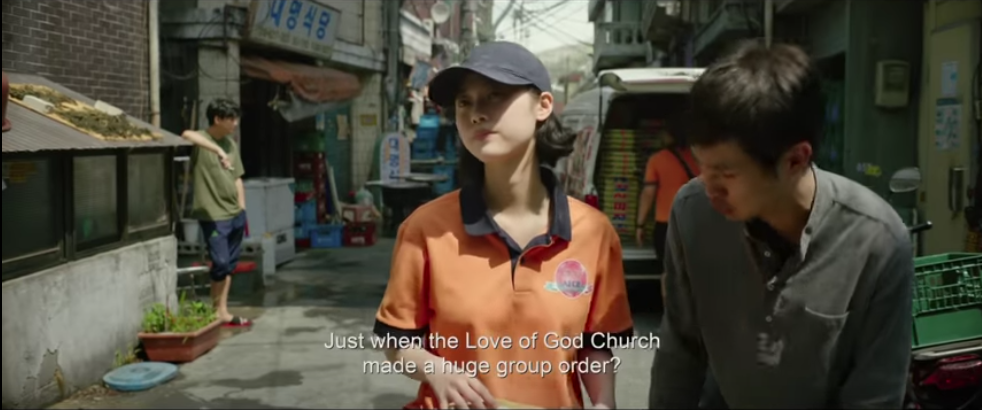
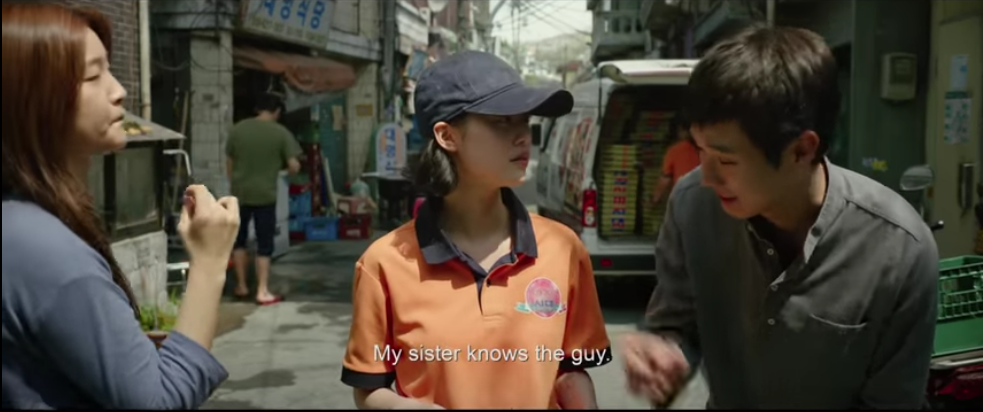
So. I loved every frame of PARASITE. The cinematography has the kind of range of color and grounded realism that I only associate with Korean live action, and the tracking and panning choreographed with the staging was a joy to behold. While viewing the monochrome version I noticed the interplay of background action (even the footfalls of extras are pretty loud in the mix) helping the foreground scene play out. I mean the guy smoking on screen left while Ki Woo starts his fast talk.

As he moves away, Ki Jung enters. The guy takes a seat, still looking in. He balances the pizza worker on the right.

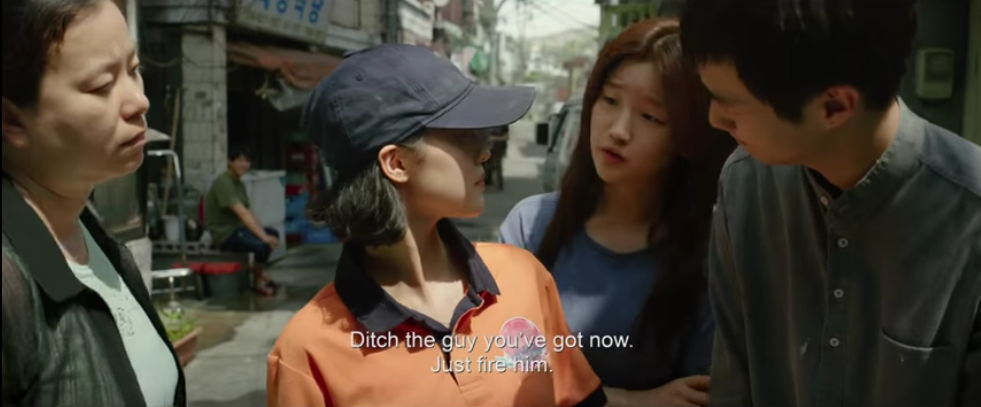
The culmination of this scene is in one take, you learn how the Ki family does their work as you watch them crowd the shot, the camera slowly pushes in while the lady in the center tries to resist.

It’s simple. But the accumulation of meticulous details and choices made PARASITE into a supremely engineered genre movie. The editing, including a hidden cut on a swish pan and an invisible wipe to combine two takes, shows how the filmmakers were practically counting frames to make sure the timing and speed and flow of information secures Maximum Entertainment.

All of the performances are spectacular, especially Song Kang Ho and his facial expressions during the finale—which feels cathartic every time by the way.

The screenplay takes Bong’s playbacks to a new level. Chung Sook is introduced nudging her hubbie’s ass with her foot, an inconsiderate gesture that gets played again, and then a third time to disastrous results. Lines of dialog foreshadow and misdirect, and they flesh out characterization because Bong’s cast talk about their situations and their feelings about wealth and employment with such convincing realism.

The structure of the narrative is impeccable. What better way to enter an upstairs/downstairs thriller than with our con family searching for a wifi signal? The pacing accelerates toward the midpoint, with this skillfully handled montage with a great original score (baroque composition with a modern Alexandre Desplat type of arranging)—Ki Jung blowing the fuzz off a peach is so beautifully framed and shot, yet it does not feel superfluous because every moment of the film seems to be exuding this much enthusiasm.

And the humor—the pitchest of black humor coming through at the most inappropriate moments; this is classic Bong. What a joy to see this in a theater with a big crowd, so unified in its responsiveness. 

#

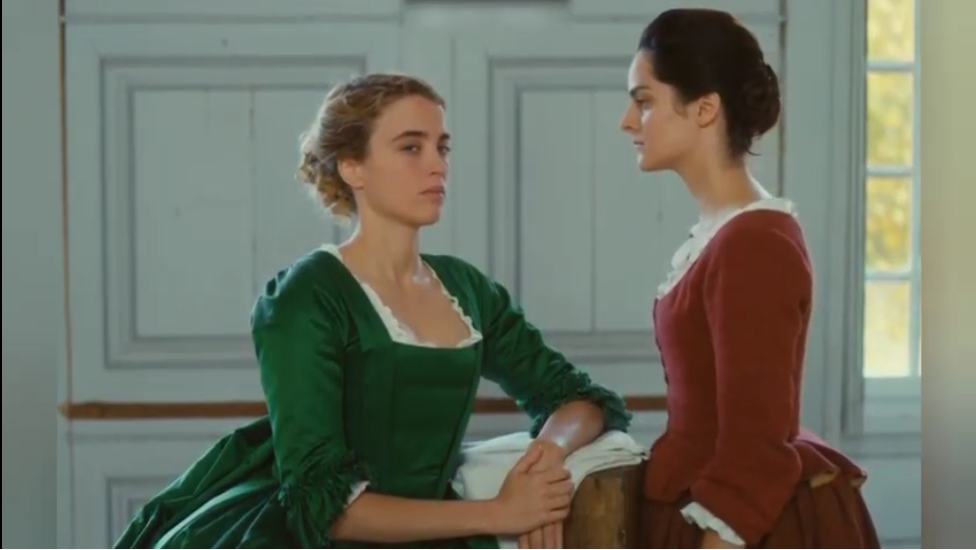
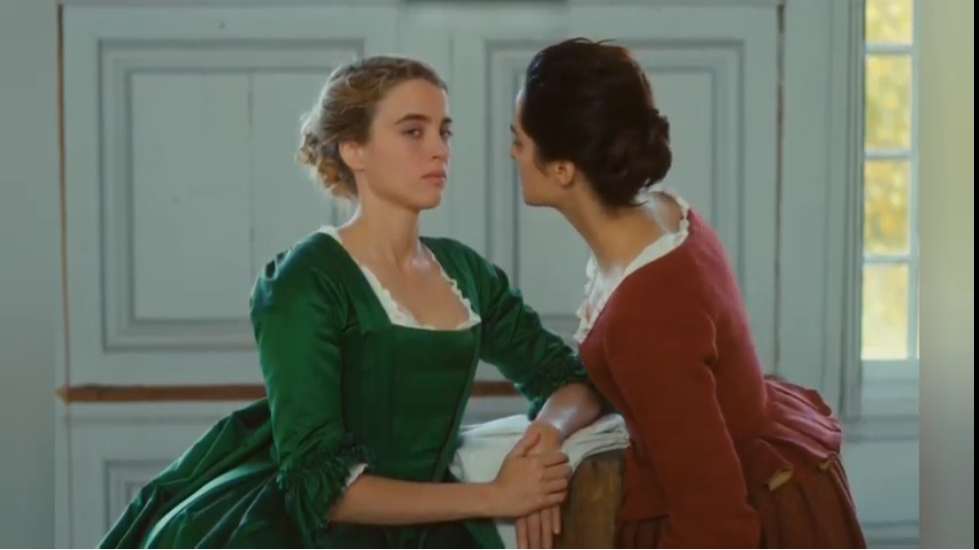
A romance by the sea? Too conventional? No! PORTRAIT has a narrative structure at least as immaculate as PARASITE, although they are also very different. PARASITE covers a week and change until the midpoint, then the plot goes through a very tense evening, night, and Sunday morning. PORTRAIT mimics the the ocean waves on the cliffs of Brittany, and has a diurnal rhythm. The romance takes its time to come to full flower, then leave only memories.

There are three women on an island (isolation, secrecy, Utopia) in a noble household with the parents missing. They are of different classes (an aristocrat, a petty bourgeois artisanal painter, and a servant girl), but they eat in the kitchen together, hang out, play cards, do drugs, help out in a crisis. Specifically, the servant girl Sophie wants to terminate a pregnancy, and Marianne and Heloise try their own methods, help gather herbal ingredients, and they stay by her. 

This subplot culminates so beautifully with the romance, in a scene involving Marianne painting a scene that Helouise and Sophie re-enact. They discuss Orpheus in the underworld. The movie meditates so well on its theme. Imagine that, a forbidden love plot that is neither tragic nor smarmy by the ending. It finishes on a note of gratitude for a cherished moment of passionate, individual sex-love, and even hope for the future. (There’s no music track in this movie! But music is important, and the sound mixing is extremely dense.) 

Engels in ORIGIN OF THE FAMILY identifies relations of sexual love as having appeared in modernity, and the late 18th century setting here is apt historically but the production also does not try to add period window dressing. The dialog feels current.

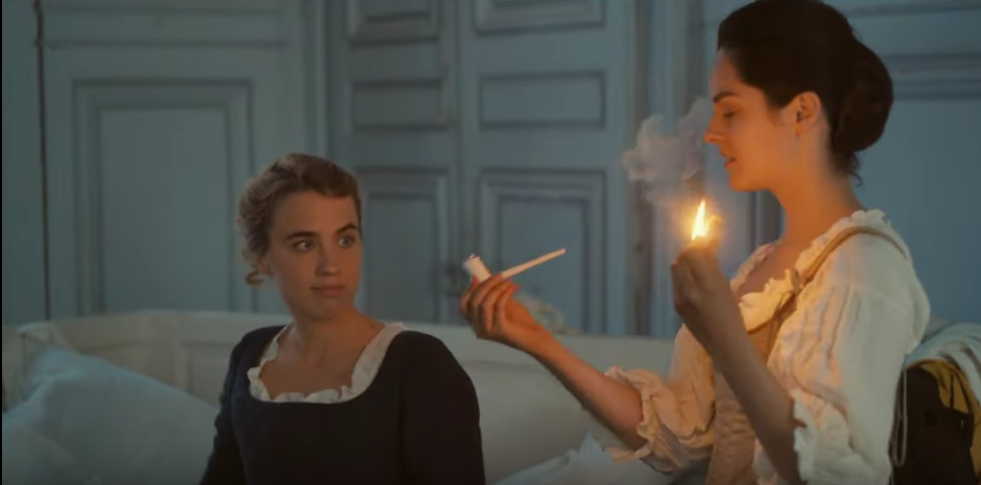
It hasn’t been lost on people that Marianne shares her name with the figure of lady liberty. We see her in profile quite a bit, sometimes with a light. (The final shot is also a profile, with an overwhelming performance, a reaction shot up there with the one in PARIS, TEXAS.)

The 8K digital cinematography, my God, the color saturation, the Rembrandt lighting…

Anyway, if I were a hack critic I would write that Celine Sciamma’s film is the 21st century PASSION OF JOAN OF ARC. But I think I mean it.