The utterly scuppered summation for November

Image
(Source)

Read in November: Nesbo’s THE LEOPARD (much more violent, and more of a whodunnit than the dark motive-searching of Snowman; I’m glad Nesbo is willing to mix it up in this series) | Ashbery’s WAKEFULNESS.

António Lobo Antunes’s THE LAND AT THE END OF THE WORLD

An early book that has Lobo Antunes channeling Malcolm Lowry—and to better effect, since unfortunately I find UNDER THE VOLCANO disappointing in some respects (haven’t finished it yet). It’s hard to put a word on the fault I find with it, but it’s obscure. Even though the writing is clear for the most part, though it does slur in its rhythm. The novel’s landscape and characters remain shadowy from start to finish. Whenever we’re in the Consul’s point of view a kind of deranged yet pure-hearted and idle wordplay takes up the foreground, a semantic drift that serves as a kind of touchstone of the shitfaced: katzenjammer becomes cat’s pajamas, katabasis into cat’s abysses, then Cathartes atratus and so on.

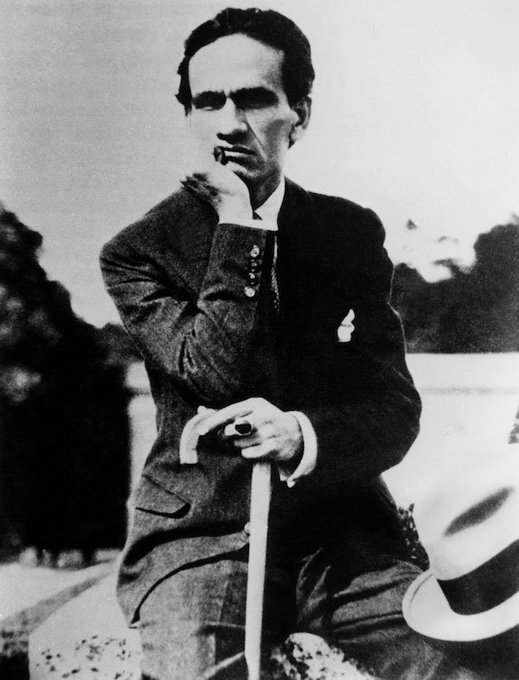
Vallejo’s AGAINST PROFESSIONAL SECRETS 

This is a wonderful collection of prose pieces and notes. There’s such whimsy coming round the edges of these aphoristic constructions.

Cuando un órgano ejerce su función con plenitud, no hay malicia posible en el cuerpo. En el momento en que el tenista lanza magistralmente su bola, le posee una inocencia totalmente animal.

Lo mismo ocurre con el cerebro. En el momento en que el filósofo sorprende una nueva verdad, es una bestia completa. Anatole France decía que el sentimiento religioso es la función de un órgano especial del cuerpo humano, hasta ahora desconocido. Podría también afirmarse que, en el momento preciso en que este órgano de la funciona con plenitud, el creyente es también un ser desprovisto a tal punto de malicia que se diría un perfecto animal.

(When an organ carries out its function fully, there is no possible malice in the body. At the moment a tennis player masterfully tosses the ball, he is possessed by animal innocence.

The same occurs within the brain. At the moment the philosopher discovers a new truth, he is a complete beast. Anatole France said that religious sentiment is the function of a special organ of the human body, yet to be discovered. One could also affirm that, at the precise moment that this organ of faith functions at its peak, the believer is also a being so devoid of malice that he could be called utterly animal.) 

I had a reading of these lines, but my booster shot for the Covid vaccine obliterated it, so that I can no longer understand what I had thought.

Vallejo is someone you want to follow as a disciple, what a scary authoritative presence. This book includes fragments from his notebooks, and just the single mention of Knut Hamsun compels me to put him at the top of the TBR. Also: “El arte según Marx: reflejo de la economía (Art according to Marx: reflection of the economy).” And “Poetas según Marx, que deben ser políticos militantes y conocerlo y vivirlo todo (Poets according to Marx, should be militant politicians who know it all and live it all).

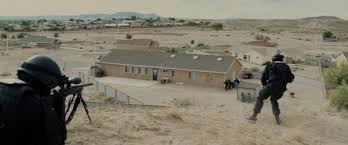
Lately I’ve been thinking about the opening shot of SICARIO, where the federal troops creep into a view of suburban America. A story I once read in PLOUGHSHARES (I can’t seem to locate it) opens with a similar image, armed cops on the rooftop of a family home to stop a mass shooter. The same vibe is achieved in THE GHOST SOLDIERS by James Tate, a poetry collection that creates the impression that all these pieces take place in the same small town in the Midwest that is constantly disrupted by warfare, with bombs landing in cow pastures and tanks blowing away farm houses. I’m increasingly drawn to this conceit of massive, mechanized violence brought to bear on safe and idyllic places where such things aren’t supposed to happen, but of course the comfort of the latter rests on the former taking place elsewhere.
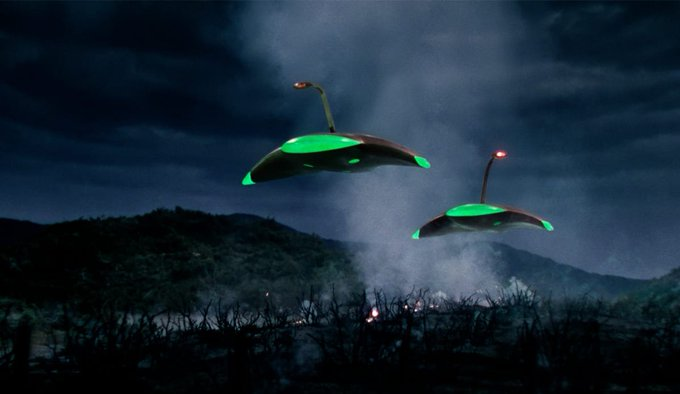
The first 30 pages of WAR OF THE WORLDS makes this point again, as ground zero for the Martian invasion is the peaceful northern London suburb of Barnet. A Sci-fi war bursts into a scene of bourgeois domestic bliss:

About six in the evening, as I sat at tea with my wife in the summerhouse talking vigorously about the battle that was lowering upon us, I heard a muffled detonation from the common, and immediately after a gust of firing. Close on the heels of that came a violent rattling crash, quite close to us, that shook the ground; and, starting out upon the lawn, I saw the tops of the trees about the Oriental College burst into smoky red flame, and the tower of the little church beside it slide down into ruin. The pinnacle of the mosque had vanished, and the roof line of the college itself looked as if a hundred-ton gun had been at work upon it. One of our chimneys cracked as if a shot had hit it, flew, and a piece of it came clattering down the tiles and made a heap of broken red fragments upon the flower bed by my study window.

I’m pretty sure the first time I read this book was shortly before 9/11, and perhaps the longer you wait before a reread, the more empowering it may feel. It goes by fast. I was moved to revisit it by the 83rd anniversary of Welles’s radio broadcast last Halloween weekend. And to my surprise the modern film and TV adaptations are pretty faithful to Wells’s original plot, but with faster pacing and other adornments.

Unfortunately I seemed to have entered a trough toward the end of November, and in the middle of producing this post, I have forgotten how to read and write.
From Jack K to James T // September summation

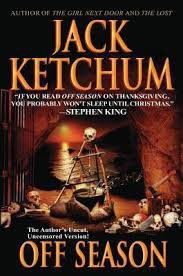
Even though it’s mid-October. September’s reading contained both the pulpiest of pulp and an important encounter in big L Literature. First, I ran through a few Jack Ketchum titles. I haven’t gotten to his masterpiece GIRL NEXT DOOR yet, but tore through and reasonably enjoyed RED and OFF SEASON and OFFSPRING, the first two entries in the Dead River sequence. This is no-frills formulaic writing with extreme grisly violence, and I must say I prefer this kind of lean storytelling over Stephen King doorstops, if we had to choose between horror writers steeped in the Northeast. Ketchum just has a clean, hard, clause-by-clause style that I never tire of. But a peculiar technique in each book is the reference to a story in the news.

Early in OFF SEASON, for example, Marjorie reads the New York Post in her Manhattan apartment. “There were two stories in particular that she read, so odd that in spite of herself they commanded her attention. In one a 45-year-old laborer in Paramus had tried to set his wife afire, having gone out to the garage after a drunken squabble to fill his glass with his glass with gasoline. He’d doused her with the gas but then, police said, was too drunk to light a match properly. In the other story a man in Virginia had hanged his beagle puppy from a tree in the backyard because it wouldn’t obey him.” Sure these vignettes lend the impression of a mad and violent world just like the real life news. But what’s interesting is how precisely off-set these stories are: the first one acts as a foil for the novel’s plot about straight couples under external threat, and the second is like a reflection of the horrendous act that kicks off RED. Speaking of which, the protagonist in that book (which otherwise doesn’t trade on sexual violence) also remembers “reading in the paper not so long ago about a woman in Florida who had orchestrated a strip-show in her home for some of the local teenage boys, with her fourteen-year-old daughter as the star attraction. She’d turn down the lights and turn on some music and her daughter would take off her clothes and then the woman would leave the room and her daughter would have sex with the boys on a first-come, first-served basis. There didn’t even appear to be money involved.

Why anyone would want to do that he didn’t know. But then he didn’t necessarily believe that age brought wisdom. He didn’t understand a lot of things. Figured he never would.

And Ketchum wasn’t the only splatterpunk read last month. I dabbled in the stories of BONDING, Maggie Seibert’s collection with Expat Press, which are wonderful and punchy. And even Jo Nesbo’s THE SNOWMAN might qualify, given how the titular Norwegian serial killer chops up and poses the corpses of his victims in theatrical ways, making him a Nordic Jack the Ripper meets Michael Meyers–though this fellow has plenty of psychological motivation, explained after the fact a la PSYCHO. Formulaic once again, but this sadistic noir is addictive reading. I consider it the segue into my sudden interest in Norwegian literature, ignited by Jon Fosse.

###

Feeling the fatigue of reading only novels the last few months, I restarted my poetry reading with some later Tate. What a tricky poet. His absurd anecdotes are delightful, though people are wrong to call it prose poetry or flash fiction. The are still definitely lineated. The photograph of the last poem in his typewriter included in GOVERNMENT LAKE shows how he set up his margins in such a way that they almost run flush to the right edge. But his actual prose is recognizably that. His situations undermine themselves often at the last second. They incorporate mundanity and genre tropes. They’re deadpan lyrical poems, usually just a page long, that can get a laugh a minute sometimes, like stand-up. Tate is so appealing on the surface but it’s hard to “get into” the enjoyment of the work in a practical-critical way; the meaning gets lost in the ironic absurdities, and the closer you look at the text the more weird things you notice, like sudden changes in tense or a possible missing sentence. The ending of “The Photograph of Lincoln” from DOME OF THE HIDDEN PAVILION, is a perfect example of his bathos and laugh-out-loud humor.

I headed
back the way I had come. On the mountain a man with a rifle
in his hand standing in the middle of the road stopped me. He
came over to my door and said, “My five-year-old son has been
captured by bears, or at least I think he has. I was up on
the mountain hunting with him by my side. The next thing

I know he’s gone. You’ve got to help me. When you get down
the mountain go directly to the police and tell them. They’re
the only chance I’ve got.” I looked behind him. The boy was
running down the mountain yelling, “Daddy, Daddy, why did you

leave me?”

People online are so quick to miscategorize Tate’s poetry since his use of storytelling seems to run counter to the rest of American poetry, even if he uses the same kind of diction and starkness. The lyric is the hegemonic form, similar to how stand-up comics don’t really tell jokes anymore, since it’s all observational humor. The focus on everydayness is as big a part of modern American poetry as the “visionary” aspect to it, which comes through in these lines by Stevens from “Of Modern Poetry” in PARTS OF A WORLD

It must
Be the finding of a satisfaction, and may
Be of a man skating, a woman dancing, a woman
Combing. The poem of the act of the mind.

In Ashbery’s “Dangerous Moonlight” from CAN YOU HEAR, BIRD we get these lines from a professor speaking that are even more specific, and suggests an idea of the poet who can concentrate something out of common human experiences (sees and breeds) in a precise way (unlike enharmonics in music where you can call a C-sharp a D-flat if you want) 

There is a poetry in mere existence,
the kind that shopkeepers and people walking along the street lead,
you know, and evenness, that fills them up to whatever brim
is there, and stays, transient, all the days of their lives.
Such enharmonics are not for your poet-person. He sees, and breeds:
Otherwise the game isn’t worth the candle to him. He’d as soon rhyme breeze
with breathes, as walk over to that fire hydrant in the grass
to examine it, see what it’s made of, make sure it’s not an idea in some
philosopher’s mind, that will bruise and cloud over once the mind’s
removed, leaving but a dubious trace of itself, like a ring of puffball dust…”

It’s not all spontaneous creation, since the poet should still avoid clumsy language and trite expression. Lastly it seems the poet is searching for that which hasn’t been fully rationalized by society yet, and make sure their content is not already the speculative product of a philosopher, something which the imaginative space of poetry may refuse to sustain.

But the fact that these difficult and canonical modernists have suddenly lit up for me may prove that Tate is the accessible poet (or anti-poet) who makes the other great poets a little more accessible. 

Source