Confined escapism–pleasure reading in March

My immediate sense after finishing the Leonora Carrington collection produced by the Dorothy Project is that she has aged very well. Kelly Link, Angela Carter, Robert Aickman, and it seems the whole general tendency of fantastic or speculative or weird tales is toward this oneiric work that mixes the gothic with fairytales. The word for it now is fabulism. I still have this nagging feeling that SF as a whole has abandoned historical materialism in favor of thoroughly non-empirical imaginative writing. (Or what I’ve taken to be SF based to some extent on tendencies and contradictions among historical modes of production is no longer on the order of the day.) Fabulism as a concept may account for this. It also seems to create a continuity for fantastic fiction between canonical literature like Poe and Hawthorne to pulp magazines in the early and mid 20th century. The latter used to be an overhanging sin on fantasy that Jameson and Suvin used to speak of in the 70s and 80s.

And it’s not just the content Carrington established, but the style, which is plain and direct, completely transparent as it relates marvelous things. This is of course in line with the older gothic novels. Cesar Aira writes like this too. The writing is clear but it’s also loose, so that the events are hard to keep track of in your memory.

I’ve thought for a year now that Carrington is more ironical and darkly humorous than any of the above. I had that impression from her institutionalization memoir DOWN BELOW. The early pieces in this collection are terrific. Everyone loves to talk about “The Debutante,” with its face-ripping and then face-eating talking hyena, made more gruesome by the sultry narrator’s POV. But what really gets me this this moment, after the hyena has devoured the maid, leaving only her feet:

“I can’t eat any more. Her two feet are left over still, but if you have a little bag, I’ll eat them later in the day.”

“You’ll find a bag embroidered with fleurs-de-lis in the cupboard. Empty out the handkerchiefs you’ll find inside, and take it.” She did as I suggested. Then she said, “Turn round now and look how beautiful I am.”

The humor in these stories kills me, especially the ending of “The Happy Corpse.”

Many of the stories are translated from French and Spanish, and the prose there seems way more placid than the ones written in English, where a reflective tone and social observation come out. This is the opening of “White Rabbits”:

The time has come that I must tell the events which began in 40 Pest Street. The houses, which were reddish black, looked as if they had issued mysteriously from the fire of London. The house in front of my window, covered with an occasional wisp of creeper, was as black and empty looking as any plague-ridden residence subsequently licked by flames and smoke. This is not the way I had imagined New York.

The animals, the detailed designs of objects, the dark forests, the rotting meat, the rituals and magical correspondences, the tension between domestic comfort and wild freedom: all of these elements express unique insights about a woman’s position in Europe—”The Neutral Man” may well be a true anecdote, like Amy Hempel’s story about her motorcycle accident. I wouldn’t protest a re-centering of the Surrealism canon on Carrington’s writing and pictures.

#
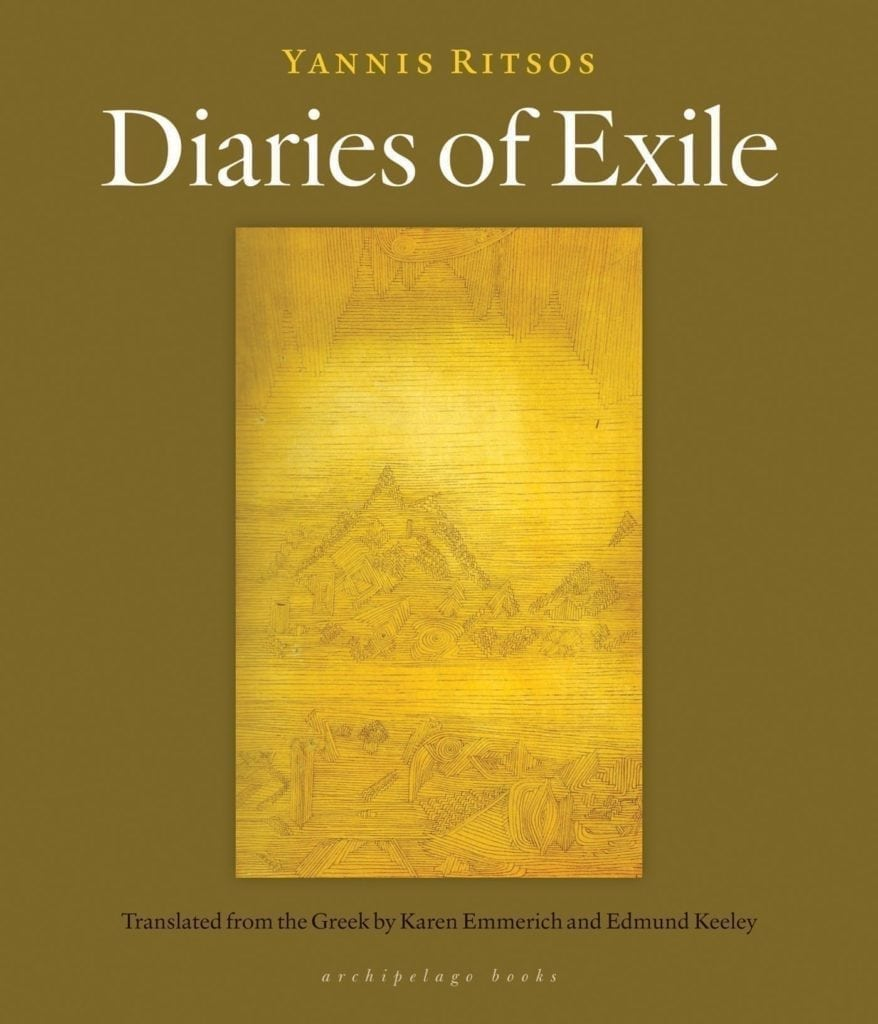
I’m struggling to talk about DIARIES OF EXILE by Yannis Ritsos. I picked it up because I wanted to read something about confinement, in light of the coronavirus situation. I was blown away by its simplicity and honesty. The poems, which comprise Ritsos’s prison diaries in verse, between 1948 and 1950, are blunt but never brutal. There is a pureness and sensitivity to the speaker, who finds a placid consolation in productive activity with other people, even if they never communicate.

I do mean simple, in its repetitive observations and images—cigarettes, cigarette packaging (a source of paper for writing) the change of the seasons in a barren place—and the sentence structures, sometimes laid out line by line. Yet they layer sophisticated ideas. The first two stanzas of “November 17” stand out to me both for this reason, the way it talks about the forms of wood, as an object of labor and as an entity of nature, and a rare bit of religious imagery.

The wind assumes its original position
the trees return to their old shape
no longer the wood of the bed-frame, the coat hanger, the wardrobe,
the wooden bowl on the villager’s round table
the wooden spoon that ladles out food
but now the tree with its branches and its shade
in the clouds and wind that strip the land of color
that dress with a certain nakedness free of forgetting and of memory
the houses, the bread, people and their works.

Things are simpler than we thought
so much so that we are sometimes startled; we stand
looking and smiling precisely there where we pressed our nails into our palm.

And then this stanza:

All this happened slowly, bit by bit. We didn’t notice.
Maybe tomorrow the old things will happen again. Nothing is certain.
But maybe out of all this will remain a tighter grasp of the hand
two eyes that gazed into two other eyes with no tilt of hesitation
a lighter that lit five cigarettes without preference;
and the number five wasn’t one, two, three, four, five,
but only a single number—five.

Of course all this doesn’t make a poem
and here I toss it onto the page like a useless stone on the stones
that will maybe someday help to build a house.

I will also remember the poem about the dog at the end of the first Diary.

The poems get sparser the further we go into Ritsos’s internment. On Christmas Day:

The window brings in the sky
in little squares.

Everything is tormented
like the old women gathering radishes.
Even the stones.

Was Christ really born in a season like this?

Plus, this passage from a letter to his sister, quoted in the translator’s introduction, may be the best writing advice I’ve ever heard:

the image is always a means and not an end in itself – we’ve said this before – you know it – you should avoid mere decoration – Don’t cover up your heart – when there’s no heart, there’s nothing at all – of course heart alone isn’t enough – but it shouldn’t be missing, either. Guard against the allure of the word, which always leads to verbosity – but don’t ever neglect that allure in the name of an emotion or of spontaneity.

#
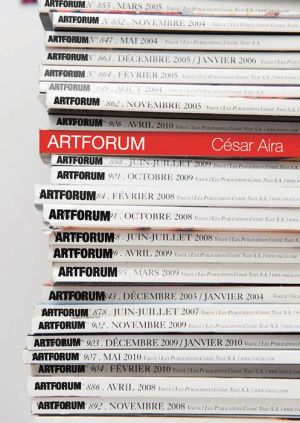
Nothing like one of Don Cesar’s short philosophical novels to clear your head. Like the last translation from New Directions, BIRTHDAY, ARTFORUM reads like a lightly fictionalized diary, about the author’s obsession with collecting back numbers of the magazine, scavenging at bookstores, trying to get an international subscription. He doesn’t seem that invested in the actual content beyond the reproductions of artistic dream states. What really attracts him are the magazine’s properties as an object, its square cut, its glossy pages etc.

Formally, the book is made of very short stories and sketches and ruminations. Some of them are dated; it’s possible Cesar wrote these pieces across 20 years and finally collected them into a very rich book, the funniest that I’ve read by him in a while.

A highlight is the first chapter, the only truly marvelous event in the plot, where an issue of Artforum sacrifices itself by getting wet to keep the other magazines on the table dry. “Can an object love a man? The entire history of animism was contained in that question.” All objects are carriers of information, and so books “fulfilled their condition as objects twice over by being specialized carriers of information; they were superobjects, because in their infinite variety and novelty they could supplant all other objects in imagination and desire.” I’d say my reading of Merce Rodoreda’s GARDEN BY THE SEA is supplanting my desire to be in a Spanish seaside villa rather than in self-quarantine in a Brooklyn apartment.

ARTFORUM is not directly about contemporary art but is about the experience of objects that aren’t useful but are enigmatic enough to appeal to us and call our attention—like broken clothespins. And then there’s the experience of waiting, its changing colors, its infinite plying.

I should write a story about what it was like to wait for it those many months, but it is impossible because the wait was made up of so many very tiny spiritual movements, so varied, that the story would never end.

Another small treat in this work is that Aira includes a moment of reflection on his mysterious writing process (I think the magazine articles are too credulous about this sometimes).

My work as a writer was a constant repetition of time’s surrender to waiting. I never could, and in fact never wanted to, write for more than one hour, and I spent the vast remainder of each day impatiently waiting for the next one. And within that hour the pattern of the day is repeated: I think of something and together with the thought comes its formulation. In a few seconds it’s written, and then I have to wait till I think of something else, something which doesn’t happen. I don’t want to dig more deeply into this, but I fear that within a few seconds that very thing is going to happen again.

This is quite theoretically oriented, similar to pages in THE LITERARY CONFERENCE, that business about “the velocity of thought and the thought itself,” which leads me to believe this is more “genuine.” Unless it’s another trick—that’s our Aira.

Hell is no more people–topical reads in March

We live in a camp … Stanzas of final peace
Lie in the heart’s residuum … Amen.
But would it be amen, in choirs, if once
in total war we died and after death
Returned, unable to die again, fated
To endure thereafter every mortal wound,
Beyond a second death, as evil’s end?

Wallace Stevens, “Extracts From Addresses to the Academy of Fine Ideas”

Why yes, it was creepy to re-read THE PLAGUE by Camus while COVID-19 swept through Eurasia. But Camus’s novel is not a procedural drama; one notices what little interest the narration takes in the finer logistics of the quarantine, like where and how does the food and “serum” get shipped in. It leans toward the allegorical, and the main cast represent different philosophical stances toward the suffering and enclosure.

On re-reading I enjoyed the crackling dialogue. The sequence with Rambert the journalist attempting to break out of Oran under quarantine early in the novel plays out in public meetings where characters and authority figures keep crossing paths and bumping into each other. It could be staged like a play, and it emphasizes the lack of privacy.

Spoilers. The unknown narrator reveals himself in the end to be the doctor Rieux. Not that it was a difficult guess; he is the first character introduced after the descriptions of Oran during normal times, with its citizens living their lives in the way the existentialists lovingly called stupid humanism.

Why have the Doctor the narrator of the book at all? As a character he’s even tempered and stoic, noncommittal in his conjectures, almost like Jacques the Fatalist, really. His judgements come out more so in his record of events:

In this respect our townsfolk were like everybody else, wrapped up in themselves; in other words they were humanists: they disbelieved in pestilences. A pestilence isn’t a thing made to man’s measure; therefore we tell ourselves that pestilence is a mere bogy of the mind, a bad dream that will pass away. But it doesn’t always pass away and, from one bad dream to another, it is men who pass away, and the humanists first of all, because they haven’t taken their precautions. Our townsfolk were not more to blame than others; they forgot to be modest, that was all, and thought that everything still was possible for them; which presupposed that pestilences were impossible. They went on doing business, arranged for journeys, and formed views. How should they have given a thought to anything like plague, which rules out any future, cancels journeys, silences the exchange of views. They fancied themselves free, and no one will ever be free so long as there are pestilences.

The first person does make the middle section more impactful with its switch to the collective “We” pronoun. You could argue that the narrative’s ultimately affirming stance is based on how the story is commemorated by a witness.

Between Rieux’s stoic resistance to the absurdity of the plague and the repentant Communist Tarrou’s belief that humankind is at bottom good, or at least “better than they seem,” and that it’s a matter of comprehending people in all their aspects and reaching understanding, is Camus’s ideal way to exist. They’re the two ethical saints of the narrative, with Tarrou meeting his end as a martyr to the plague. Rieux is the confessor.

The book is so well paced; not a single part of it drags. The wave of dead and dying rats that wells up into the town is described in the creepiest ways.

I had thought that THE FIRST MAN, his unfinished autofiction was my favorite work mainly for its style. But the architecture of PLAGUE is something to behold. I’ll always admire Camus for his style above all else, certainly over his philosophy and politics. The argumentative skeleton of THE REBEL is not so great, let’s be honest. And the heroic non-committal stance of the absurdist, this absolute refusal of absolutism, didn’t look so great when it came to the question of Algerian liberation and independence. The instincts he did have was for representation, for literary flair and flow. When I think of “Myth of Sisyphus” I don’t give “One must imagine Sisyphus happy” much weight. No, what I will always remember is his description of Sisyphus’s plight itself, plied out in sensuous detail.

As for this myth, one sees merely the whole effort of a body straining to raise the huge stone, to roll it, and push it up a slope a hundred times over; one sees the face screwed up, the cheek tight against the stone, the shoulder bracing the clay-covered mass, the foot wedging it, the fresh start with arms outstretched, the wholly human security of two earthclotted hands. At the very end of his long effort measured by skyless space and time without depth,the purpose is achieved. Then Sisyphus watches the stone rush down in a few moments toward that lower world whence he will have to push it up again toward the summit. He goes back down to the plain.

#

I’m sure I don’t know.

The pandemic status of the coronavirus crisis renewed interest in Soderbergh’s 2011 movie CONTAGION. This is much more of a procedural, naturalistically acted, and terrifying for all of its plausibility.

That is decisively not the experience with NIGHT OF CAMP DAVID. This 1965 political thriller by Fletcher Knebel shares in the Cold War anxieties of privacy and authoritarianism. The madness of the POTUS is signaled by his grand wiretapping scheme. (The Nero Wolfe novel THE DOORBELL RANG is similar in this regard.)

With the US ruling class about to replace one doddering old fool with another in the presidency, it may also be a good time to reflect on presidents who lost their touch while serving in US history, from Reagan and Johnson. And in fiction, as the marketing at Vintage hoped, we can read about Mark Hollenbach, whose paranoia, unfortunate outbursts, and delusional ambitions of a new world order triggers an investigation by senator Jim McVeigh who then tries to round up a posse to pull a civilian coup.

The scenario is not exaggerated in order to keep it plausible, but it only makes the suspenseful parts underwhelming. The male characters are so boring and their dialog, while crisp, is full of boys club ribaldry. The two women, the protagonist’s wife and lover, are patchworks of cliches of course. Rather everyone just stay focused and talk about work!

The plot sadly drags on in the early moments; elements are set up and left hanging till the final four chapters where everything culminates, dissolves and re-culminates thanks to these elements swooping right in time. But that means there’s a lot of backfill through investigations while we wait. And the material is drab, in keeping with the grounded realism.

The actual historical mad kings of America were much more vivid in their madness than what Fletcher paints here.

#

For something different, the delightful “Tale of Ivan the Fool” by Tolstoy. Apparently Thomas Mann adored this story.

The petty-bourgeois work ethic of the Russian peasantry is on display here. No need to worry about the hard work that needs to be done; enchantment helps you out. Devils and imps are not so profoundly evil here; their tricks bring to mind the line in Wallace Stevens that “good is evil’s last invention.” Ivan is a fool because he does nothing for himself. His sister Martha is also a fool but only in the way that she’s mute (but why?). Yet by doing nothing Ivan eventually ends up the tzar of his own kingdom.

For the modern urban petty bourgeoisie currently self-isolating in their rooms, as I currently am at the time of writing, we can consider ourselves our own foolish lords.

Dialogic of Enlightenment: books read in February

Here’s a beautiful thought: Karel Capek and Franz Kafka were drinking buddies in Prague, two of the greatest contributors to literary modernism in such distinctive ways.

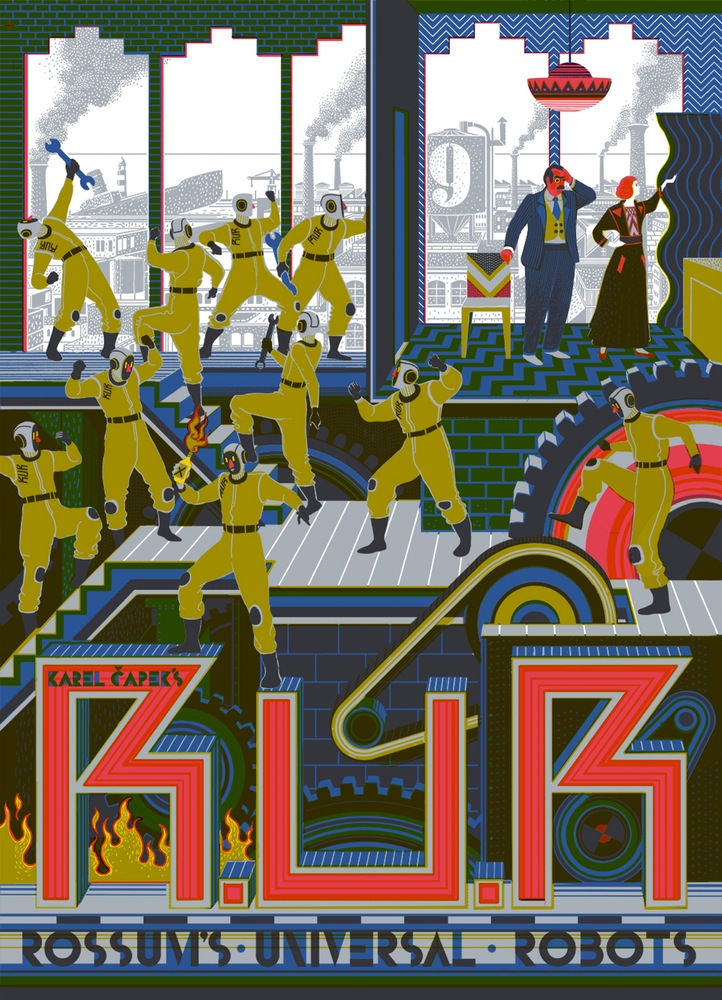
In case you didn’t know, Capek’s 1920 play R.U.R. is the first appearance of the word “Robot,” which comes from the Czech, and is pretty much the OG rise of the machines story. The first act of three is played broadly for laughs, a parody of contemporary movie melodramas. We’re at Rossum’s robot factory complex set on a remote island. Initially we get some corporate espionage, where Helena Glory infiltrates the island, causes some discord, and marries the boss.

The robots themselves are fascinating. They are not really mechanical people or androids but assembled organisms, not unlike replicants in Philip K. Dick. They’re kneaded out of dough, their nervous system and entrails are wound up–we don’t have Fordist conveyor belts or a Taylorist quota system. Robot production has a distinct handicraft character to it, even as it runs along the track of an imperialist monopoly firm.

One of Kafka’s late parables says that it was laziness that got humanity kicked out of Eden, and it is laziness that will keep them out. The revolt of the robots (with a League and a Manifesto) in this play suggests that work and toil all along was the Eden; that productive activity is simply part of our internal nature, which has been alienated since these gigantic productive forces have started to administer the world—real Horkheimer and Adorno stuff.

Spoilers. The robots triumph, humankind is extinct, and the robots evolve to become more than human. Though they are missing Rossum’s blueprints for robotkind that would allow them to reproduce. As an SF reader, it’s a weak story point; if one person discovered it someone else can. But it has a nice mystical tinge, like the script that brings the golem to life.

#

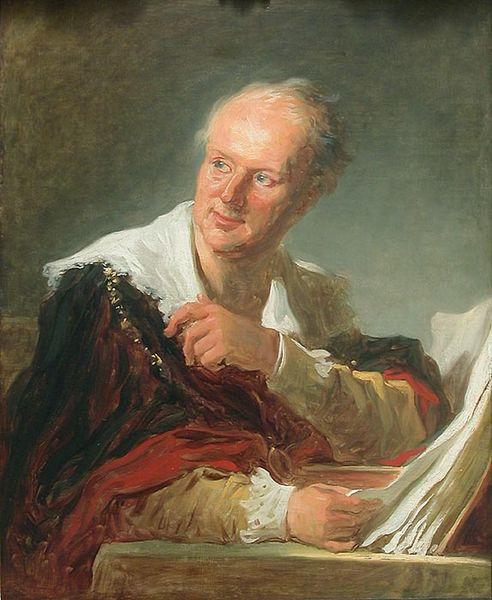
Having watched PORTRAIT OF A LADY ON FIRE and having read JACQUES THE FATALIST by Denis Diderot over the six days proceeding that momentous experience in the cinema, I have turned instant francophile—again.

Seriously, both Sciamma’s film and this quintessential novel of Enlightenment have an intellectually sumptuous quality: a direct and unapologetic paean to the harmony of freedom and dignity, of reason and passion.

Stylistically the book has no rules, it seems to randomly go back and forth from prose text to play text, and it will even switch to present tense for action scenes. It’s dialog driven, like MIST by Miguel de Unamuno which I read in January, but in the latter novel speech and dialog are foregrounded as the fundamental way to reach a construction or understanding of self. In JACQUES the focus is more on the political dimension of “dialogical” novels, the striving for democracy.

In its blunt way it’s more of an anti-novel than anything Robbe-Grillet could do:

How had they met? By chance, like everybody else. What were their names? What’s it to you? Where were they coming from? From the nearest place. Where were they going? Does anyone really know where they’re going? What were they saying? The Master wasn’t saying anything, and Jacques was saying that his Captain used to say that everything that happens to us here below, for good and for ill, was written up there, on high.

The “plot” is that Jacques and his Master/literary foil want to share their love stories with and get love stories out of each other, but mishaps and distractions keep happening: there are other stories to tell and everyone else they run into has their own story. Many of these stories involve doubles. Even the narrator is divided, so that it openly refuses to narrate this novel like a conventional romantic or gothic affair.

What couldn’t I make of this episode if the fancy took me to reduce you to tears! I’d make the woman someone important: I’d make her the niece of the curé of the nearest village, I’d rouse all the men in the parish, I’d get ready to show lots of fighting and sex, for, truth to tell, the girl was very shapely under those nether garments, as Jacques and his Master had noticed. Love never wanted a better opportunity! Why shouldn’t Jacques fall in love a second time? Why shouldn’t he turn out a second time to be the rival—even the preferred rival—of his Master?

You mean it has happened once already?

You’re always asking questions! Don’t you want Jacques to go on with the tale of his loves?

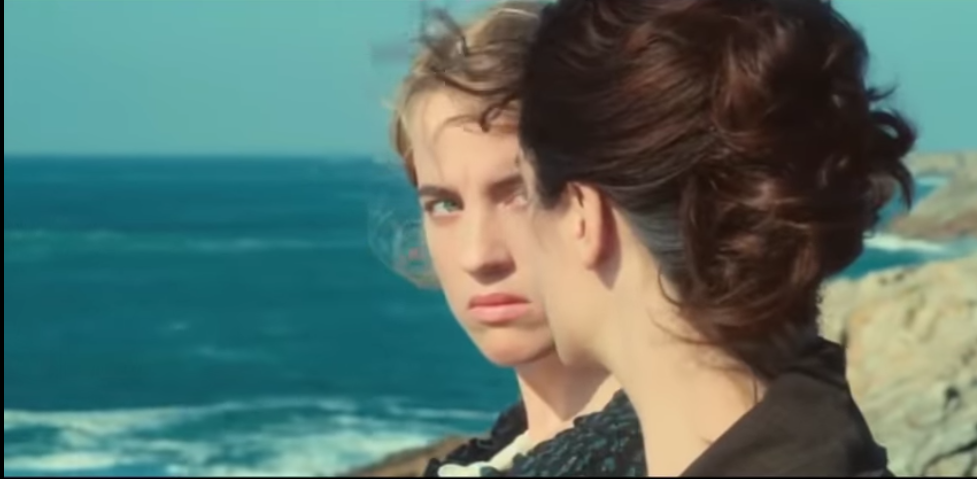
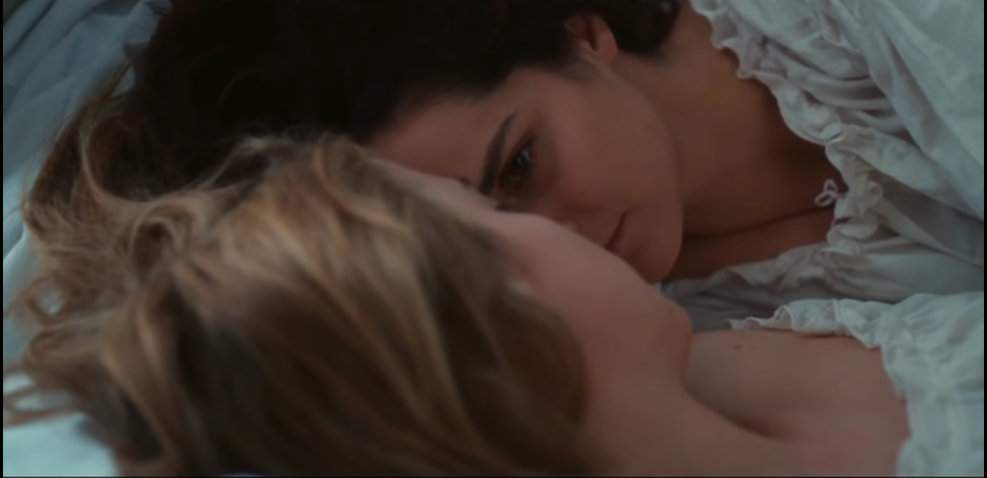
PORTRAIT OF A LADY left me convinced that its setting—three women of three classes on a private island (Capek is on this Utopian/satirical social experiment wavelength as well) on the Brittany coast at the end of the 18th century—is where deep sexual love between two equals can come into full flower. (And the banter and occasional drama between Jacques and his passive Master is intoxicating in its own way.) It’s that notion of freedom, that principle whose development is the upshot of capitalism’s expansion. We buy and sell as equals on paper. This is not the age for following someone else’s rule set. Religion is part of this world but neither text is focused on faith or sin as impulses or obstacles; it’s really about consciousness and understanding the world around you and dealing with life’s cruel ironies.

😍

#

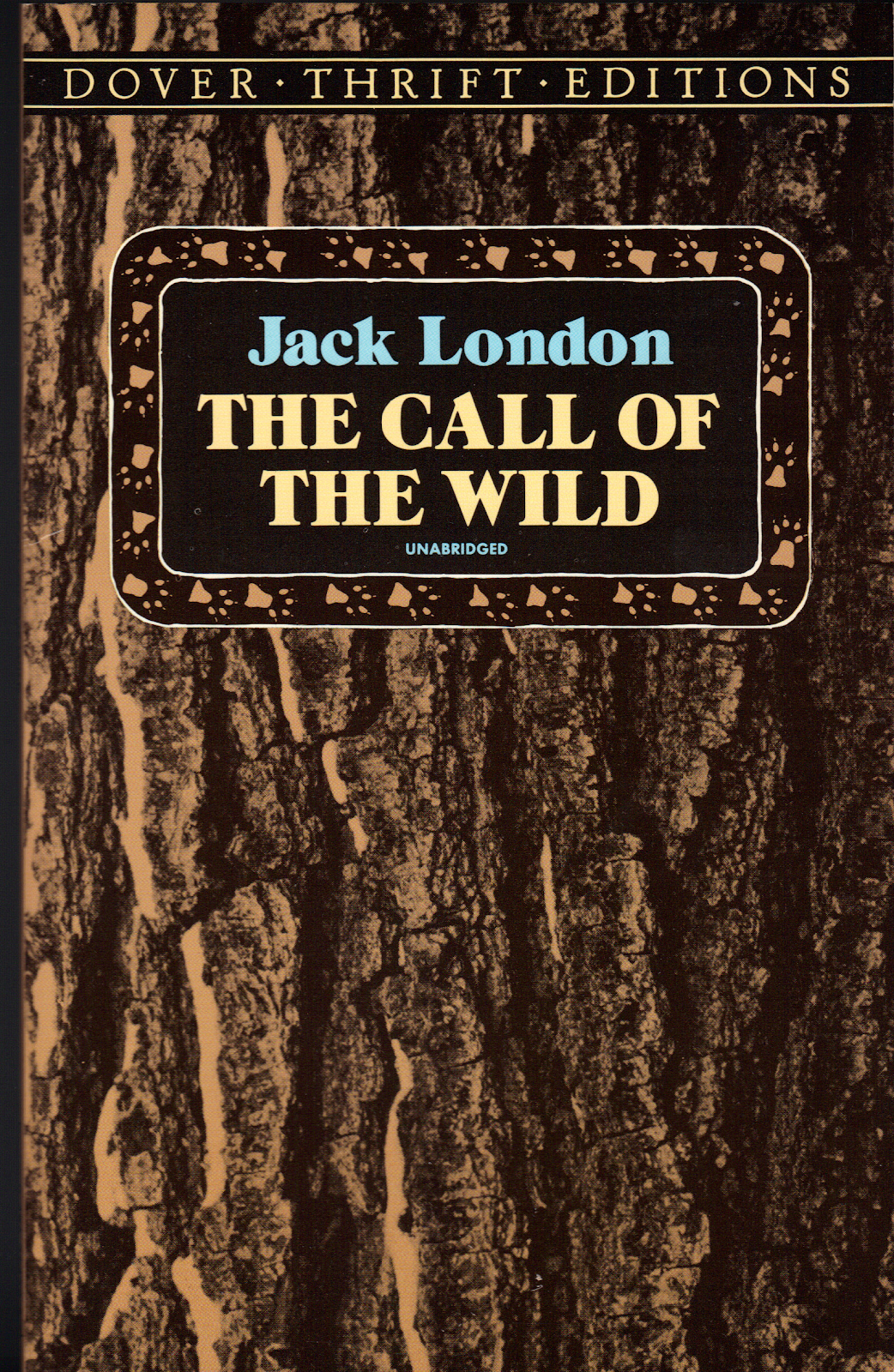
Because it happens to be on my shelf and because I’ve thought about reading more novels that are currently being adapted into movies this year, I read THE CALL OF THE WILD by Jack London and it’s a fine episodic adventure story. Shame about the movie’s bloated VFX, going by the trailer—suppose it could have been traditionally animated, the first from 20th Century in 20 years! Then Buck’s exaggerated animations and snap poses might have made sense. As it is, now that 20th Century Fox has been devoured by the Mouse, it appears it may be an outlet for Disney’s live action productions that seem to provide what the older conception of blockbusters used to offer but inevitably wind up so off-putting.

As with everything else of London that I’ve read, the phonetic dialog was rough going but otherwise his style is heavy yet tight. There is some vicious dog fighting and dog abuse going on in here, and London chooses great, heartrending moments to go subjunctive, so that in the single process of a battered and overworked sled dog dragging himself to his spot on the pull team, he uses “would” to describe it in all these specific ways; like little time portraits of ragged misery.

Reading for the movies would be a great excuse to revisit Austen’s EMMA, and some H.G. Wells classics. But the prospect of reading things like DUNE and JCO’s BLONDE is daunting, even this early in the year.

#

As for non-fiction books, I read quite a few about economics and the workplace. I did *not* read CRASHED by Adam Tooze, a long work of economic history after the 2008 crash, which has sparked a lot of discussion, from the Financial Times to Perry Anderson in the NLR.

But for an assessment of the Great Recession, I can recommend THE LONG DEPRESSION by Michael Roberts. Roberts is a Trotskyist, seems to have been an autodidact, without an academic background in econ, and subscribes to the Kondratiev long cycle theory, which is a bit crankish. But he is a committed supporter of Marx’s law of profitability and its tendency to fall as the organic composition of capital rises—THE LONG DEPRESSION substantiates this with a lot of current empirical data. This book is a very concrete explanation of how the last crisis happened, why it should be considered a depression like the ones in the mid 20th century and the late 19th century, and why crisis is an intrinsic part of the capitalist mode of production.

Even when stock markets fluctuate or bottom out (and the Coronavirus panic has triggered a steep drop reminiscent of the financial meltdown), the ultimate low-lying tie to the production sector is the key. Falling profitability means finance capital won’t invest in new productive forces because the returns are not worth the risk in an economy that has so much overhanging debt. So they hoard their savings or gamble at the stock market. Which is why world capitalism skates by on bubbles of fictitious capital. The economy is pretty good on the immediate short term for businesses, but the world capitalist system’s growth is contracting. There is a great takedown of Keynesianism in this book too.

Meanwhile, student activists are watching the grad student strike wave taking place at UC in these weeks. I have already noticed ideas and rhetoric being voiced that follow from anti-work theory and politics. THE PROBLEM OF WORK by Kathi Weeks, almost 10 years old, has become surprisingly relevant again, with its discussion of universal income (proposed by the Nixon administration!) and workplace despotism. It retreads a lot of classic economistic deviations, from the Autonomist movement to Federici’s wages for housework campaign. Weeks’s reading is insightful for framing the resurgence of utopian socialism (a future with no work and all Individual flourishing, a nation of Oscar Wildes) as a third way escape from the debates of the second international, between revolutionary Bolshevism and evolutionary Bernsteinism.

The movies feel like cinema again

Every part of my body hurts

The whole of the winter film season felt like a soft and gently warm wave of enjoyment. Coming from someone who is not into Scorsese’s gangster pictures as much as things like AGE OF INNOCENCE and HUGO, THE IRISHMAN / I HEARD YOU PAINT HOUSES was so engrossing; I did not feel the length at all, and its style, from the rough eyeline matches in a baptism scene, and the cutting in one of Hoffa’s blowouts, had such verve and control. Then there was the brake lining of the wheels in FORD V FERRARI glowing orange while skidding into the night. And THE LIGHTHOUSE was a perfect midnight movie experience with high caliber technique included.

But two movies, PARASITE and PORTRAIT OF A LADY ON FIRE were just outstanding. Watching these two movies within months of each other was like getting two fully-charged defibrillator shots on a movie goer’s heart. Consider my love and desire to tell stories more than slightly rekindled. 

I was way too passionate about film in my teens; I couldn’t talk about much else. Nor did I truly understand the art in all its aspects, or at a depth that may require simply more time among human beings in society. I would see anything in the theater, I mean it. The multiplex on the car dealership avenue in the far suburbs of east Portland had a 5 dollar matinee; I remember some days called for a triple-header. Digital projectors were rolling out, and I wanted to savor the last days of 35mm exhibitions, with the big platters of film, the motor, the strobing shutter, the cue marks. These were all part of the charm.

The passion ebbed, and my interests narrowed into the ultra-minimalist tendency that began in the 70s, with filmmakers like Chantal Ackerman, James Benning, Bela Tarr, Pedro Costa, Lav Diaz, Apichatpong Weresethekul, and Tsai Ming Liang. These people often challenged the boundary between cinema and museum video art. Everything else was too commercial. 

Nevertheless, I have always loved Bong Joon Ho—especially what he manages to do with genres and tones—since I watched a DVD of THE HOST shortly before I went to see MOTHER in 2009. Never would I imagine that in a decade he would be holding two Oscar statues and making them kiss like Ken dolls. Even with as gaudy a meat parade as the Academy Awards, with a history as sordid and dishonorable as theirs, I felt so happy at the long overdue recognition and attention South Korea’s film industry is now getting from the mainstream. The reaction videos, from viewing parties to the news passing through Twitch streams, felt wholesome.

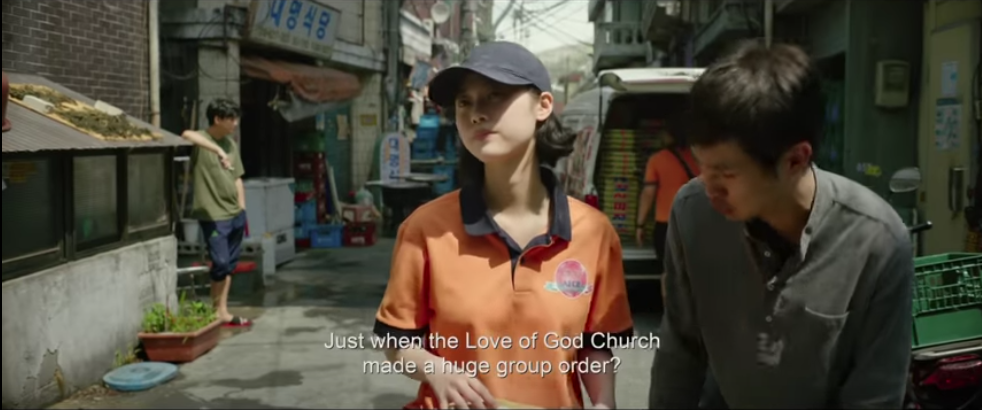
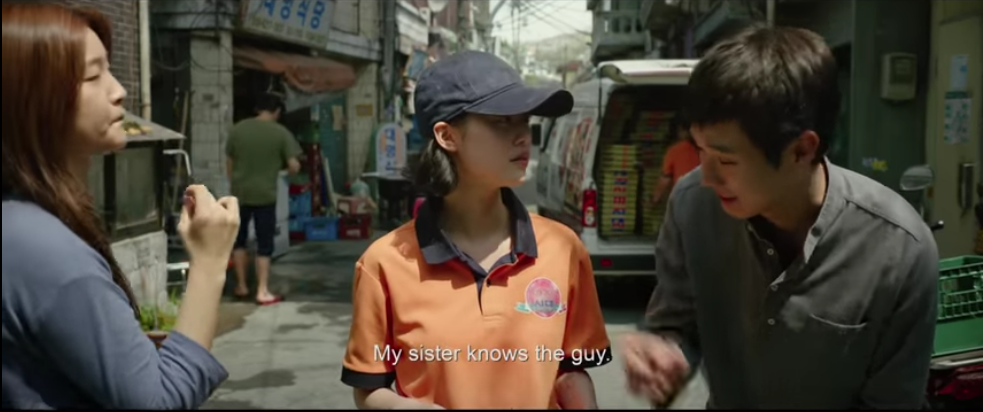
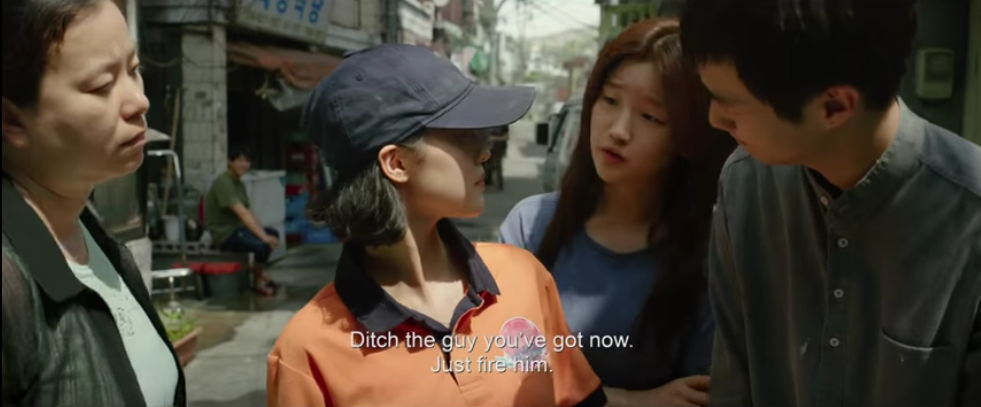
So. I loved every frame of PARASITE. The cinematography has the kind of range of color and grounded realism that I only associate with Korean live action, and the tracking and panning choreographed with the staging was a joy to behold. While viewing the monochrome version I noticed the interplay of background action (even the footfalls of extras are pretty loud in the mix) helping the foreground scene play out. I mean the guy smoking on screen left while Ki Woo starts his fast talk.

As he moves away, Ki Jung enters. The guy takes a seat, still looking in. He balances the pizza worker on the right.

The culmination of this scene is in one take, you learn how the Ki family does their work as you watch them crowd the shot, the camera slowly pushes in while the lady in the center tries to resist.

It’s simple. But the accumulation of meticulous details and choices made PARASITE into a supremely engineered genre movie. The editing, including a hidden cut on a swish pan and an invisible wipe to combine two takes, shows how the filmmakers were practically counting frames to make sure the timing and speed and flow of information secures Maximum Entertainment.

All of the performances are spectacular, especially Song Kang Ho and his facial expressions during the finale—which feels cathartic every time by the way.

The screenplay takes Bong’s playbacks to a new level. Chung Sook is introduced nudging her hubbie’s ass with her foot, an inconsiderate gesture that gets played again, and then a third time to disastrous results. Lines of dialog foreshadow and misdirect, and they flesh out characterization because Bong’s cast talk about their situations and their feelings about wealth and employment with such convincing realism.

The structure of the narrative is impeccable. What better way to enter an upstairs/downstairs thriller than with our con family searching for a wifi signal? The pacing accelerates toward the midpoint, with this skillfully handled montage with a great original score (baroque composition with a modern Alexandre Desplat type of arranging)—Ki Jung blowing the fuzz off a peach is so beautifully framed and shot, yet it does not feel superfluous because every moment of the film seems to be exuding this much enthusiasm.

And the humor—the pitchest of black humor coming through at the most inappropriate moments; this is classic Bong. What a joy to see this in a theater with a big crowd, so unified in its responsiveness. 

#

A romance by the sea? Too conventional? No! PORTRAIT has a narrative structure at least as immaculate as PARASITE, although they are also very different. PARASITE covers a week and change until the midpoint, then the plot goes through a very tense evening, night, and Sunday morning. PORTRAIT mimics the the ocean waves on the cliffs of Brittany, and has a diurnal rhythm. The romance takes its time to come to full flower, then leave only memories.

There are three women on an island (isolation, secrecy, Utopia) in a noble household with the parents missing. They are of different classes (an aristocrat, a petty bourgeois artisanal painter, and a servant girl), but they eat in the kitchen together, hang out, play cards, do drugs, help out in a crisis. Specifically, the servant girl Sophie wants to terminate a pregnancy, and Marianne and Heloise try their own methods, help gather herbal ingredients, and they stay by her. 

This subplot culminates so beautifully with the romance, in a scene involving Marianne painting a scene that Helouise and Sophie re-enact. They discuss Orpheus in the underworld. The movie meditates so well on its theme. Imagine that, a forbidden love plot that is neither tragic nor smarmy by the ending. It finishes on a note of gratitude for a cherished moment of passionate, individual sex-love, and even hope for the future. (There’s no music track in this movie! But music is important, and the sound mixing is extremely dense.) 

Engels in ORIGIN OF THE FAMILY identifies relations of sexual love as having appeared in modernity, and the late 18th century setting here is apt historically but the production also does not try to add period window dressing. The dialog feels current.

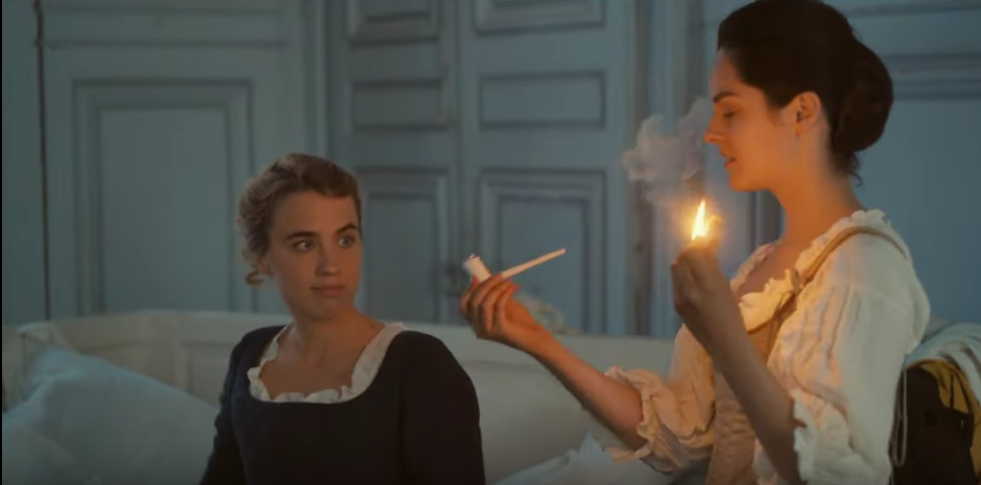
It hasn’t been lost on people that Marianne shares her name with the figure of lady liberty. We see her in profile quite a bit, sometimes with a light. (The final shot is also a profile, with an overwhelming performance, a reaction shot up there with the one in PARIS, TEXAS.)

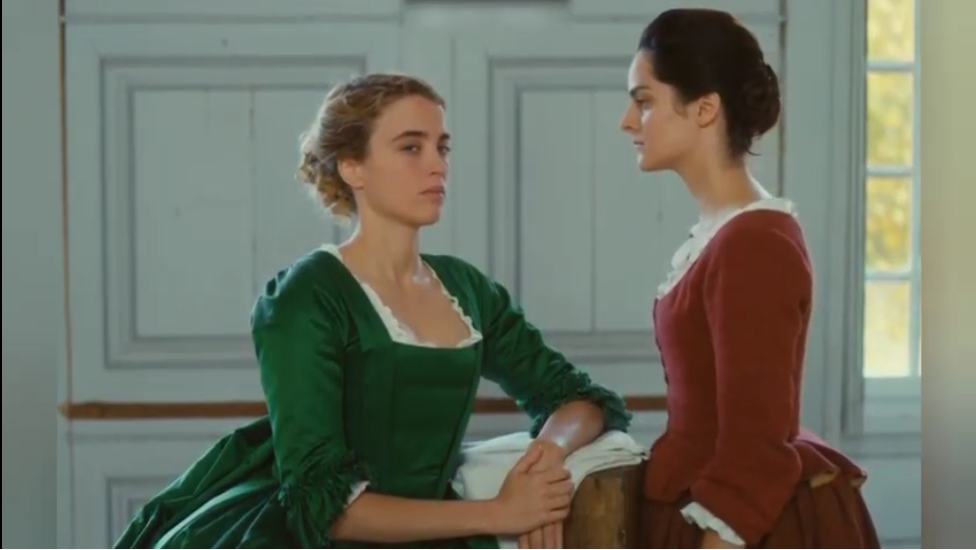
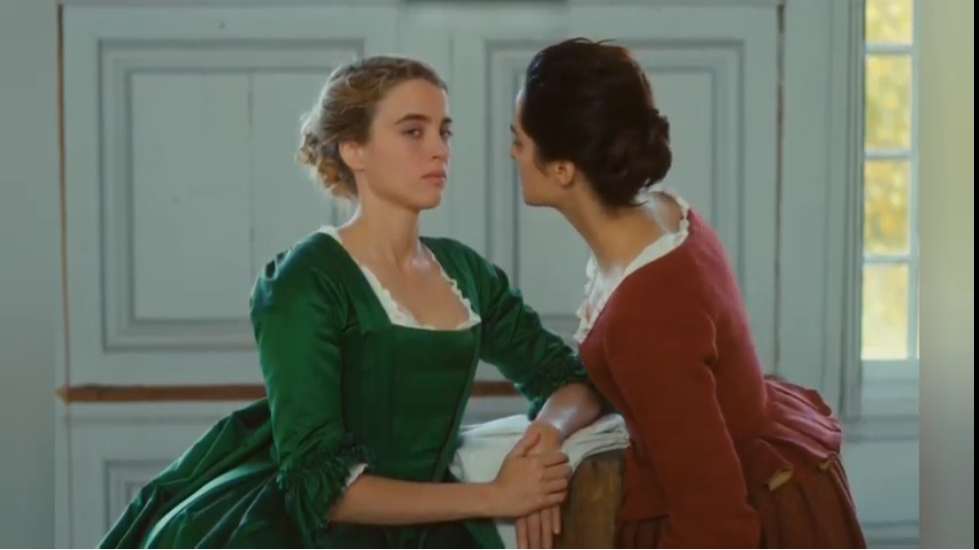
The 8K digital cinematography, my God, the color saturation, the Rembrandt lighting…

Anyway, if I were a hack critic I would write that Celine Sciamma’s film is the 21st century PASSION OF JOAN OF ARC. But I think I mean it.